
| Periodical: | |
|
|
|
From Pat Deveney's database:
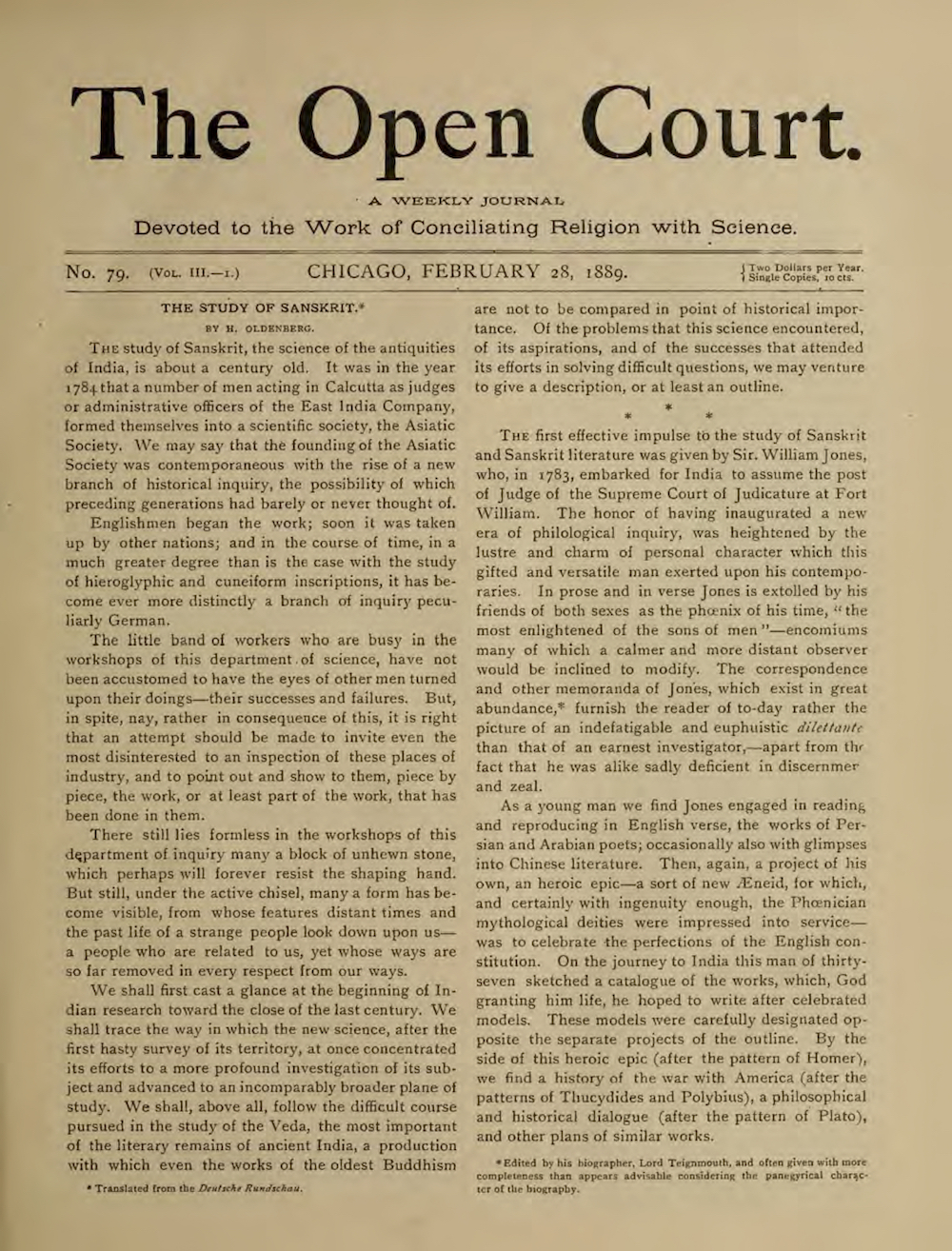
Open Court, The. The journal held itself out as a forum for the free exchange of ideas, proclaiming that it "was founded to serve as a center for an earnest and thoroughgoing reformation of religion under the influence of science, and in working to this end it has combined a fearless radicalism with a reverent conservatism." In practice, this meant a scientific criticism of the established churches combined with an idealistic philosophy that reduced religion to little more than a vague universal sentiment of awe and reverence and a striving for "interfaith" dialogue toward progressive goals ("the Religious Parliament Idea"). Religion was "a scientific fact," but the journal carried on a relentless battle with its contemporary doctrinal expressions. The editor of the journal, Paul Carus (1852-1919), was German born and educated and a devotee of Spinoza. His father-in-law Edward Hegeler owned this journal and its sister, the Monist, which Carus edited as well. Carus's approach to the religion of the day, not surprisingly, allied him with the educated, progressive East Coast reformers like Sarah Farmer, at whose Green Acre camp Carus lectured. Not surprisingly, Buddhism (which Carus played a central role in introducing to the west) and Baha'i were regularly featured in the journal. The journal offered translations by leading scholars of the "sacred writings" of the East, coupled with learned discussions of socialism, Tolstoy, Schopenhauer, psychical research, free trade, woman's rights, and other topics of current interest to the classes for whom the journal was published. Contributions by Francis Ellingwood Abbot, Moncure Conway, B.F. Underwood, and others of the antecedent "free religion" movements, as well as by Anna Ballard, Sara A. Underwood, Elizabeth Cady Stanton, D.T. Suzuki, William Wundt, Max Dessoir, C. Staniland Wake, and many others. The journal and its publisher also regularly published revelations by Henry R. Evans and David Abbott on the "legerdemain" of current spiritualist mediums. See also the note under the Monist, also owned by Hegeler and edited by Carus. Rowell's American Newspaper Directory for 1900 says the journal had a circulation of about 2,500. NYPL; and many other locations. |
|
| Open Court Dictionary Catalog | |
| Open Court V1 1887-88 | |
| Open Court V2 1888-89 | |
| Open Court V3 1889-90 | |
| Open Court V4 1890-91 | |
| Open Court V5 1891 | |
| Open Court V6 1892 | |
| Open Court V7 1893 | |
| Open Court V8 1894 | |
| Open Court V9 1895 | |
| Open Court V10 1896 | |
| Open Court V11 1897 | |
| Open Court V12 1898 | |
| Open Court V13 1899 | |
| Open Court V14 1900 | |
| Open Court V15 1901 | |
| Open Court V16 1902 | |
| Open Court V17 1903 | |
| Open Court V10 1896 | |
| Open Court V18 1904 | |
| Open Court V19 1905 | |
| Open Court V20 1906 | |
| Open Court V21 1907 | |
| Open Court V22 1908 | |
| Open Court V23 1909 | |
| Open Court V24 1910 | |
| Open Court V25 1911 | |
| Open Court V26 1912 | |
| Open Court V27 1913 | |
| Open Court V28 1914 | |
| Open Court V29 1915 | |
| Open Court V30 1916 | |
| Open Court V31 1917 | |
| Open Court V32 1918 | |
| Open Court V33 1919 | |
| Open Court V34 1920 | |
| Open Court V35 1921 | |
| Open Court V36 1922 |
|
|