|
Summary:
|
From Pat Deveney's journal database:
Path, The
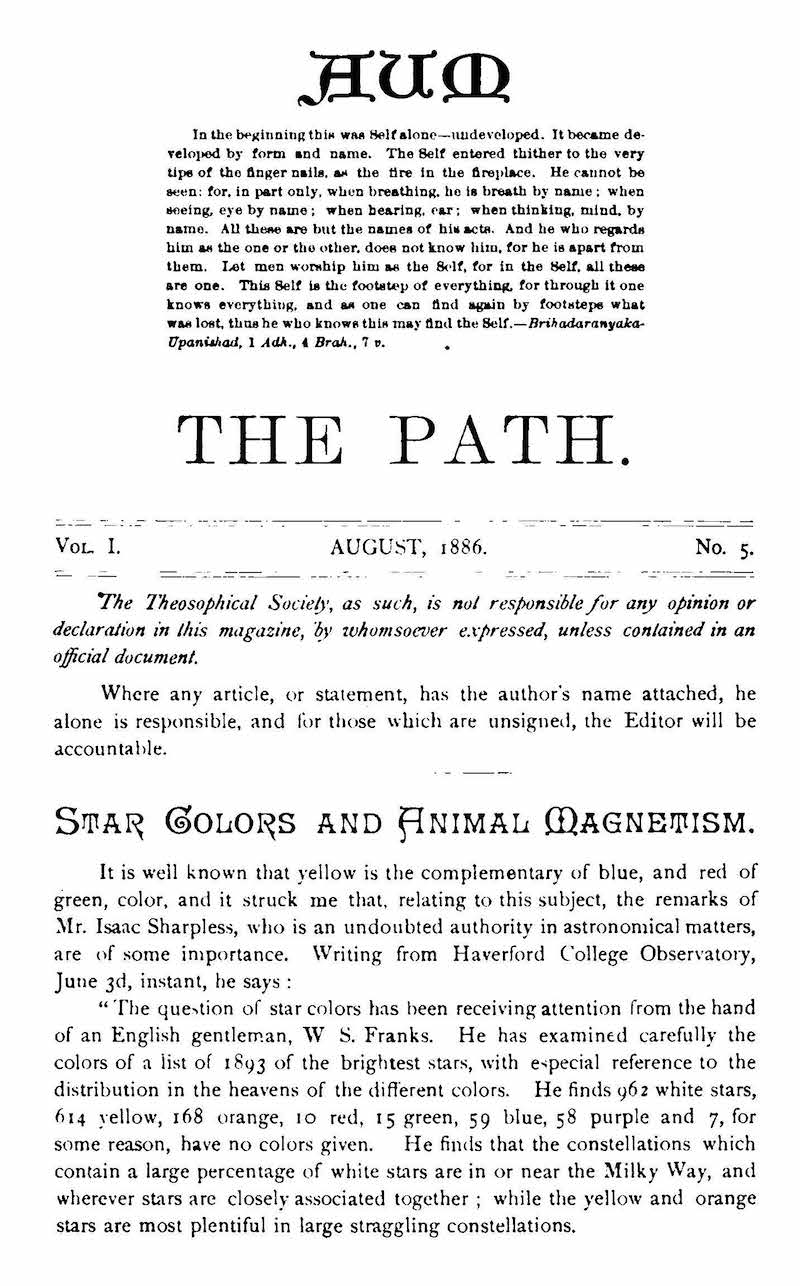
A Magazine Devoted to the Brotherhood of Humanity, Theosophy in America, and the Study of Occult Science, Philosophy, and Aryan Science.
1886-1896 Monthly. New York, NY. Language: English.
Editor: William Q. Judge, editor and publisher. Succeeded by: Theosophy (1896-1897)->Universal Brotherhood
(1897-1899)->Universal Brotherhood Path (1900-1903).
1/1, April 1886-March 1896. 32 pp., 6 x 9.
This is a Theosophical journal, but Judge's role in commenting on and participating in the spiritualist and occult controversies of the era make it important to include here. It has
contributions by or excerpts from Judge (under his own name and several pseudonyms), Seth Pancoast, Mrs. J.W. Cables, W.P. Phelon, Stanley B. Sexton, C.H.A. Bjerregaard, J. Ralston Skinner, Baron J. Spedalieri, J.D. Buck, "Jasper Niemand" (Julia Campbell Ver Planck), Franz Hartmann, et al. The Campbell Theosophical Research Library has compiled a table of contents
of the journal and published it online at austheos.org.au. Reprinted Edmonton Theosophical Society.
The theosophy.net article index included.
|
| Claude-Generated Themes:
|
The Path, published monthly in New York from 1886 to 1896 under William Quan Judge, was the flagship of American Theosophy during Helena Blavatsky's lifetime and the principal organ of the movement's United States Section. Its idiom is the movement's own — the Masters and adepts, universal brotherhood, the Secret Doctrine, and above all the twin doctrines of karma and reincarnation — but Judge's editorial manner was practical rather than cosmological. The magazine taught readers how to study: why apparently contradictory teachings remain contradictory until one can view a subject from opposite grounds, why occult powers pursued for selfish ends atrophy the person who seeks them, what a student should do first. Spiritualism and mesmerism appear only in a critical and comparative register, since Theosophy had defined itself against the seance room, and the Indic and Zoroastrian citations that fill its pages belong to the wisdom-religion argument rather than to any sectarian purpose. It is a central document of late nineteenth-century Anglo-American Theosophy, and it gave its name to the journals that succeeded it.
Generated by Claude from the periodical's digitized text; a thematic reading, not a bibliographic description.
|
