| Summary:
|
From Pat Deveney's database:
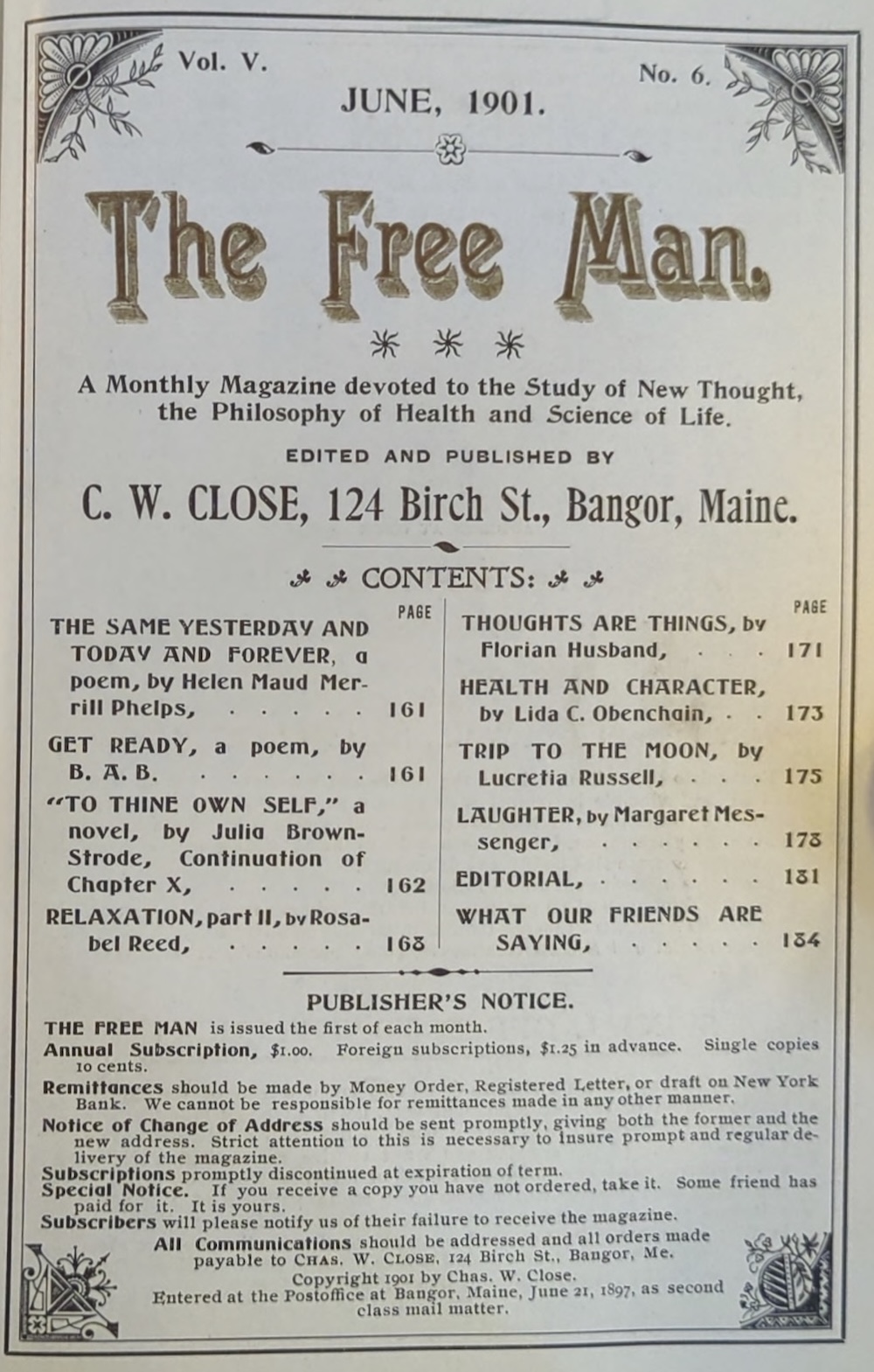
Free Man, The.
A Monthly Magazine, Devoted to the Study of New Thought, the Philosophy of Health and the Science of Life.
1897--1901 Monthly
Bangor, ME.
Language: English.
Editor: Charles W. Close, Ph.D., S.S.D. / Ph.D., LL.D.
Publisher: C.W. Close.
Succeeds: The Mionion Letter (June 1893-April 1895, the predecessor of Free Man); The New Thought, Melrose, Massachusetts (absorbed September 1898); (absorbed January 1900); The Searchlight (Elm Grove, West Virginia, absorbed August 1900); Spiritual Being (South Bend, Indiana, absorbed August 1900)
Succeeded by: Mind (absorbed this journal, 1901); Twentieth Century Physician; Phrenopathic Journal; Old and New
1/1, January 1897-5/8, August 1901.
16-32 pp., 6 x 9, $1.00 a year. After boasting of a circulation of 5,000 in 1898 and 10,000 in 1900, the journal failed and was absorbed by Mind in mid-1901. Close (1859-1915) had practiced as a mental healer since 1883 and had been granted his Ph.D. and S.S.D. by Andrew J. Swarts' Spiritual Science University in Chicago in 1888. Close called his system "Phrenopathy, or Rational mind cure," the core of which was "the sex principle": "Throughout the universe all life and activity, whether in mineral, plant, animal or man, is produced through the sex principle." "Substance becomes individualized through the action of the sex-principle in nature. * * * At first it is hermaphroditic, then the feminine sex becomes visible, and ultimately both sexes have distinct personalities." Beyond these generalities, Close hinted at "the higher regenerative power for soul and body" that lay at the root of the sex function and which "the student will discover as he or she progresses in spiritual knowledge." This power arose from the control of the "sex magnetism or aura" that "attracts from the universal LIFE, and also from the personal lives of others, certain elements necessary to its own upbuilding." Sex, in other words, was a good thing and an essential part of life, although it was necessary to control it by the will. Close expounded these ideas in Phrenopathy; Or, Rational Mind Cure (1894) and Sexual Law and the Philosophy of Perfect Health (1898) and various other journals, pamphlets and articles.
In the early 1890s Close started in Bangor, Maine, the Mionions, a name that he said was "pronounced my-own-e-un, accent on second syllable and was derived from words signifying that which of right belongs to me, and means perfect individuality on the Spiritual-Human plane. A Mionion is one who is striving to perfect his (or her) individuality in all directions." The organ of this society was the quarterly Mionion Letter, published from 1893-1895. When this came to naught Close started the Free Man in January 1897 to promulgate the same teachings. This was published "in the interest of the new philosophy of thought and the science of life."
The journal was largely written by Close but also offered article and excerpts from Henry Wood, Joseph Maille, Eleanor Kirk, William E. Towne, William Denton, and Lucretia Russell, ("Trip to the Moon"). et al., with filler in the form of serialized novels by the likes of Virginia Durant Young (One of the Blue Hen's Chickens," "a Mental Science South Carolina romance"). It had extensive advertisements for Paul Tyner's The Temple, Nancy McKay Gordon, Peter Braun's The New Man, Star of the Magi, Helen Wilmans, O'Hashnu Hara, and others, and devoted considerable space to Close's lessons ("Success Treatments," $1.00 a month; "Health Treatments," $5.00, etc.) and books and the offerings of his "F.M. Mionion Book Company." Notable among these was "The Conquest of Fate." After this journal failed and was absorbed into Mind in mid-1901, Close started several other short-lived journals: Twentieth Century Physician, Phrenopathic Journal, and Old and New. He died in 1915.
|