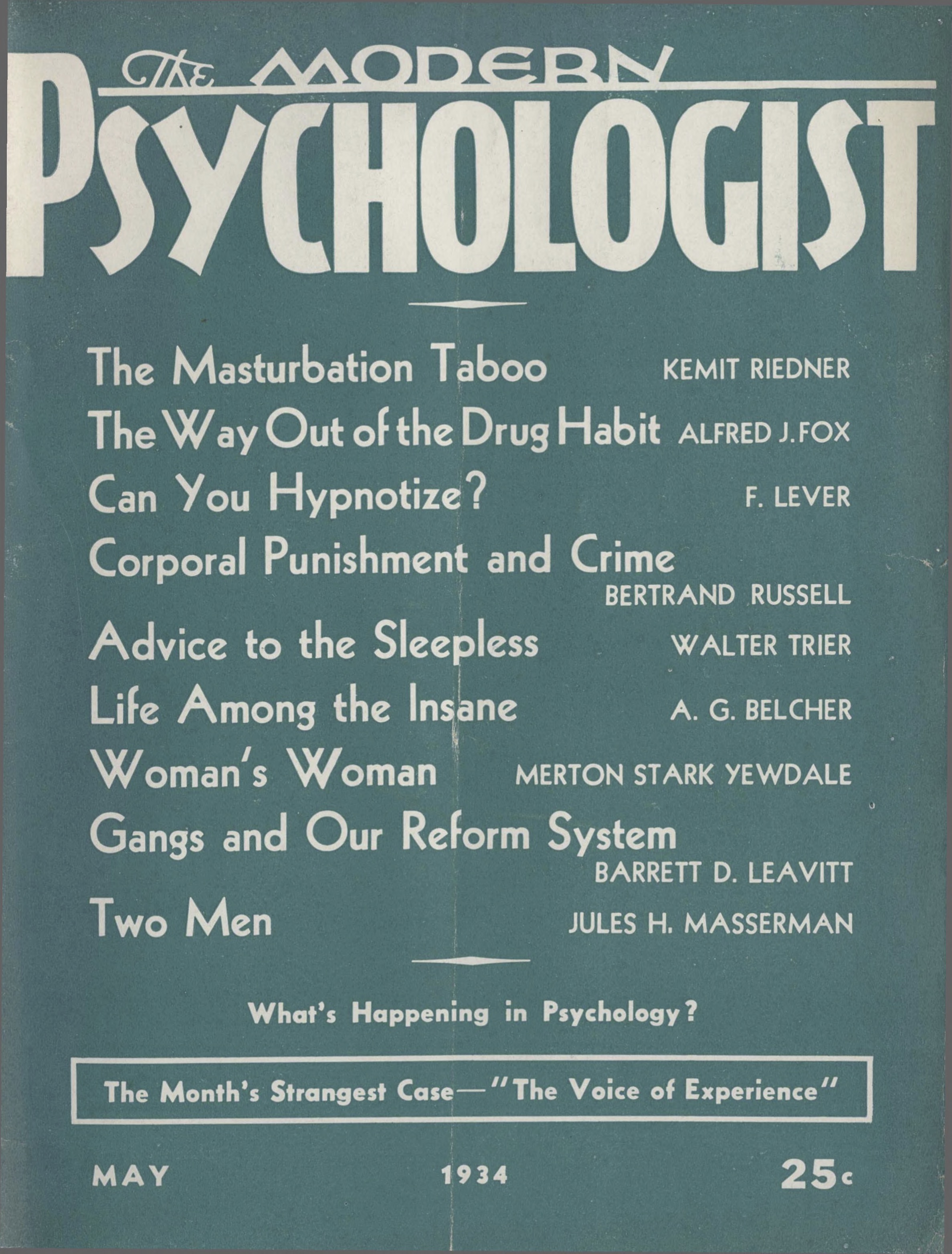
| Summary: |
- Summary by:
- Pat Deveney
- Title:
- Modern Psychologist, The.
- Subtitle:
- A Magazine of Contemporary Thought in Psychology, Psychiatry, and Psychoanalysis.
- Motto:
- Other Titles:
- Published:
- 1932-1938
- Frequency:
- 1932
- Location:
- Language:
- Editor(s):
- Dagobert D. Runes, editor; Dr. Frank B. Robinson, et al., associate editors.
- Publisher(s):
- National Scientific Publications, Inc..
- Corporate Author:
- Succession:
- Succeeded by: Merged into Practical psychology cf. The Modern Psychologist. v. 10, no. 2, p. 7.
- Description:
1/1, 1932-1938. $3.00 a year, 48 pp. This was a commercial venture designed to popularize the emerging “modern” or “scientific” psychology, and much of its content was designed and titled to attract attention and subscribers, like “The Psychology of the ‘Strip-Tease,” “The Strange Cult of Flagellation,” etc., with a strong dose of the titillating, with regular articles on “The Normality of Petting,” incest, unmarried motherhood, bisexuality, lesbianism, necrophiliacs, etc. The journal had contributions by and on Sigmund Freud, Alfred Adler, Carl Jung, Havelock Ellis, Wilhelm Stekel, et al., The editor, Dagobert D. Runes (1902-1982), an Austrian educated in the Vienna Circle, who had become a public intellectual in the United States, devoted the journal to spreading word of the new, “modern psychology” that prided itself on its scientific basis and fearless broaching of taboo subjects, but still found room to discuss subjects that had been considered to belong to the field of spirituality and occultism, like spiritism, hypnosis, autosuggestion, “Gypsy Fortune Telling,” and Jung’s mysticism. The advertisers who chose the journal were well aware of the close relationship of “modern psychology” with the “practical psychology” of New Thought: “Elizabeth Carter, Graduate Psychologist, Daily Guide Chart—Success,” “The Futurist Society of Cleveland, Ohio (”Learn how to use your brain!”), “The College of Divine Metaphysics” (”Study for the Degree”), “The M.S.R. Realization Secret” (”It gives me anything I want”—until the Federal Trade Commission in 1937 enjoined D.J. Hinman from using “secret” in his advertisements). Category: New Thought. |