
International Association for the Preservation of Spiritualist and Occult Periodicals


Periodical: The Word (Princeton)

Summary:  From Pat Deveney's database:

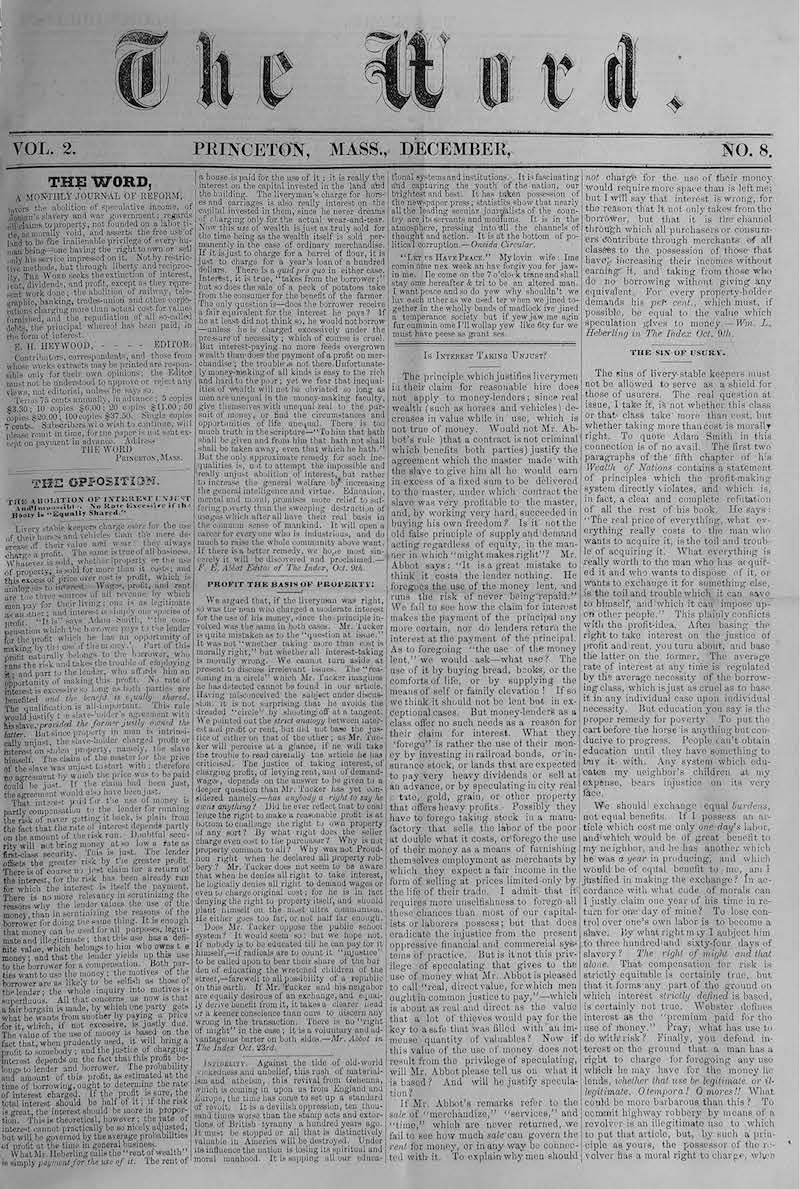
Word, The.
A Monthly Journal of Reform.
1872—1893 Monthly (irregular)
Princeton, then Cambridge, then Princeton, MA. Language: English.
Editor: Ezra Hervey Heywood and Angela Tilton Heywood, with occasional assistance from Benjamin R. Tucker.
1/1, 1872-April 1893 (not published in 1891).

This was, even by the standards of the time, a radical journal. Heywood (1829-1893) was a spiritualist and a prolific writer on anarchism, free speech, abolition, the rights of labor, sexual and marriage liberation, socialism, and general reform. He was most notably the author of Cupid’s Yokes, or, The Binding Forces of Conjugal Life: An Essay to Consider Some Moral and Physiological Phases of Love and Marriage, Wherein is Asserted the Natural Right and Necessity of Sexual Self-Government (Princeton,MA: Co-operative Publishing Company, n.d. [1876]), the pamphlet for selling which D.M. Bennett and Heywood were sent to jail, and which split the reform movement in the United States. Contributions by, among others, J.K. Ingalls and Lois Waisbrooker. Heywood was arrested at least five times for his writings, the last time in 1890 for a series of articles by him and his wife in The Word on sexual subjects. He died shortly after his release from jail.

Other Sources:NYPL.
Issues:The Word V2 N8 Dec 1873
Claude-Generated Themes:   'The Word' was Ezra H. Heywood's radical monthly, published at Princeton, Massachusetts (1872-1893), and it belongs to the individualist-anarchist and free-love wing of the nineteenth-century American reform press rather than to the occult tradition. Its pages mix mutualist economics in the lineage of Josiah Warren -- attacks on interest, rent, and profit, and on wage 'slavery' -- with an uncompromising defense of free love against church-and-state marriage. Heywood's paper was a running target of Comstock-era censorship, and its columns carry the resulting anti-blackmail and free-speech agitation. Occult vocabulary is absent; apparent 'phrenology' and 'spiritualism' cues are artifacts of ordinary words ('gall,' 'medium' of exchange). It sits alongside the freethought and labor-radical papers of its era.

Generated by Claude from the periodical's digitized text; a thematic reading, not a bibliographic description.
Topics:Anarchism and Radical Individualism | Socialism and Labor Reform | Spiritualism