
| Periodical: | |
|
|
|
|
From Pat Deveney's database:
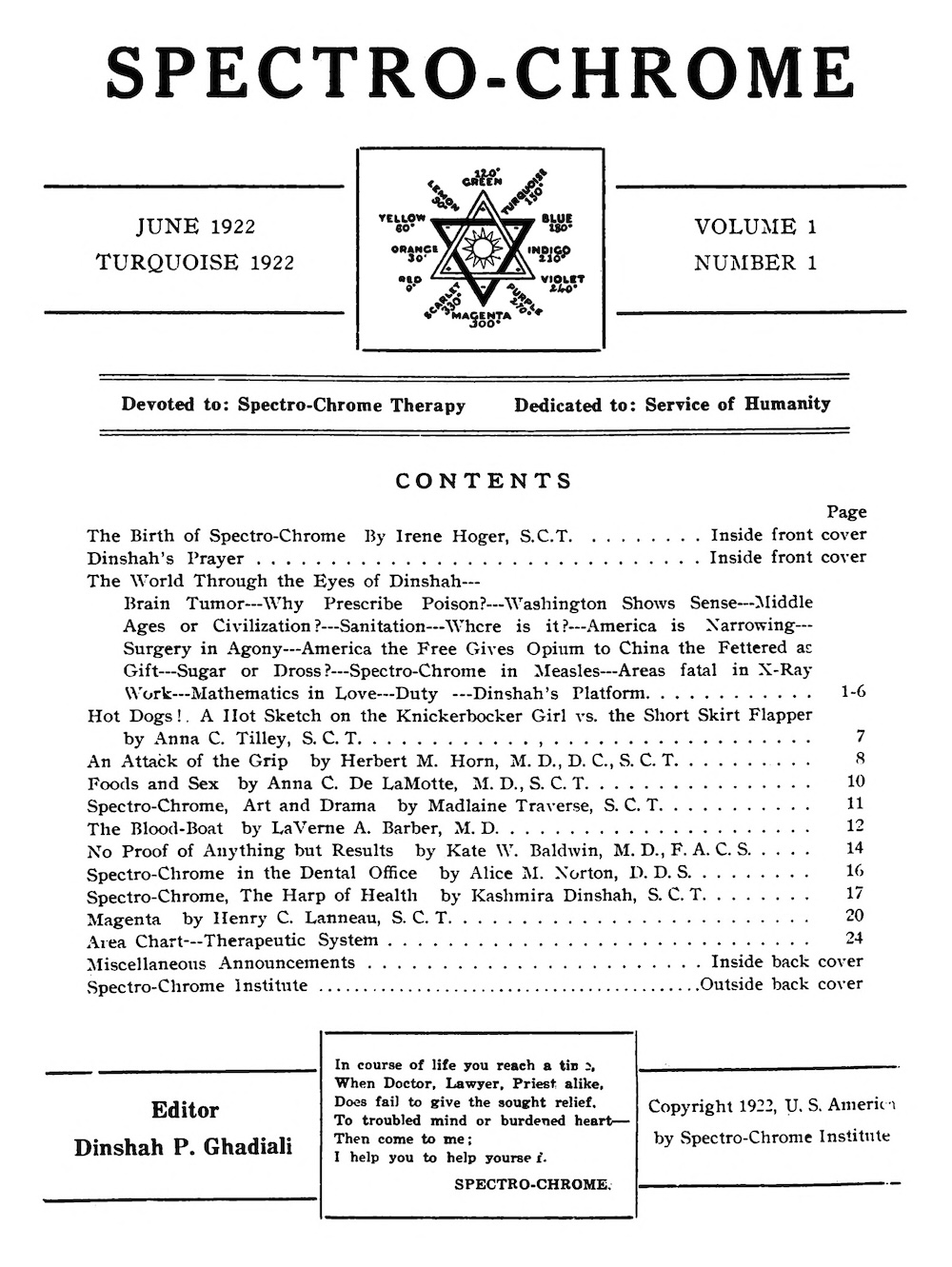
Spectro-Chrome. The severe presentation of this journal intentionally bore all the hallmarks of a regular medical journal but it was the product of a dubious Parsi immigrant from Bombay who used it and its successor to tout the benefits of his color-therapy device (a light bulb, fan and two focusing lenses and a variety of colored glass filters), some eleven thousand of which were sold for amounts up to $750.00 each. Colonel Dinshah P. Ghadiali, M.D. (1873-1966) labeled himself as a "Metaphysician and Psychologist" after he immigrated in 1911 and had become a Theosophist in India in 1891, and claimed several other inventions before he came up with Spectro-Chrome in 1920. The idea, he freely admitted, was derived from his reading of Edwin Babbitt and continued the "Blue Light Mania" of the era, following in the footsteps of General Augustus Pleasanton and Seth Pancoast. The early years of the journal recited a long list of academic degrees after his name, all of which, including his "M.D.," awarded by various mail-order institutions. In later years, after various encounters with the law, he carefully added "Honorary" before his medical degree. (The title of "Colonel" was earned legitimately by Ghadiali by his service in the New York Police Air Reserves.) The journal consisted of expositions on the theory and practice of the therapy and the the organization of his treatment empire, attacks on the Medical Octopus of the American Medical Association, and Ghadiali's wandering thoughts on general topics of interest to him. The masthead bore the trademark of a sun centered in a six-pointed star composed of two interlocking triangles, black and white, surrounded at the key points and angles by the names of 12 colors spaced circumferentially every 30° and labeled with descriptions of the appropriate medical weaknesses to be cured by application of that specific color to that part of the anatomy. Ghadiali added to the simple intuition of Babbitt a variety of astrological and quack medical injunctions, requiring his followers to eschew meat, alcohol, tobacco, vaccinations, tampons, high-heeled shoes, furs and silk stockings, and to bath in coconut oil and plan their diets around the recipes provided in his cookbook. He was convicted in 1925 for violating the Mann Act ("White Slave Traffic Act" of 1910) by traveling interstate for the "immoral purpose" of having sex with his secretary while on a promotional tour to tout his invention around the country (she said she had been mesmerized by him). He spent 18 months in prison and the journal carried the caption "Incarceration Issue" while he was imprisoned. In 1931, he was arrested again, for larceny by fraudulent promotion of his device, but succeeded in convincing a jury of its bona fides. The Government tried again in 1946, successfully, and Ghadiali spent three years in prison and was forced to stop the journal. On his release he reorganized the business as the Visible Spectrum Research Institute and in 1955 re-started the journal as the Visible Spectrum Researcher, which was ordered closed a few years later, although a Spectro-Chrome kit can still be acquired from Amazon as a experimental novelty. An illustrated discussion of Ghadiali and Spectro-Chrome is provided by Christopher Turner, "Kingpin of Fakers," Cabinet, Summer 2005.
|
| Spectro-chrome V1 N1 Jun 1922 | |
| Spectro-chrome V1 N2 Jul 1922 | |
| Spectro-chrome V1 N3 Aug 1922 | |
| Spectro-chrome V1 N4 Sep 1922 | Spectro-chrome V2 N10 Oct 1923 |
| Spectro-chrome V2 N1 Jan 1923 | |
| Spectro-chrome V2 N4 Apr 1923 | |
| Spectro-chrome V2 N7 Jul 1923 | |
| Spectro-chrome V2 N8 Aug 1923 | |
| Spectro-chrome V4 N12 Dec 1925 | |
| Spectro-chrome V4 N4 Apr 1925 | |
| Spectro-chrome V4 N9 Sep 1925 | |
| Spectro-chrome V5 N1-3 Jan-mar 1927 | |
| Spectro-chrome V6 N1-9 Jan-sep 1928 | |
| Spectro-chrome V7 Nx [nd] 1929 | |
| Spectro-chrome V9 N12 Dec 1933 | |
| Spectro-chrome V9 N1 Jan 1933 | |
| Spectro-chrome V9 N4 Apr 1933 | |
| Spectro-chrome V9 N8-10 Aug-oct 1933 | |
| Spectro-chrome V10 N12 Dec 1934 | |
| Spectro-chrome V10 N3 Mar 1934 | |
| Spectro-chrome V10 N4 Apr 1934 | |
| Spectro-chrome V10 N7 Jul 1934 | |
| Spectro-chrome V10 N9 Sep 1934 | |
| Spectro-chrome V11 N10-11 Oct-nov 1935 | |
| Spectro-chrome V11 N3 Mar 1935 | |
| Spectro-chrome V11 N7 Jul 1935 | |
| Spectro-chrome V12 N2 Feb 1936 | |
| Spectro-chrome V12 N5 May 1936 | |
| Spectro-chrome V12 N8 Aug 1936 | |
| Spectro-chrome V13 N12 Dec 1937 | |
| Spectro-chrome V13 N1 Jan 1937 | |
| Spectro-chrome V14 N7 Jul 1938 | |
| Spectro-chrome V15 N8 Aug 1939 | |
| Spectro-chrome V16 N10 Oct 1940 | |
| Spectro-chrome V17 N1 Jan 1941 | |
| Spectro-chrome V17 N5 May 1941 | |
| Spectro-chrome V18 N8 Aug 1942 | |
| Spectro-chrome V19 N4 Apr 1943 | |
| Spectro-chrome V20 N3 Mar 1944 | |
| Spectro-chrome V21 N3 Mar 1945 | |
| Spectro-chrome V22 N11 Nov 1946 | |
| Spectro-chrome V23 N10 Oct 1947 |
|
|