
| Periodical: | |
|
|
|
From Pat Deveney's database:
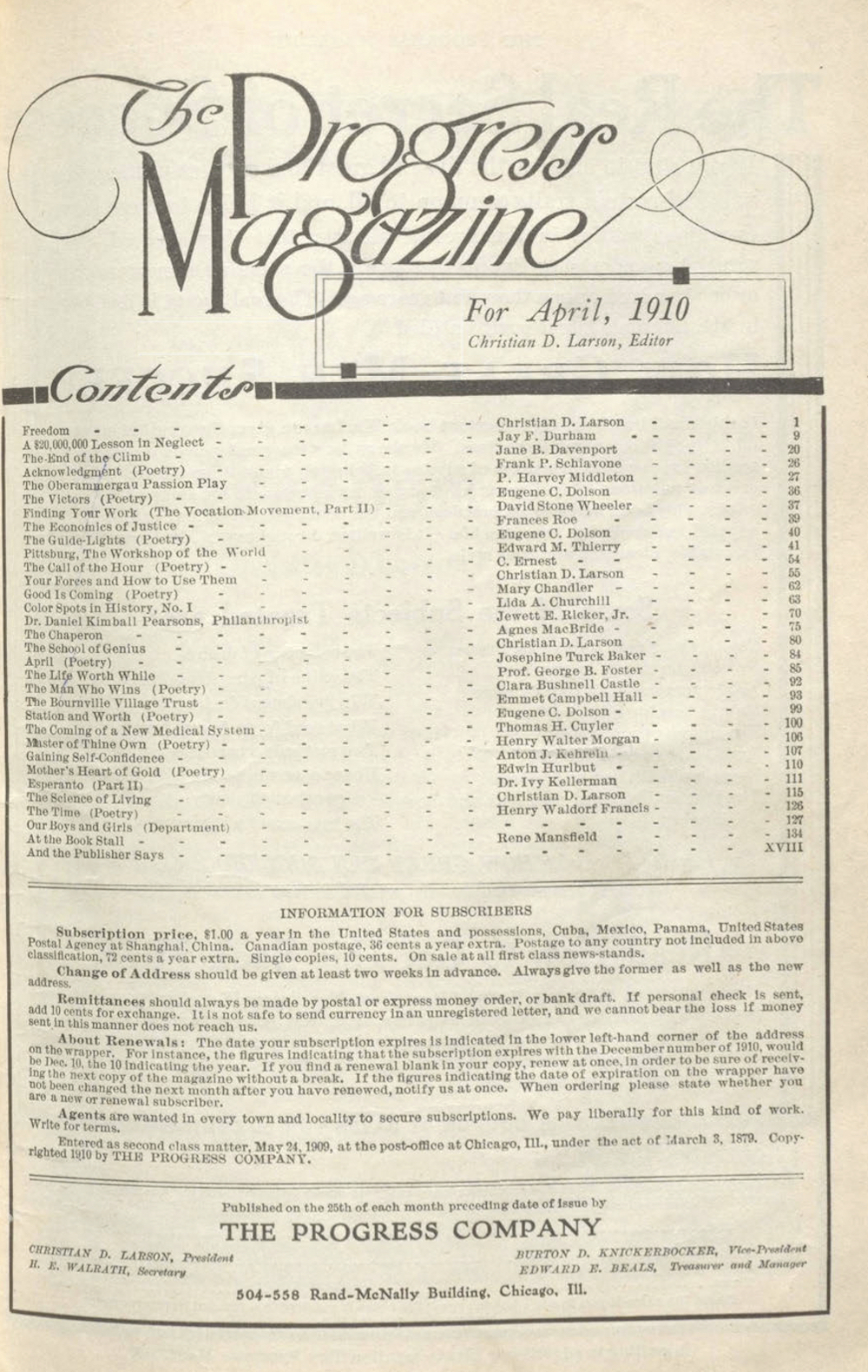
Progress Magazine, The. This is one of the transformations of Eternal Progress (q.v.). The name was changed, Larson later complained, because "first-class advertisers" would not advertise in what appeared to be a New Thought magazine. To attract a more general audience (as well as "first-class advertisers"), the journal offered novelettes, articles on "Wireless Telegraphy, and the Aeroplane," "Halley's Comet," "Novels that Have Made Authors Rich," and the like, and an extensive a children's page ("Our Boys and Girls," Conducted by Uncle Booker) and book reviews on topics of general interest. Contributions by Larson ("Your Forces and How to Use them"), William Walker Atkinson (on "Eugenics, the New Science": "It is being recognized clearly that the Race may be, and should be, improved, consciously, deliberately and scientific ally, instead of being allowed to ‘jest grow up,' like Topsy"), Lida A. Churchill, et al. Beals, the manager of the journal, went on to be co-author and publisher of several series of books with Atkinson, and also wrote in Neue Gedanken. |
|
| LOC; NYPL; Princeton University; Oklahoma State University; University of Texas, Austin; and other locations in OCLC. | |
| Progress Magazine V9 N4 Jun 1909 | |
| Progress Magazine V9 N5 Jul 1909 | |
| Progress Magazine V9 N6 Aug 1909 | |
| Progress Magazine V9 N7 Sep 1909 | |
| Progress Magazine V9 N8 Oct 1909 | |
| Progress Magazine V9 N9 Nov 1909 | |
| Progress Magazine V9 N10 Dec 1909 | |
| Progress Magazine V9 N11 Jan 1910 | |
| Progress Magazine V10 N1 Mar 1910 | |
| Progress Magazine V10 N2 Apr 1910 | |
| Progress Magazine V10 N3 May 1910 |
|
|