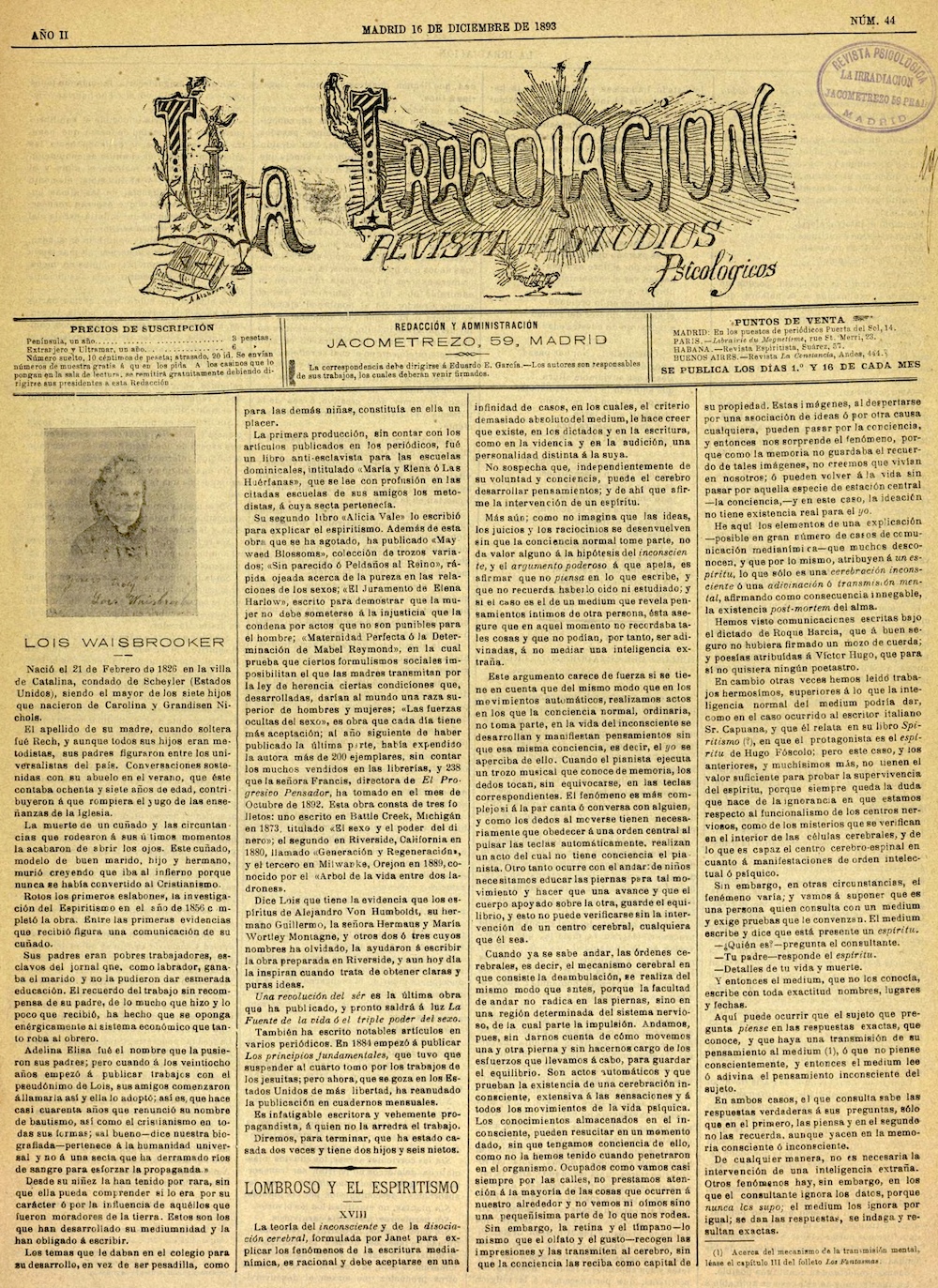
1/1, February 27, 1892-1897; 1908(?)
3 pesetas a year in Spain and Portugal and 6 abroad, 4 pp.
Originally a subscription came with a free year of Lucie Grange's La Lumiere. After the hiatus from 1897-1900 said to have been caused by the Spanish-American War, the journal appeared in a totally new format under the name La Irradiacion, Periodico-Biblioteca. This consisted of four pamphlets of 32 pages each published weekly, devoted to topics like science, philosophy, economics, and spiritualism. The subscription cost 6 pesetas in Spain and 10 pesetas abroad. The first spiritualist offering in January 1900 had articles on "The Origin and End of Worlds," "Chiromancy," the esoterism of the Emerald Tablet of Hermes Trismegistus, and "The Treasure of the Garden," this last penned by a 16th century writer. In venturing on this new format, the journal was partially following the lead of Revista de Estudios Psicologicos which had supplemented that journal with a companion weekly monograph on spiritualist topics.
Unlike its contemporaries, which depended on patronage or the sponsorship of a spiritist society, this journal was a commercial venture of the publisher, who devoted a page of each issue to advertising its own "Biblioteca ‘La Irradiacion,'" "Folletin Espiritista,"and "Almanaque de ‘La Irradiacion,'" and listing works on spiritism and "psychological" subjects that it had for sale from other publishers.
The title of the journal referred to the "sfera de irradiacion," the hypothesized non-material magnetic or spiritual field that "spiritualists" envisioned to distinguish their views from those of "materialists" and to explain the mysterious actio-in-distans phenomena of spiritualism, magnetism, hypnotism, and the like. The subtitle of the journal explicitly covered "psychological studies," a term that became the the subtitle of a great number of Spanish- and Portuguese-language spiritist journals as they moved from doctrinaire spiritism to the view of spiritism as only one possible example of the complexities and intricacies of human psychology, and spirituality worldwide, and the journal regularly carried articles on "The Wonders of Suggestion," Theosophy, bilocation, "Buddha's illumination," claivoyance of animals, "Lombroso and Spiritualism," psychic science, antiquity of magnetism, clairvoyance of animals, "The Eternal Buddha," "Kissing a Spirit," "an Indian Legend," Mesmer and magnetism, "The Reconstitution of Gnosis," curative hypnotism, and the like. In its first issues the journal announced it would publish the most notable articles and spiritual phenomena encountered in the journals of the "United States, England, France, Germany, Belgium, Italy, the Spanish-American republics and the provinces of Ultramar," with frequent borrowings from Light and the Banner of Light. The journal also regularly carried extensive biographies of notable spiritualists and researchers around the world, complete with a photograph: Paul Gibier, Eusabia Pallatino, Wiliiam Crookes, Manuel Sanz Benito, P.G. Leymarie, Rev. N.F. Ravlin, Edwin D. Babbitt, et al, and most notably (in the issue of December 1893) Lois Waisbrooker.
The journal is listed as adhering to the 1892 Spanish-American spiritualist congress convened by Fraternidad Universal in Madrid to honor the discovery of America. Noted in Mario Mendez Bejarano, Historia de Filosofia en España hasta el Siglo XX (1927), and in The Progressive Thinker and Ubersinnliche Welt, 1893, and Banner of Light, 84/10 (November 5, 1898): 1.