
International Association for the Preservation of Spiritualist and Occult Periodicals


Periodical: Brahmavadin

Summary: From Pat Deveney's database:

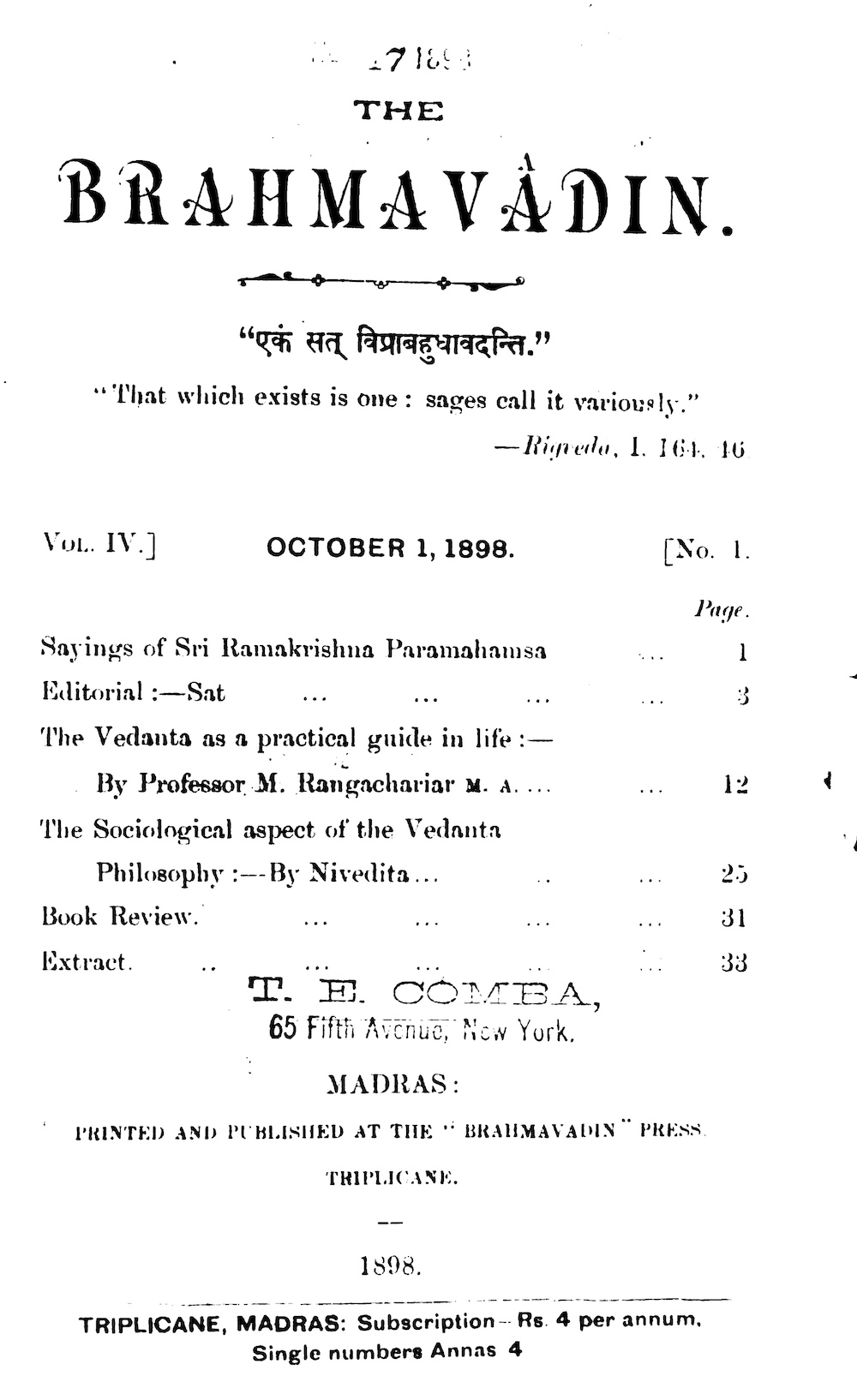
Brahmavadin, The.
A Monthly Religious and Philosophical Journal / The Monthly Magazine of Religion, Philosophy and Allied Subjects.
That which exists is one: sages call it variously
1895--1914 Semimonthly, monthly (from 1898)
Triplicane, Madras, India.
Language: English.
Editor: Alasinga Perumal (1865-1909).
Publisher: Tripilicant (Madras), Thompson & Co. (New York). Succeeded by: Vedanta Kesari (1914-present)
1/1, September 1895-19/, March-April 1914.
Rs. 4/ $2.00 a year.

This was published by Alasinga Perumal after Swami Vivekananda had suggested the project to him and it was devoted to Vedanta as envisioned by Vivekananda It contained contributions by various swamis who sought to spread the word of Vedanta to the West, such as Sister Nivedita and Swami Abhedananda, but also contained occasional articles on Islam, Christianity, Jainism, etc. Noted in The Metaphysical Magazine, 1896, "List of Advance Thought Publications," The New Cycle, March 1900, 159-60, and The Metaphysical Magazine, February 1901, 159, and in Notes and Queries, January 1900.

Other Sources:
Issues:Brahmavadin V4 N1 - V4 NS 23-24 Oct 1898-Sep 1899
Brahmavadin V5 1900
Brahmavadin V6 1901
Brahmavadin V7 1902
Brahmavadin V8 1903
Brahmavadin V9 1904
Brahmavadin V10 1905
Brahmavadin V11 1906
Brahmavadin V12 1907
Brahmavadin V13 1908
Brahmavadin V15 1910
Claude-Generated Themes:   Brahmavadin (from 1895, Madras) was a Vedanta review born in the circle of Swami Vivekananda and the Ramakrishna movement, its title meaning 'the speaker of Brahman.' Its concern is Advaita Vedanta argued from scripture — the great identity 'that art thou,' the exegesis of injunction and statement, and the reform of caste read through Vedantic non-dualism — addressed to an educated modern readership. It is systematic Hindu philosophy and comparative religion rather than any séance-room or mind-cure interest, and stands among the channels by which classical Indian thought reached Western and Anglophone-Indian audiences. Its karmic vocabulary is doctrinal, not spiritualist.

Generated by Claude from the periodical's digitized text; a thematic reading, not a bibliographic description.
Topics:Yoga and Vedanta