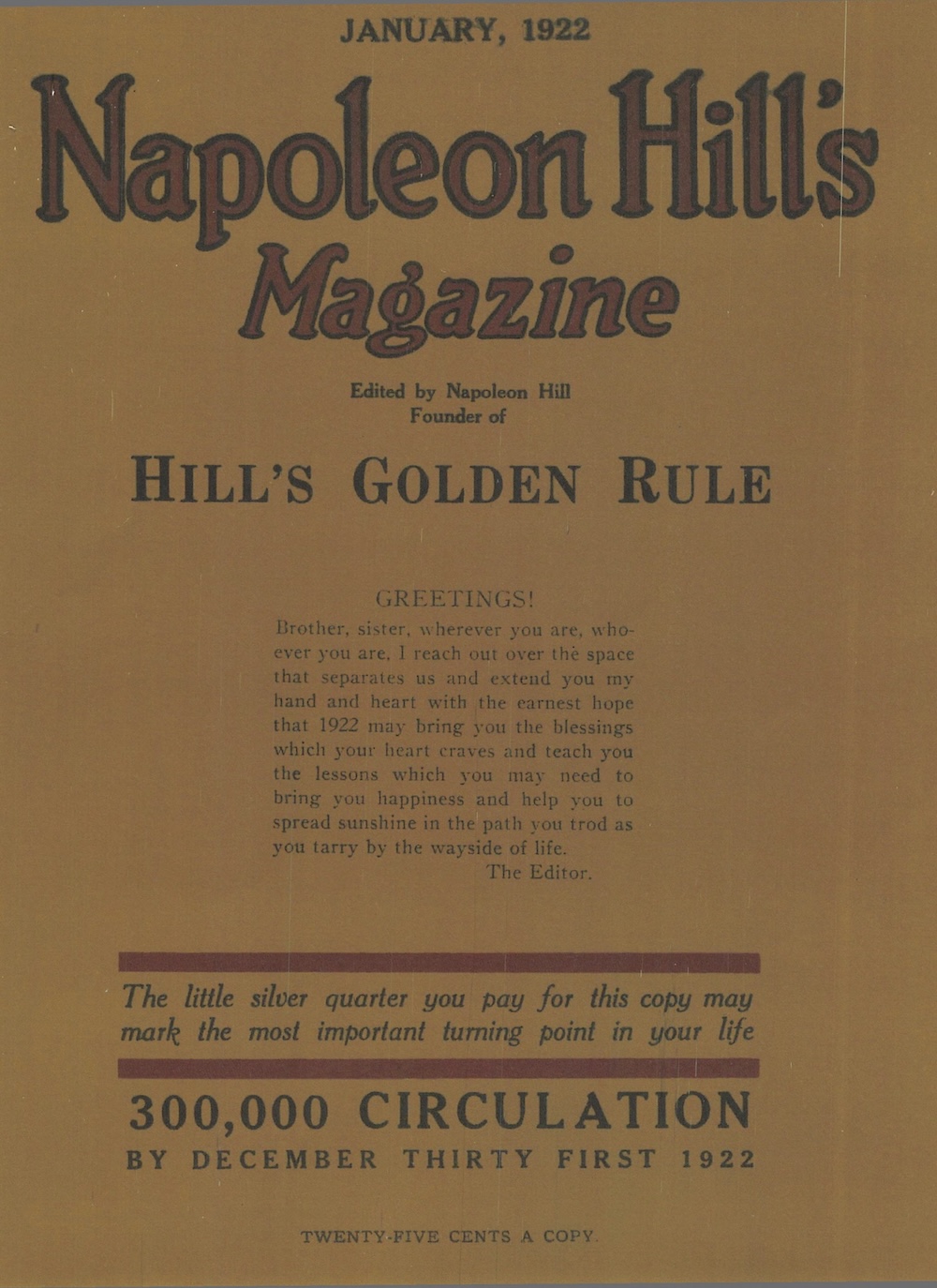
1/1, April 1921-1923 (?) 48 pp., 25 cents a copy, $2.50-$3.00 a year.
Napoleon Hill (1883-1970), who started this journal when the Federal Trade Commission shut down its predecessor, was a huckster and confidence man who, ironically for a man who promoted himself as the teacher of sure-fire methods of achieving success and fortune, spent almost his whole life as a loser, living hand to mouth, one step ahead of various law enforcement agencies and disgruntled investors. As the researcher Matt Novak has detailed, practically everything Hill wrote in his various journals and books about his rise from being a coal-miner in West Virginia earning a dollar a day to a millionaire by the age of 21, was a lie. Even in an era that saw the rise of sterling confidence men like Thomas J. Betiero (see Star of the Magi), Albert de Sarak, Conde de Das (see l’Etoile d’Orient), Elmen S. Prather and H. Spencer Lewis (see Modern Miracles), Lewis H. Anderson (see Lover’s Gazette), Prof. El-Tanah (William Francis Mitchell, see Twentieth Century Astrology), Sydney B. Flower (see Goldfield Gossip and many other journals), et al., Hill stands out for his creativity and audaciousness—and for the enduring success of his books.
With the appearance of Hill’s Golden Rule: The New Psychology. An Inspirational Magazine Dealing with the Fundamentals of True Success. Applied Psychology, Business Philosophy, Practical Idealism in 1919, and this journal in 1921, Hill, who wrote most of the content of both magazines under a variety of pseudonyms, began expounding on his version of New Thought: “Whatever the mind of man can conceive and believe, it can achieve.” Following the lead of Wallace D. Wattles, Ralph Waldo Trine, Charles F. Haanel, H.H. Brown, and many other New Thought promoters of individual achievement and success, Hill advocated the universal application of the Golden Rule (“Do unto others as you would have them do unto you”) together with single-minded focus, auto-suggestion, and religious faith, all powered by preservation and direction of (sexual) energy, all leading to the creation of the “Master Mind” of joint conviction and aspiration to achieve a common goal—success and wealth. The energy that is available to man to succeed was, as Hill later expounded on in his Think and Grow Rich (1937), sexual in nature, and was not to be dissipated or repressed but rather “transmuted” and redirected to power achievement and wealth. This was a staple of New Thought mages, who, like Hill, offered lessons on "Mystery of Sex Transmutation (the Tenth Step toward Riches)” and “Private Lessons in the Cultivation of Magnetism of the Sex” and "Conservation of Sex-Vitality." “[D]esire, when harnessed and transmuted into action other than that of physical expression, may raise one to the status of a genius.”
Hill buttressed the worth of his lessons by elaborate (and bogus) accounts of his relationships with various rich and famous men like Andrew Carnegie, from whom he said he had learned his methods, but the actual story of his career before starting these journals after World War I is shabbier and rather pathetic: the usual sequence of these con men of arrests for various frauds (selling goods he didn’t own, kiting bad checks, and posing as an attorney) and flight to avoid jail. Early in his career he discovered the financial wonders of dubious schools and diploma mills. He started with an academy to teach automobile driving which he milked for all it was worth by having his students work without recompense for an automobile company (which paid him) and by selling shares in his schools and lending his students money to pay his tuition at exorbitant interest. In later years he expanded these methods into a variety of success schools, like the George Washington Institute in Chicago, which offered shares in the venture for $10.00 until Hill was arrested for violating the Illinois Blue Sky laws.
All of these escapades led Hill by 1908 to drop the name “Oliver N. Hill” he had been employing and re-appear as Napoleon Hill. By 1917 he was involved with Seymour E.J. Cox and his wife, Nellie, in promoting the Prudential Oil & Refining Company, Prudential Trust & Securities Company, and General Oil Company in Texas. These were elaborate schemes to use mass advertising and dubious “independent” journals to pump the stock of the Coxes’ oil ventures with claims of a five percent per month return on investment and to glorify the Coxes’ endeavors as a way of raising money for returning soldiers (an angle that Hill invented). To further these schemes Hill and the Coxes in 1919 started Truth, a monthly journal in Houston (apparently independent of the Coxes) and extolled the success of their various oil companies. Hill then furthered this effort by publishing “An Interesting Man and his Wife Who Have Made $1,000,000 for Other People,” praising the Coxes and their charitable purposes, in his own journal, Hill’s Golden Rule, which had either been started to further the Coxes’ schemes or turned to that purpose after the fact. The Federal Trade Commission was not amused by all of this by 1922 had issued a cease-and-desist order against the Coxes, barring the use of magazine promotion of their schemes. Hill was named in the complaint but couldn’t be served, and in 1921 started this journal. In 1924 Seymour Cox was sentenced to five years in federal prison for his efforts, and on his release started over in the oil business in Oklahoma, which led to the same result.
Hill’s Golden Rule magazine claimed a circulation of 500,000 within six months of its launch, and this journal was supposed to have had a circulation of at least 100,000, but both claims are almost certainly false. The journal ceased publication about 1923, and Hill moved to Canton, Ohio where he started another college (and associated with a newspaper editor who was murdered, apparently by the mob). His subsequent career until his death in 1970 mirrored his early life. In 1931 he founded and promoted a company to make a movie based on an incident in the Book of Mormon, “Corianton: A Story of Unholy Love.” The movie was eventually made, with Hill as co-producer, but Hill was hounded by charges of peculation and driven into bankruptcy. In 1937 his book Think and Grow Rich, probably largely written by his then wife, was wildly successful, but it little benefitted Hill because he had assigned the profits from the book to his wife to avoid creditors and she promptly divorced him. In the late 1930s he joined and collaborated in The Royal Fraternity of Master Metaphysicians of James Bernard Schafer (1896-1955) on Long Island, New York, and became the godfather of the “Immortal Baby Jean,” an infant that had been adopted and raised to be immortal by avoiding “destructive thoughts.” By 1942 Baby Jean had been reclaimed by her mother and Schafer sentenced to five years in Sing Sing for larceny in selling stock in his journal, Truth Digest—a scheme he blamed Hill for hatching. Hill avoided prosecution by moving to Florida. In 1954 he teamed up with W. Clement Stone, an authentic although somewhat dubious millionaire, who had been impressed by Think and Grow Rich, to publish Success Unlimited, a New Thought success journal that lasted into the new century under the editorship of Og Mandino by touting the “mental vitamins” and “Positive Mental Attitude” provided by its offerings.
Category: New Thought, Sexual Elements, Quackery.