| Summary: |
- Summary by:
- Pat Deveney
- Title:
- Life from the Dead.
- Subtitle:
- Being a National Bell-Ringing Journal Advocating the Identity of the British Nation with the Lost Ten Tribes of Israel.
- Motto:
- Other Titles:
- Published:
- 1873-1880
- Frequency:
- Monthly
- Location:
- London, England.
- Language:
- Editor(s):
- Edward Hine.
- Publisher(s):
- W.H. Guest and Partridge & Company.
- Corporate Author:
- Succession:
- Succeeded by: Leading the Nation to Glory (weekly companion journal, 1875)—>name changed to The Nation’s Glory Leader the same year
- Description:
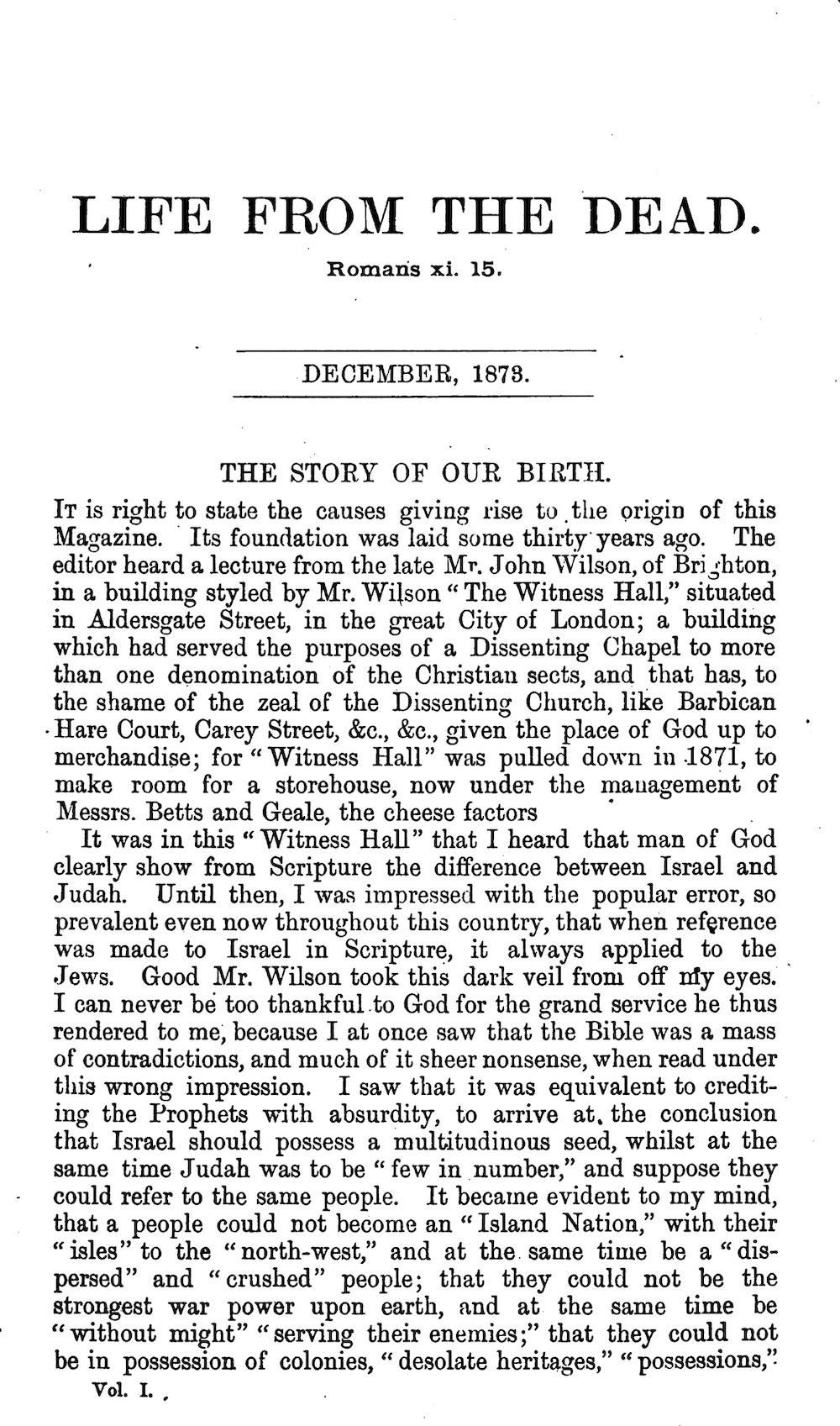
1/1, December 1873-1880. 52 pp., 4d. a month, 6s. a year. This was the journal of Edward Hine (1825-1891), who had founded the British-Israel Identity Corporation in 1880, and was devoted to reviving, correcting and elaborating on the British-Israel theories of John Wilson of an earlier generation. On Wilson see the notes under Time of the End and Watchman of Ephraim. The first issue recites Hine’s hearing a lecture by John Wilson when he was 15 and realizing the difference between Judah and the Jews and the Ten Lost Tribes of Israel and the implications for contemporary Britons. The title of the journal was taken from Romans 11:15: "For if their rejection is the reconciliation of the world, what will their acceptance be, but life from the dead?" Hine applied St. Paul’s words, not to the Jews who were rejecting Christ, but to the Ten Lost Tribes of Israel distributed in ignorance about the world whose descendants’ acceptance of this truth of their Israelite Identity would mark a national rebirth. The fundamental underlying impetus for Hine’s belief was that the British were obviously enjoying the divine blessings given to Judah/Israel that set the British Empire “high above all the nations of earth,” proving to him that the British/Anglo-Saxons were heirs of the Lost Tribes. In opposition to Wilson’s more ecumenical views, Hine consistently held that it was only the Anglo-Saxon Britons who were descended from Israel and shared God’s blessings, a view that largely did not prevail and resulted in the dominance of The Standard of Israel and The Banner of Israel and like-minded journals in the coming decades. Hine’s views were expressed in “Twenty-seven Reasons Why the Modern European Nations Cannot Be Part of Israel,” serialized in the journal, and in other articles. This exclusionary view would find greater acceptance in the Nativist version of Anglo-Israel that took root in the United States. See the notes under Destiny, Heir of the World, etc. Similarly, Hine’s insistence that the Lost Tribes were distributed by social classes among the British (Zebulon—>lawyers; Asher—>soldiers; Dan—>mariners; Reuben—>farmers; and Ephraim—>drunkards, although Hine found the characteristic widely distributed among the British) was universally rejected. See the note under Standard of Israel. The journal contained regular contributions by Rev. Glover, C. Piazzi Smyth (on the Great Pyramid), “Philo-Israel,” and many of the other leading lights of British-Israel at the time. On British-Israel generally, see the note under Banner of Israel. 1/1, December 1873-1880. 52 pp., 4d. a month, 6s. a year. This was the journal of Edward Hine (1825-1891), who had founded the British-Israel Identity Corporation in 1880, and was devoted to reviving, correcting and elaborating on the British-Israel theories of John Wilson of an earlier generation. On Wilson see the notes under Time of the End and Watchman of Ephraim. The first issue recites Hine’s hearing a lecture by John Wilson when he was 15 and realizing the difference between Judah and the Jews and the Ten Lost Tribes of Israel and the implications for contemporary Britons. The title of the journal was taken from Romans 11:15: "For if their rejection is the reconciliation of the world, what will their acceptance be, but life from the dead?" Hine applied St. Paul’s words, not to the Jews who were rejecting Christ, but to the Ten Lost Tribes of Israel distributed in ignorance about the world whose descendants’ acceptance of this truth of their Israelite Identity would mark a national rebirth. The fundamental underlying impetus for Hine’s belief was that the British were obviously enjoying the divine blessings given to Judah/Israel that set the British Empire “high above all the nations of earth,” proving to him that the British/Anglo-Saxons were heirs of the Lost Tribes. In opposition to Wilson’s more ecumenical views, Hine consistently held that it was only the Anglo-Saxon Britons who were descended from Israel and shared God’s blessings, a view that largely did not prevail and resulted in the dominance of The Standard of Israel and The Banner of Israel and like-minded journals in the coming decades. Hine’s views were expressed in “Twenty-seven Reasons Why the Modern European Nations Cannot Be Part of Israel,” serialized in the journal, and in other articles. This exclusionary view would find greater acceptance in the Nativist version of Anglo-Israel that took root in the United States. See the notes under Destiny, Heir of the World, etc. Similarly, Hine’s insistence that the Lost Tribes were distributed by social classes among the British (Zebulon—>lawyers; Asher—>soldiers; Dan—>mariners; Reuben—>farmers; and Ephraim—>drunkards, although Hine found the characteristic widely distributed among the British) was universally rejected. See the note under Standard of Israel. The journal contained regular contributions by Rev. Glover, C. Piazzi Smyth (on the Great Pyramid), “Philo-Israel,” and many of the other leading lights of British-Israel at the time. On British-Israel generally, see the note under Banner of Israel. Category: Anglo-Israel. |