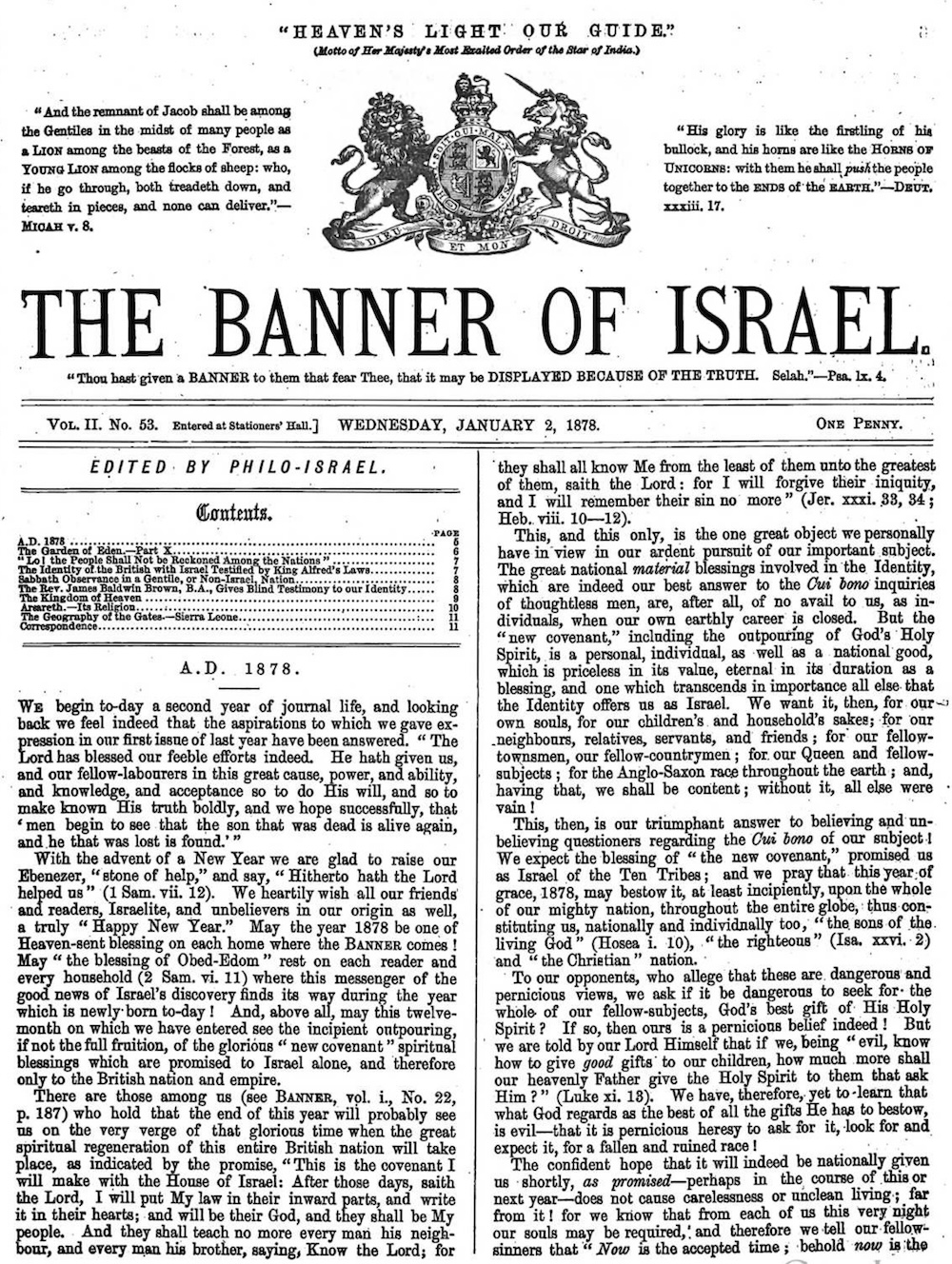
1/1, January 3, 1877-45/2348, December 25, 1921. 1d., 12 pp. This was the continuation of William Cookson’s Israel’s Identity Standard published in Liverpool after “Philo-Israel’ (Edward Wheeler Bird, 1823-1903) took over that journal and left the accumulated debt to Cookson. Cookson. See the note under that journal. The new National Message, the organ of the British-Israel World Federation, was started in 1922 and by 1923 was calling itself The National Message and Banner, a name that that continued into the 1930s although this journal under its original name was still being published independently at least until the end of 1924 and the formal merger of the two probably occurred in 1926. “Philo-Israel” (Ezra Wheeler Bird, 1823-1903) was the editor of the journal for its first 27 years. He was an Anglo-Indian judge who was converted to British-Israelitism by reading Edward Hine’s Forty-seven Identifications of the Lost ten Tribes of Israel (1874) but came to disagree with Hine over whether the heritage of Israel extended to the wider Teutonic/Germanic peoples of Northern Europe. Like John Wilson, Bird believed that the blood of Israel was spread widely among this larger class although the Anglo-Saxons of course held a predominant place. This journal, together with The Standard of Israel, the other prominent British-Israel journal of the early period, advocated that position, which became the prevailing view and more easily led to the incorporation into the heritage of Israel the Scots, Welsh, Irish, the Scythians and all Northern European peoples. Bird regarded the Germans, specifically, as descendants of Israel, unlike Hine who saw them as Assyrians—an important political point at the time, especially while Victoria was queen.
The formal origin of what would become British- or Anglo-Israel began with Our Israelitish Origin (1840) by John Wilson (1799-1870), but its foundations lay in the traditional European peoples’ creative search for exalted origins, and in mythology and the prophetic and millenarian visions revolving around the Ten Lost Tribes of Israel led into captivity in 722 B.C. and the return and the restoration of Israel coincident with the reintroduction of the Jews to England in the seventeenth century. Almost all European peoples in the Middle Ages sought to find a pedigree in some exalted people of what passed for history. The British chose Brutus, a grandson or great grandson of Aeneas of Troy, and the Scots, not to be outdone, chose Scota, daughter of an Egyptian pharaoh, and the Scythians, whom later tradition equated with the Ten Lost Tribes of Israel. The Irish one-upped them both by claiming descent from Noah through Japheth and also from Tea Tephi, the daughter of King Zedekiah, who had been brought by the Prophet Jeremiah to Ireland. This tendency was supplemented with rabbinic speculation in the 1650s and later on the restoration of the lost tribes to Palestine and by the visions of Richard Brothers (1757–1824) in the eighteenth century. Brothers, an English prophet, proclaimed in the 1790s that a “hidden Israel” existed among the British and Northern Europeans who were unaware (until he enlightened them) of their descent from the Ten Lost Tribes of Israel and that he was the divinely appointed “Prince of the Hebrews and Nephew of the Almighty” who would restore the Jews and Israel to the Holy Land. These prognostications had no immediate effect on the rise of the British-Israel (Edward Hine said he had never heard of Brothers until he had already begun publishing his works), but after the fact they were incorporated into the movement. To all this was added the early nineteenth-century revival of interest in Welsh, Irish and Scottish Druidism which, as some were quick to claim, was but a degenerate form of Israelite, especially Levitical, beliefs.
At the remove of a century and a half, British-Israel, not in its political and popular aspects, can be seen as the work of learned antiquarians who debated abstruse points in the pages of its journals. It was a word game largely played by idle and isolated Church of England curates, canons and vicars and retired Indian Army officers with time on their hands and a bent towards antiquarianism, who indited leisured essays distributed as pamphlets or published articles in the movement’s periodicals. The game had a high cost of entry in terms of knowledge, especially Biblical, linguistic and historical knowledge. This was an era when the sources available to understand ancient history were largely limited to the Bible (and specifically in the case of British-Israel to the King James version of the Bible) and to the Roman and Greek classics and compilations of mythology and story, together with the works of medieval chroniclers and the scattered remnants of Scottish, Irish, Breton and Welsh bardic histories for those who could read them. Research consisted in dubious etymologies (“Saxon” = “Isaac’s sons” and “British”= berith-ish, “Covenant Man,” etc.) and the the hopeful creations of cognate identities—Dan=Danaoi (the Homeric Greeks)=Danaan (the Irish, as in Tuatha dé Danaan)=the Danes, etc.—and the compilation of trails through history from Israel to the Phoenicians to the Greeks to the Scythians, etc., to Britain, and the interdigitating of vast lists of obscure genealogies.
Early on, this olla podrida became intermixed with the numerical speculations surrounding the Book of Daniel and the Great Pyramid. John Wilson’s Our Israelitish Origin exhausted Daniel’s number speculation to identify his age as the age for the re-appearance of the Lost Tribes and their promised dominance. Pyramidology and Anglo-Israel arose at the same time and intermingled because of Charles Piazzi Smyth’s “pyramid inch” which it was claimed was almost exactly the same as the traditional British inch, proving the latter’s derivation from the former! Smyth (1819-1900) was an astronomer and remembered today for his Our Inheritance in the Great Pyramid (1864) which advanced the “pyramid inch” theory and buttressed it with the claim that the pyramid was built as a source of prophecy by Noah and Melchizedek under divine inspiration. John Wilson and Piazzi Smyth lectured together across Britain from the 1840s about their theories, and Smyth in the 1870s regularly contributed to Edward Hine’s two periodicals: Life from the Dead (1873-1880) and Leading the Nation to Glory/Nation’s Glory Leader (1875-1880) and to other British-Israel publications. To this was added the conclusions of a student of Smyth’s that the numbers of “pyramid inches” in the measurements of various dimensions of the Great Pyramid amounted to the number of years from the construction of the pyramid to specific historical events, notably to the Victorian era and its zenith in the reign of Victoria (of the bloodline of King David through King Zedekiah of Judah’s daughter Tea Tephi) and to the British Empire as the beneficiary of Jacob’s promises that Ephraim (the British) would become “a multitude of nations” and Manasseh (the United States) a great people.
Probably none of these ideas would have been advanced, and certainly none would have been adopted by vast numbers of the British from the 1870s on had the British Empire not been riding the crest of world domination at the time, a phenomenon that many were quick to emphasize coincided exactly with the Biblical promises to Israel: material wealth and territory, “multitudes as the sand of the sea,” “a nation and a company of nations,” “possession of the gate of his enemies” (the Suez Canal, Gibraltar, Malta, Cyprus, Hong Kong and the Cape of Good Hope), etc., and a queen descended from King David and crowned on the Stone of Destiny. This coincidence of expectation and history that led to the rise of British-Israel also led to its demise after the First World War.
Major divisions always persisted in British-Israel. John Wilson, who originated the movement and had edited Time of the End and Watchman of Ephrain, believed that all the continental nations of Northern Europe were descendants of the Lost tribes, although, of course, the Anglo-Saxons enjoyed a privileged position. Edward Hine, editor of Life from the Dead and Leading the Nation to Glory by Our Identification with Israel limited the descendants of the Lost Tribes to the British and specifically the Anglo-Saxons) on the common-sense basis that, after all, the British were obviously enjoying the promised divine blessings that set the British Empire “high above all the nations of earth.” Hine also speculated that the Ten Lost Tribes of Israel were distributed among the British by social classes and characteristics (Ephraim was the drunkards; Asher the soldiers; Dan the mariners; Reuben the farmers, etc.), a view that attracted no following. All adherents of British-Israel engaged in internecine debates over whether the Germans properly counted as Israelites or should be classed with the Assyrians (as Hine believed), and over what was to be done with the Catholic Home-Rule Irish. Some were willing to concede that the Tuatha Dé Danaan might be the Tribe of Dan, and most agreed that the inheritance of Judah and King David might be found in Princess Tephi who was buried on Tara’s Hill (which “Philo-Israel” (Edward Wheler Bird) later paid to excavate, looking for the Lost Ark and the Stone of Destiny/Jacob’s Pillow), but the majority of those in British-Israel only grudgingly brought themselves to accept that the Irish might share the inheritance of Israel, perhaps through the Scythians. Edward Hine, for example, thought the Irish to be Canaanites and thus doomed to destruction, while “Philo-Israel” partially shared that view but thought that the Israelite heritage was preserved in Ireland among the Protestant population, especially in Ulster.
Another major source of division was contemporary Jews. The British had always had strong elements of philo-semitism (Lord George Gordon, for example, and the English Puritans and Fifth Monarchists) and early British-Israel shared that tendency and accepted the Jews (the two tribes of Israel that had not been carried into captivity) as heirs with Israel (the Ten Lost Tribes) of the Abrahamic promises of God. Over time the movement trended increasingly towards a position that diminished the role of the Jews as equal heirs and exalted the Israelites as the real heirs. In the United States especially, in journals like Howard B. Rand’s Destiny, the Jews came to be thought of as Canaanites or Edomites or Khazars and not descended from Judah and thus excluded from the blessings God had promised Israel. In the later “Christian Identity” version of Anglo-Israel, modern Jews came to be seen as descendants of Cain and offspring of Satan, while Jesus became an Anglo-Saxon.
British-Israel as a movement declined as the British Empire was diminished, and after about 1920 its journals became merely epigenous shills for an empire in decline and a refuge for those elites who shared knowledge of the secret, hidden side of history. This last was an element shared with occultism, and some occultists, like John Alexander Dowie (1847-1907), Maria de Mariátegui, Lady Caithness (1830-1895) and Walter Gornold (Sepharial, 1864–1929) explicitly aligned with the movement, while many others, like Reuben Swinburne Clymer, Hiram E. Butler, Cyrus Teen and others, incorporated fundamental elements of the movement while, perhaps, shifting the identities of the True Israel to suit their own ideas. Phrenology also was common among British-Israel believers: John Wilson was a professional phrenologist and with Edward Hine, A.B. Grimaldi (editor of The Standard of Israel) and others used the phrenological shapes of British and Israelite skulls to argue their common origin.
Category: Anglo-Israel.
List of British-Israel and Anglo-Israel journals and journals with a significant admixture of their beliefs.
||||iapsop|
Time of the End, The|Islington, England|1843|1845||
Watchman of Ephraim, The|Brighton, England|1866|1868||
Life from the Dead|London, England|1873|1880|Yes|
Leading the Nation to Glory by Our Identification with Israel|London, England|1875|1875||
Nation’s Glory Leader|London, England|1875|1880|Yes|
Standard of Israel and Journal of the Anglo-Israel Association, The|London, England|1875|1878|Yes|
Israel’s Identity Standard|Liverpool, England|1876|1877||
Banner of Israel|London, England|1877|1926|Yes|
Anglo-Israel Almanack and Diary and British-Israelites’ Companion, The|London, England|1880|1914||
Heir of the World, The|New York, NY|1880|||
Jehovah Rophi|Melbourne, Australia|1880|||
The British-Israel and Judah’s Prophetic Messenger and Universal News|London, England|1880|1883||
Messenger|London, England|1883|1886||
British Israelite||1885|1891||
Leaves of Healing|Christchurch, N.Z.|1888|||
Our Race|New Haven, CT|1890|1900|Yes|
Our Race News-Leaflet, The|New Haven, CN|1893|1907|Yes|
Covenant People, The|London, England|1894|1922|Yes|
Leaves of Healing|Chicago, IL|1894|1996|Yes|
Voice from Zion, A|Chicago, IL|1897|1906||
Blätter der Heilung|Chicago, IL|1899|1905||
Psychic Century, The|Topeka, KS|1901|1901|Yes|
Zion Banner, The|Zion City, IL|1901|1906|Yes|
British Israel Truth|London, England|1906|||
Our Race Quarterly|New Haven, CT, Haverhill, MA|1909|1917||
Northern British-Israel Review|Kilcreggan, Scotland|1910|1916||
Watchman of Israel, The|Boston, MA|1918|1921||
National Message, The|London, England|1922|1981||
British-Israel Herald, The|London, England|1924|1931|Yes|
Kingdom Message, The|Detroit, MI|1930|||
Messenger of the Covenant, The|Haverhill, MA|1930|1935||
Prophetic Herald, The|Portland, OR|1930|1970||
Beacon Light|Atascadero, CA|1933|1960|Yes|
America-Israel Message|Washington, DC|1934|1936||
The Plain Truth|Eugene, OR then in 1947, Pasadena, CA|1934|1986||
Destiny|Haverhill then Merrimac, MA|1935|1969|Yes|
Sunshine News|Minneapolis, MN|1935|1965||
Modern Mystic and Monthly Science Review, The|London, England|1937|1948|Yes|
Reminder of our National Heritage, The|Portland, OR|1937|1964||
Anglo-Saxon World|Vancover, BC, Canada|1938|1957|Yes|
Kingdom Digest|Forth Worth, Dallas, TX|1939|1951||
Malist, The|Meriden, CN|1942|1960||
Showers of Blessing|Denver, CO|1957|||
Truth and Liberty Magazine|Hopkins, MN|1957|1975||
Straight|Kannapolis, NC|1962|||
Kingdom Empire, The|Wellington, New Zealand|1964|1987||
Zion’s Restorer|Schell City, MO|1970|1975||
Milk and Meat|Fallbrook, CA|1973|1975||
Present Truth, The|Coolidge, AZ|1973|||
Link, The|London, England|1977|||
Message|London, England|1981|1981||
Crown and Commonwealth|London, England|2001|2005||