
| Periodical: | |
|
|
|
From Pat Deveney's database:
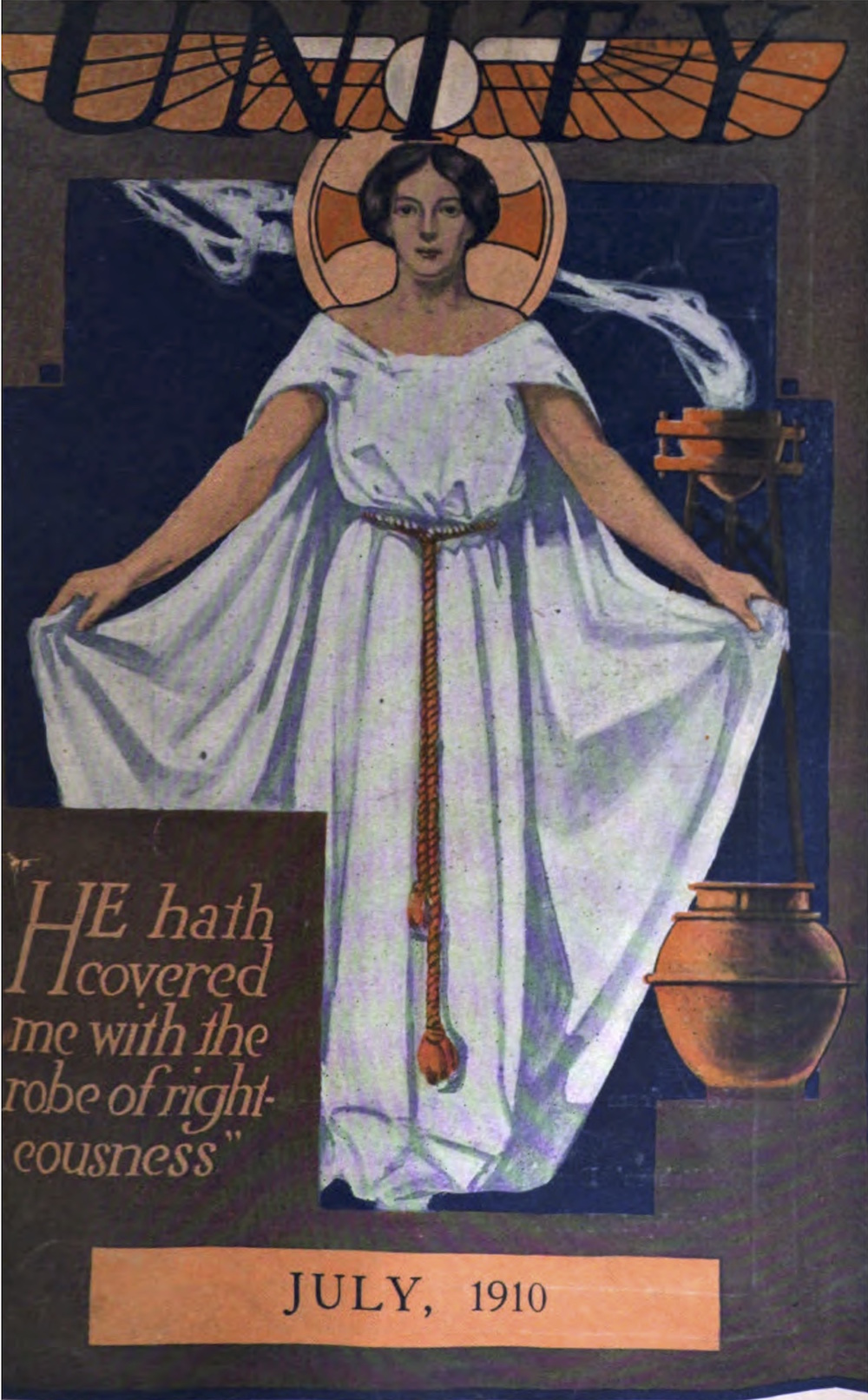
Unity. This is one of the fundamentally important New Thought journals. It was originally published June-December, 1891 as a cheaper companion to Modern Thought, devoted to Silent Unity. It was then discontinued until re-started in 1895 to absorb Modern Thought and its successors, assuming the latter journal's volume numbering. This is the longest-lived New Thought journal. J.W. Teener's dissertation on "The Unity School of Christianity" (University of Chicago, 1939) says that it reached a circulation of 148,000 by 1928, and then fell steadily thereafter. The winged globe that appeared on the cover of the journal from the first issue was taken by Charles Fillmore from F.B. Dowd's Temple of the Rosy Cross (1882; 2d ed. 1888). The journal was strongly Christian and Biblical in its presentation but rested on the fundamental propositions that God is good and within each of us and desires to assist if asked. The journal regularly carried page-sized notices in bold colors with aspirations, inspiring thoughts, suggestions to the inner self, and the like, to be placed prominently about the home. Although the journal had contributions by Horatio W. Dresser, H. Emilie Cady, Annie Rix Militz, Walter de Voe, and others, it was largely written by Fillmore and the graduates and ordained ministers of Unity. In his later years, in connection with his views on the role of sexuality in spiritual and psychical development (the "regenerate life"), Fillmore came to espouse the idea of physical immortality. The journal advertised extensively for Fillmore's books, pamphlets and courses, but managed to avoid the commercialism that affected most contemporary journals. For Fillmore and his ideas, see the note under Modern Thought. See also the notes under , Wee Wisdom, Daily Word. NYPL; Unity School of Christianity; Kansas City Public Library.
Modern Thought. The first issue proclaimed its intent to mail 10,000 copies of the second number. This was the beginning of Unity (The Unity School of Practical Christianity / Unity School of Christianity), which has endured until the present. It was founded by Charles Fillmore (1854-1948) and his wife, Myrtle Page Fillmore ( -1931). The Fillmores were adherents of the optimistic, energetic school of New Thought, but in their beginnings were closer to the "metaphysical healing" ideas of Christian Science although they were never students or adherents of Mary Baker Eddy. Their initiation into New Thought came through Emma Curtis Hopkins' Christian Science Theological Seminary in Chicago. Horatio Dresser, in his history of New Thought, lists the Fillmores, along with Eddy, among the "subjective idealists" who taught that the mind was the only reality. The journal in its early days, like many of its contemporaries, displayed the influence of spiritualism. Theosophy, and occultism--featuring in its first year an article by Freeman B. Dowd, and adopting for its masthead Dowd's (and P.B. Randolph's) emblem of the winged globe. The issue also carried Hiram Erastus Butler's article on "Developing Psychic Powers." It is often said that W.W. Atkinson published his first work in the journal but the claim is wrong. The Unity School of Christianity published Christian Science Thought-->Thought-->Unity; Wee Wisdom; ; Christian Business Man-->Business Man-->Good Business-->New; Youth-->Progress-->You-->Progress; Daily Word; and Unity School Leaflets. The Fillmores' work and journals were astonishingly influential, and many of their enterprises (publishing and book distribution, Unity Farm, Unity School, the Unity Farm, etc.) endure today.
|
|
| Unity Library and Archive, Unity Village, MO. | |
| Unity V12 1899 Jul-1900 Dec | |
| Unity V13 1900 Jul-Dec | |
| Unity V14 1901 Jan Jun | |
| Unity V16 1902 Jan-Jun | |
| Unity V17 1902 Jul-Dec | |
| Unity V18 1903 Jan-Jun | |
| Unity V19 N1 1903 Jul | |
| Unity V20 1904 Jan-Jun | |
| Unity V21 1904 Jul-Dec | |
| Unity V22 1905 Jan-Jun | |
| Unity V23 1905 Jul-Dec | |
| Unity V24 1906 Jan-Jun | |
| Unity V25 1906 Jul-Dec | |
| Unity V26 1907 Jan-Jun | |
| Unity V27 1907 Jul-Dec | |
| Unity V28 1908 Jan-Dec | |
| Unity V29 1908 Jul-Dec | |
| Unity V30 1909 Jan Jun | |
| Unity V31 1909 Jul-Dec | |
| Unity V32 1910 Jan-Jun | |
| Unity V33 1910 Jul-Dec | |
| Unity V35 1911 Jul-Dec | |
| Unity V36 1912 Jan-Jun | |
| Unity V37 1912 Jul-Dec | |
| Unity V38 1913 Jan-Jun | |
| Unity V39 1913 Jul-Dec | |
| Unity V39 1914 Jan-Jun | |
| Unity V41 1914 Jul-Dec | |
| Unity V42 1915 Jan-Jun | |
| Unity V43 1915 Jul-Dec | |
| Unity V44 1916 Jan-Jun | |
| Unity V45 1916 Jul-Dec | |
| Unity V46 1917 Jan-Jun | |
| Unity V47 1917 Jul-Dec | |
| Unity V48 1918 Jan-Jun | |
| Unity V49 1918 Jul-Dec | |
| Unity V50 1919 Jan-Jun | |
| Unity V51 1919 Jul-Dec | |
| Unity V52 1920 Jan-Jun | |
| Unity V53 1920 Jul-Dec |
|
|