
International Association for the Preservation of Spiritualist and Occult Periodicals


Periodical: U.L.T.

Summary:  From Pat Deveney's database:

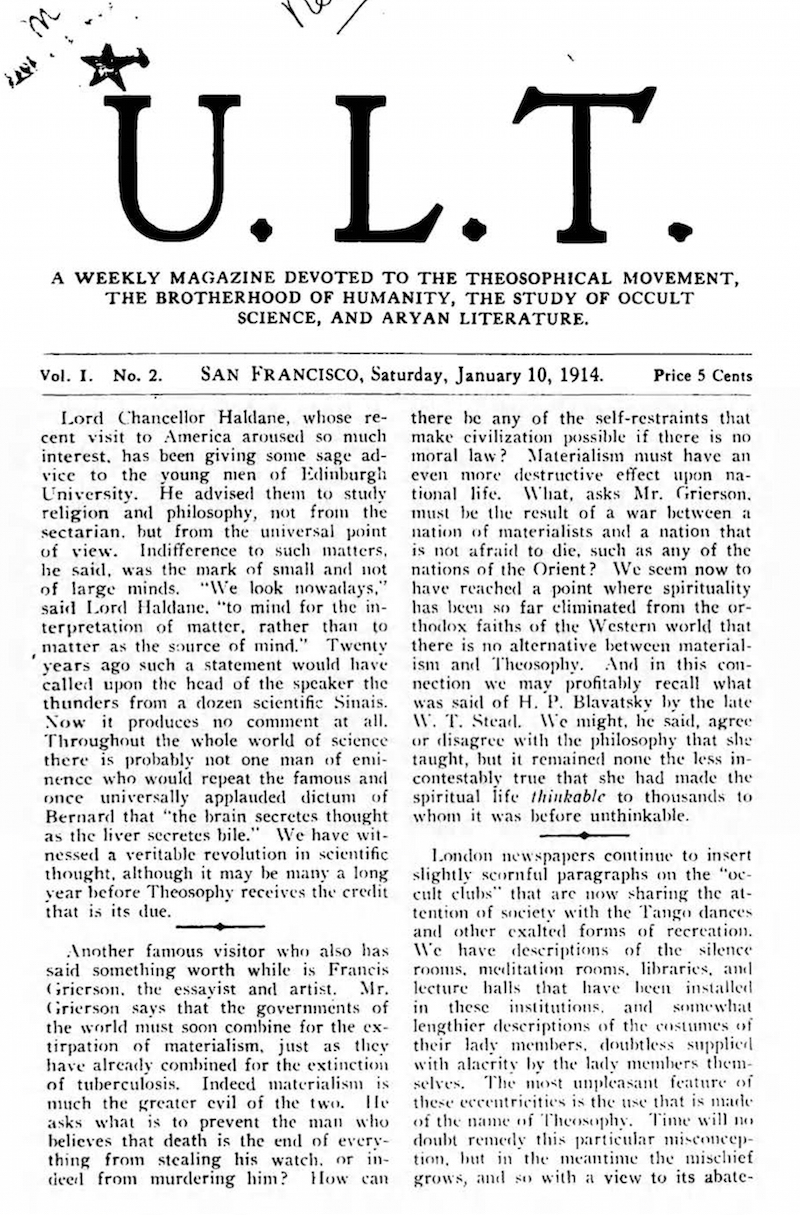
U.L.T.
A Weekly Magazine Devoted to the Theosophical Movement, the Brotherhood of Humanity, the Study of Occult Science, and Aryan Literature.
1912 Weekly
Los Angeles, then San Francisco, CA. Language: English.
Publisher: United Lodge of Theosophists.
1/1, November 1912.

The journal was originally started in Los Angeles in 1912. With the move to San Francisco, the journal was restarted with volume 1, number 1, on January 3, 1914. 8 pp., 5 cents an issue. The U.L.T. was the work of Robert Crosbie (1849-1919), a Theosophist who had followed Katherine A. Tingley in the split of Theosophy after the death of W.Q. Judge. He in turn broke with Tingley over what he felt was the cult of personality in her group and her ignoring or deviating from what he felt were the original teachings of H.B. Blavatsky. In 1909 he started the U.L.T., emphasizing the importance of anonymity in spreading word about Theosophy—characteristic that is apparent in this journal. Related journals of the same name, distinguished only by the addition of their place of publication—New York U.L.T., San Diego U.L.T., Philadelphia U.L.T., etc.—were published by the lodge.

Other Sources:LOC; Los Angeles Public Library; Metropolitan Cooperative Library System; University of California, San Diego.
Issues:U.L.T. V1 1914
U.L.T. V2 1914
U.L.T. V3 1915
U.L.T. V4 1915
Claude-Generated Themes:   U.L.T. was the weekly magazine of the United Lodge of Theosophists, launched in San Francisco in January 1914 and 'devoted to the Theosophical Movement, the Brotherhood of Humanity, the study of Occult Science, and Aryan Literature.' Written to present Theosophy 'in its simplest form for the benefit of those still unacquainted' with it, the paper is a pure house organ of the Blavatsky–Judge current, expounding the classic Theosophical program: universal brotherhood, occult science, karma and reincarnation, and the comparative study of Indic ('Aryan') source-texts. Its incidental language of spirit-control, subconscious success, and psychic faculties belongs to Theosophical doctrine rather than to the spiritualist or New Thought movements the term-panel superficially flags. It stands alongside the ULT's later monthly, Theosophy, as an early expression of the same lodge's teaching mission.

Generated by Claude from the periodical's digitized text; a thematic reading, not a bibliographic description.
Topics:Occult Science and Esoteric Philosophy | Theosophy