
| Periodical: | |
|
|
|
From Pat Deveney's database:
Two Worlds, The. With the issue of
|
|
| BL. | |
| Two Worlds V1 N1 Oct 2 1858 | |
| Two Worlds V1 N2 Oct 7 1858 | |
| Two Worlds V1 N3 Oct 14 1858 | |
| Two Worlds V1 N4 Oct 21 1858 | |
| Two Worlds V1 N5 Oct 28 1858 | |
| Two Worlds V1 N6 Nov 4 1858 | |
| Two Worlds V1 N7 Nov 11 1858 | |
| Two Worlds V1 N8 Nov 18 1858 | |
| Two Worlds V1 N9 Nov 25 1858 | |
| Two Worlds V1 N10 Dec 2 1858 | |
| Two Worlds V1 N11 Dec 11 1858 | |
| Two Worlds V1 N12 Dec 18 1858 | |
| Two Worlds V1 N13 Dec 28 1858 | |
| Two Worlds V1 N14 Jan 4 1859 | |
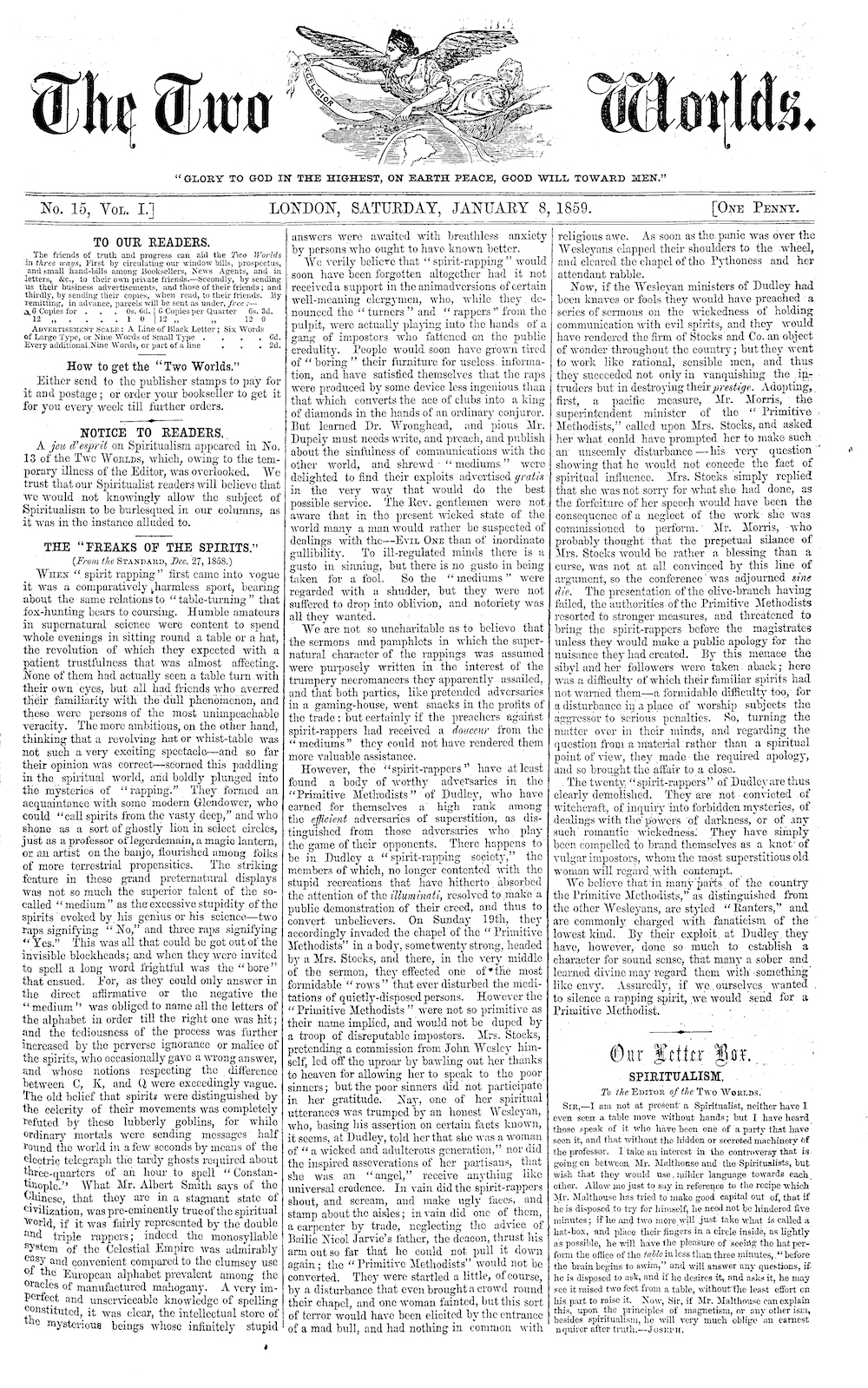
| Two Worlds V1 N15 Jan 8 1859 | |
| Two Worlds V1 N16 Jan 15 1859 | |
| Two Worlds V1 N17 Jan 22 1859 | |
| Two Worlds V1 N18 Jan 29 1859 | |
| Two Worlds V1 N19 Feb 5 1859 | |
| Two Worlds V1 N20 Feb 12 1859 | |
| Two Worlds V1 N21 Feb 19 1859 | |
| Two Worlds V1 N22 Feb 26 1859 | |
| Two Worlds V1 N23 Mar 15 1859 | |
| Two Worlds V1 N24 Apr 1 1859 | |
| Two Worlds V1 N25 Apr 15 1859 | |
| Two Worlds V1 N26 May 2 1859 | |
| Two Worlds V1 N27 May 28 1859 | |
|
Read across 1858–1859, The Two Worlds (Dixon) is a founding-era American Spiritualist paper — mediumship, spirit-rapping and communion with the dead at its center, braided with the era's mesmerism, phrenology and magnetic healing. It shows the young movement still carrying its mesmero-phrenological inheritance openly. Founding-era Spiritualism, not mesmerism proper. Generated by Claude from the periodical's digitized text; a thematic reading, not a bibliographic description. |
|
| Health Reform and Alternative Medicine | Mesmerism and Animal Magnetism | Spiritualism |
|
|