
| Periodical: | |
|
|
|
From Pat Deveney's database:
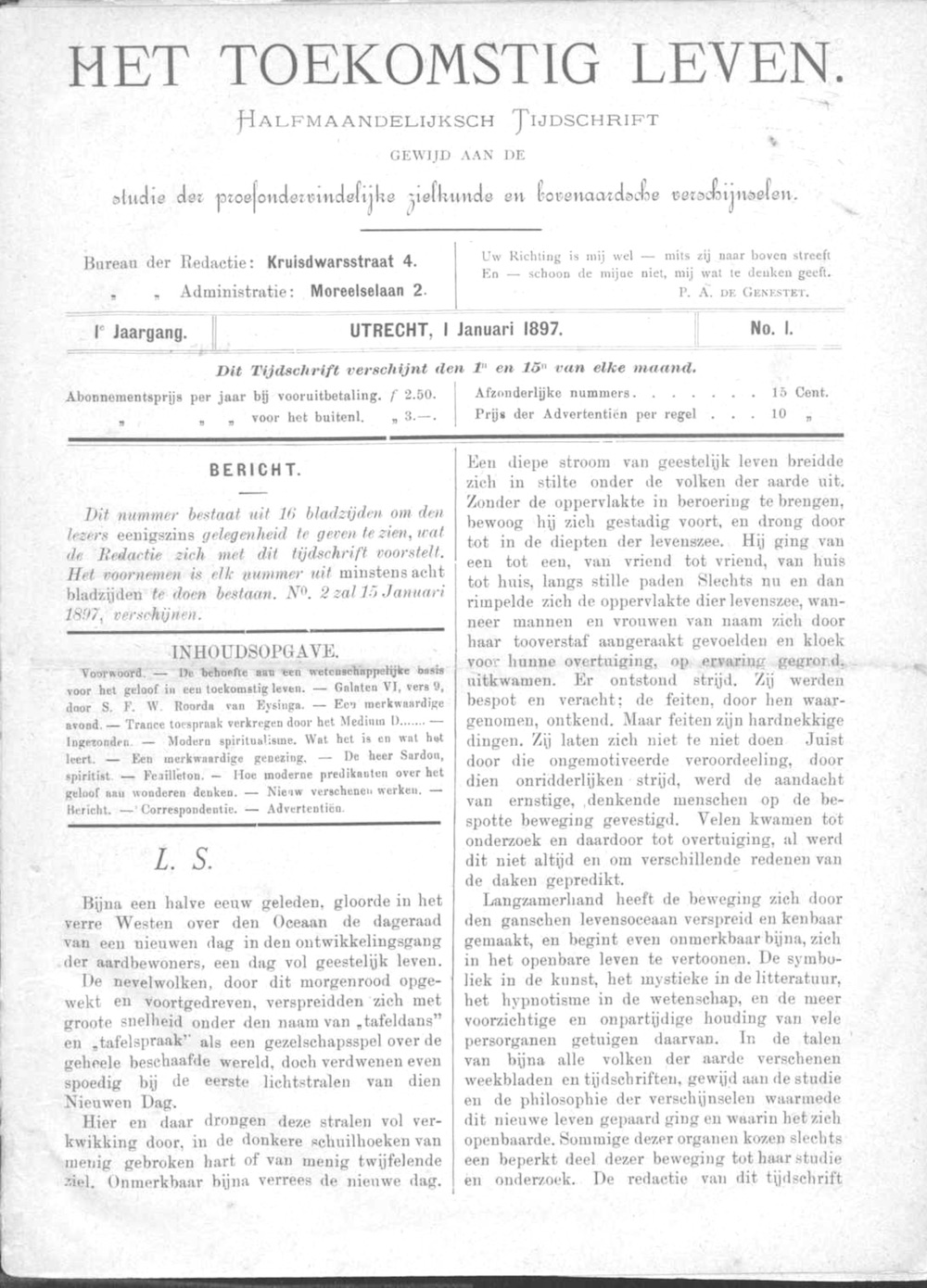
Toekomstig Leven, Het. This was not the first Dutch spiritualist journal, being preceded notably by
|
|
| Toekomistig Leven V1 N1 Jan 1 1897 | |
| Toekomistig Leven V45 N8 Aug 1941 | |
| Toekomistig Leven V45 N9 Sep 1941 | |
|
Het Toekomstig Leven (The Future Life) was a Dutch spiritualist periodical whose title states its brief: what survives death, and how the living may hear from the departed. Its pages are given over to mediums and séances, spirit controls and messages from those who have died, the classic apparatus of nineteenth-century spiritualism. Underneath runs an older magnetic layer that the movement never quite shed — somnambulists, magnetisers, clairvoyance and healing magnetism — shading into a trance-and-suggestion vocabulary at the edge of early hypnotism. Its 'spiritisme' carries a faint continental, possibly Kardecian colour, though in Dutch the word simply means spiritualism. The whole is survival-focused mediumship resting on an animal-magnetism substrate. Generated by Claude from the periodical's digitized text; a thematic reading, not a bibliographic description. |
|
| Psychical Research and Parapsychology | Spiritism (Kardecist) | Spiritualism | Survival After Death and Immortality |
|
|