
International Association for the Preservation of Spiritualist and Occult Periodicals


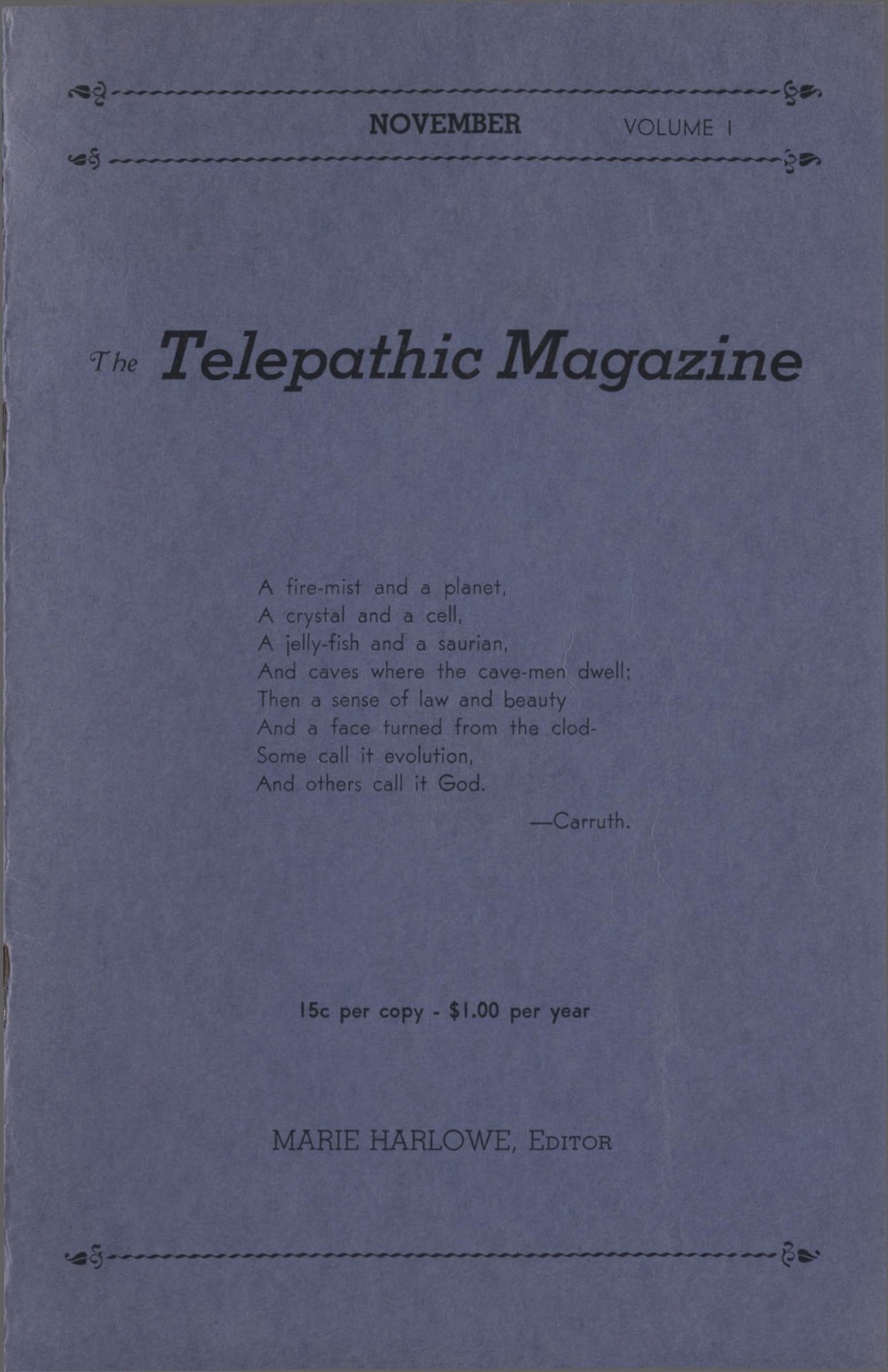
Periodical: The Telepathic Magazine (Chicago)

Summary: From Pat Deveney's journal database:

Telepathic Magazine, The.
1937—1939 Monthly
Chicago, IL(?).
Language: English.
Editor: Marie Harlowe.
Publisher: Maha Publishing Company.
Succeeds: The Occult Digest
Succeeded by: The Occult Digest
1/1, November 1937-1939.
15 cents a copy, $1.00 a year, 8-10 pp.

The journal said that it was "dedicated to telepathy in its widest sense as the mode of communication without limitation of time or space throughout all the interpenetrating realms of Being," but consisted in long discourses by Harlowe on "religion and science," occult thoughts on Christmas, etc., with contributions on the "electrical principle of life" by Dr. George Crile and verse by Ella Wheeler Wilcox. A significant part of the journal was devoted to advertising "The Moon's Sign Book" and its companion "Working Plans Book" which taught the secrets of "Plans" in Gardening, Poultry, and Business and other matters of interest ("How to make hair grow more luxuriantly by use of Moon's signs and phases. An inexpensive and effective method used by many readers.").

The journal absorbed the Occult Digest in late 1929 after Harlowe ("Maha") assumed control of that journal but the title of the merged journal remained Occult Digest. On Harlowe see the note under that journal.

Other Sources:
Issues:Telepathic Magazine Nov 1937
Claude-Generated Themes:   The Telepathic Magazine was an early-twentieth-century Chicago organ of New Thought and mental science, built around telepathy and the era's fascination with 'vibration' as a bridge between science and religion. Its writers hold that God is disclosed rather than dissolved by microscope and telescope, that a purely physical science leaves an unfilled 'void', and that an 'ancient storehouse of wisdom' anticipated modern law in the doctrine of reproduction through vibration — a claim it happily paired with Marie Corelli's 'Electrical Principle of Christianity.' Its dominant idiom is New Thought's language of success, affirmation, and prosperity, with a standing horoscope department and an occult-wisdom coloring around the edges. Thought-transference gives it its name and its psychical-research adjacency, but the register throughout is popular mental-science self-culture rather than laboratory parapsychology.

Generated by Claude from the periodical's digitized text; a thematic reading, not a bibliographic description.
Topics:Psychical Research and Parapsychology