
International Association for the Preservation of Spiritualist and Occult Periodicals


Periodical: El Siglo Espirita

Summary: From Pat Deveney's database:

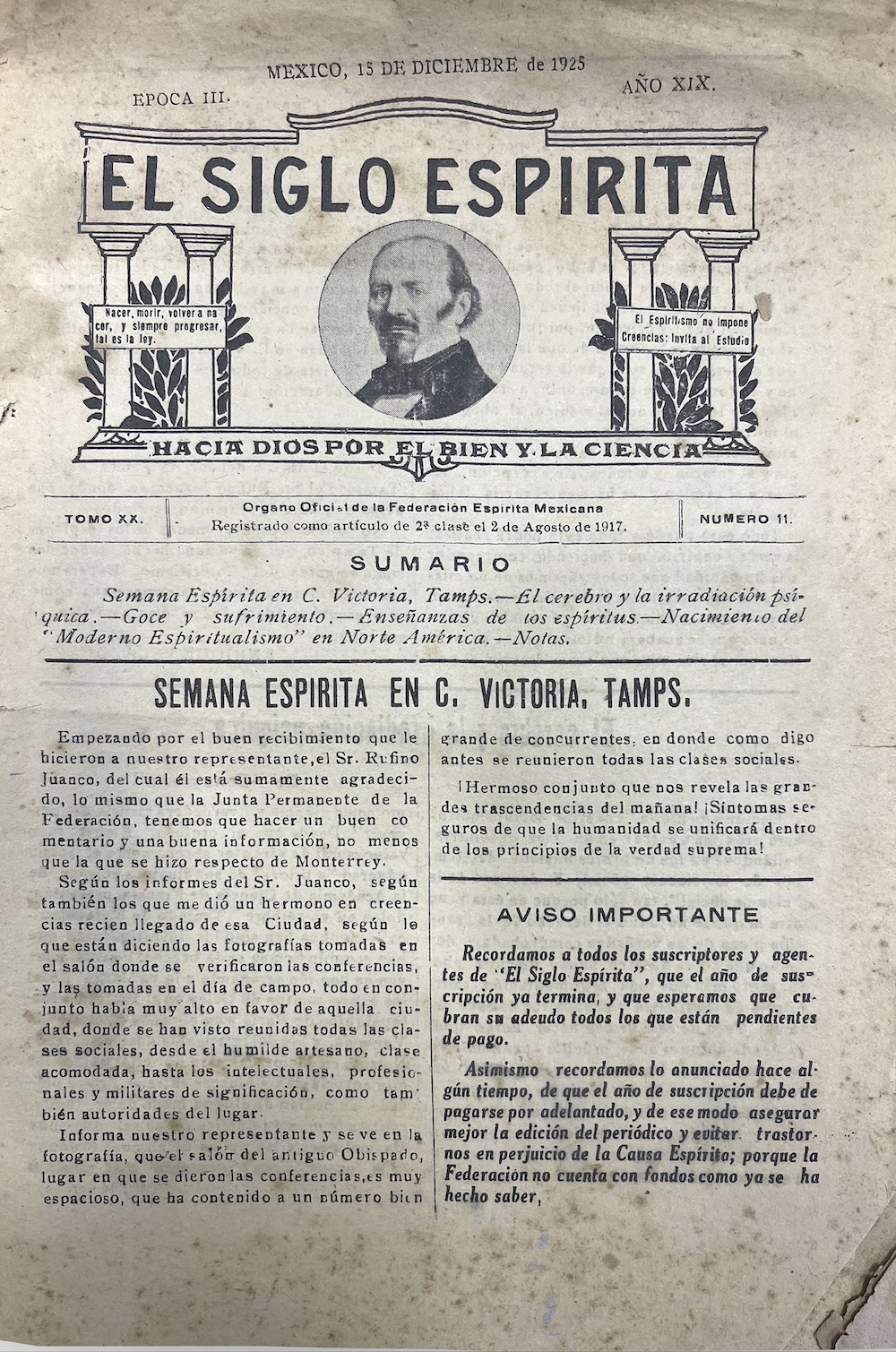
Siglo Espirita, El.
Organo de la Junta Central Permanente del Primer Congreso Nacional Espirita y de la Confederacion- Espirita Mexicana [y de la Federacion y Confederacion Espiritas Mexicana y Latino Americano].
19061950s? Bimonthly, monthly
Mexico, D.F., Mexico.
Language: Spanish.
Editor: Antonio Becerra y Castro, director; Enrique Velasquez; Antonio Becerra y Castro; Jose Salvadores Botas, editors.
Succeeded by: Helios (1911-1916) —> Siglo Espirita
1/1, 1906-April 30, 1911.
8 pp.

The journal began as the organ of the Junta Central Permanente of the first Mexican spiritualist congress. In 1911 the journal began monthly publication under the name Helios, as the organ of the second Mexican spiritualist congress of 1908, with Velasquez as the first editor. From August 1909 to September 1910 the journal published in installments El heraldo_ultratumba, Alma y sus Manifestaciones by Alex Blunck, and was publishing another book in installments when, in 1911, it changed its name to Helios. At some point, perhaps after the demise of Helios in 1916, the journal reappeared as a third series that preserved the volume numbering of the original, again under the editorship of Enrique Velazques. This third series is presents a version of spiritualism far closer to the original Kardecist approach and more removed from the broader, occult approach of the original journal. Noted in Emeterio Tellez, Bibliografia Filosofica Mexicana, vol. 2 (1913); Humilidade, 1907; La Evolucion (Barcelona), 1911, as changing its name to Helios; and in Hartmann’s Who’s Who, 1925.

Other Sources:University of Texas, Austin.
Issues:Siglo Espirita 1S V1 N4 May 1906
Siglo Espirita 3S V19 N25 UNKNOWN 1925
Siglo Espirita 3S V20 N11 Dec 15 1925
Claude-Generated Themes:   Siglo Espírita — the Spiritist Century — is a Spanish-language Kardecist review, and it wears its doctrine on its masthead and repeats it inside: there is but one spiritism. What makes the identification certain is a single word that recurs through its pages in half a dozen spellings, the perispirit, Allan Kardec's term for the semi-material envelope that clothes the soul between lives and belongs to no other teaching. Kardec is named, and so is the disembodied state, in the movement's own vocabulary. Its register is that of the Latin spiritist press at its most earnest — spiritism as the light we hide and deny, as the collective labour of the spirit unfolding, as the progressive action of the thought of the First Cause in the universe — and its working subjects are mediumship and materialization, extended by the period's habit of imagining the exteriorization of spirit as a kind of vibratory radio-wave. Reincarnation supplies the ethical structure. It belongs squarely to the Iberian and Latin American spiritist press.

Generated by Claude from the periodical's digitized text; a thematic reading, not a bibliographic description.
Topics:Spiritism (Kardecist) | Spiritualism