
| Periodical: | |
|
|
|
|
From Pat Deveney's database:
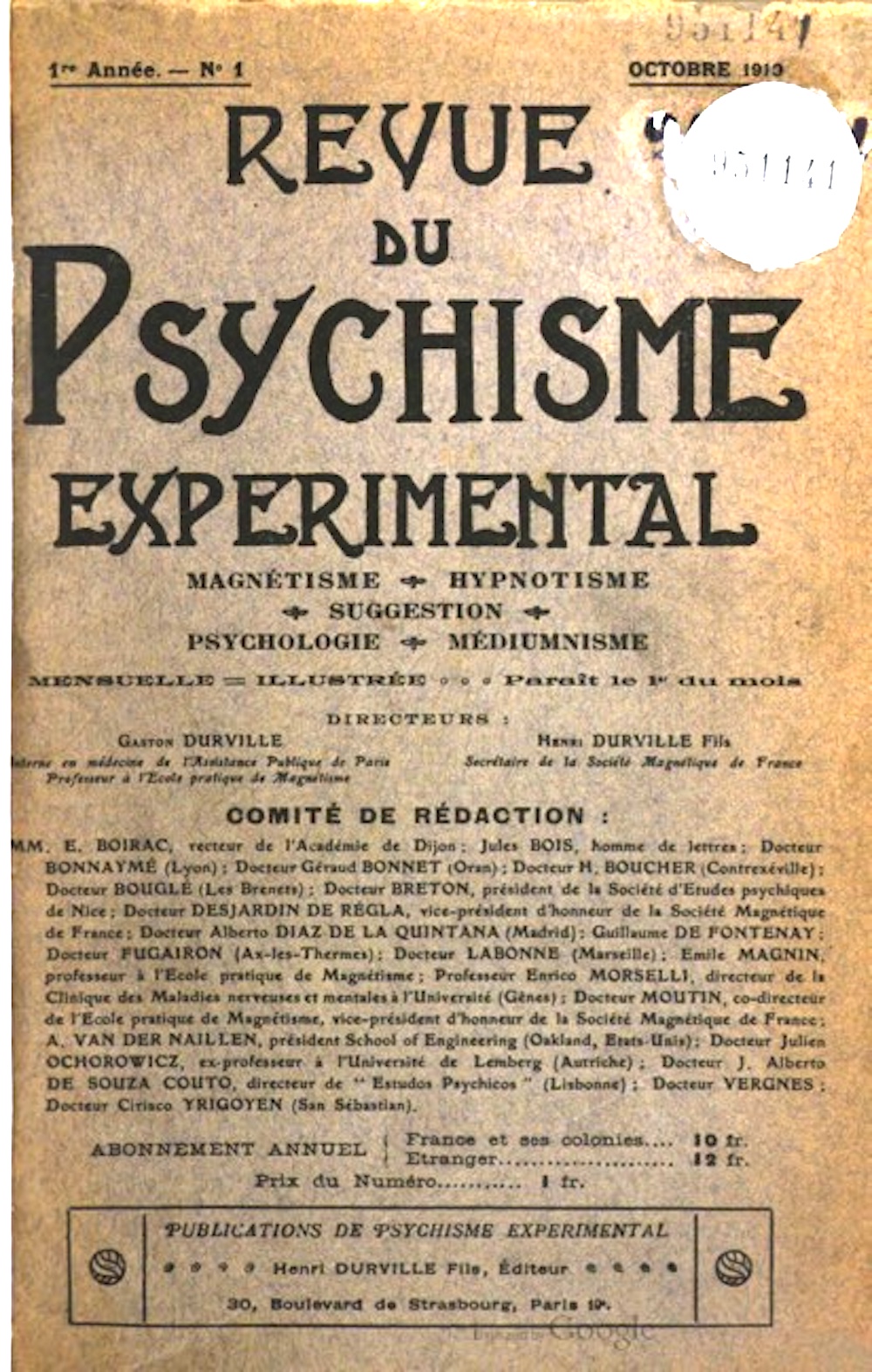
Revue du Psychisme Experimental. Henri Durville (1887-1963) and Gaston Durville (1885-1971) were part of a long line of Mesmerists. Their father, Hector, in 1879 revived the Journal du Magnetisme founded by Baron du Potet in 1845, and founded an ecole Pratique de Massage et du Magnetisme (of which a branch in Lyon was directed by Maitre Philippe, the healer who enthralled so many occultists of the Belle Epoque). He also founded the Ordre Eudaique, which devoted its interests to elevating its members through magnetism and hypnotism, and a school of magnetism to teach the same. Another brother, Gaston, in the 1930s went on to found a naturist city called Heliopolis, and was the inventor of a "suggestometer" to measure scientifically the effect of mental suggestion on physical strength. This journal was an effort by Henri and Gaston to expound upon the corollaries of magnetism and mesmerism in the direction of "psychism," the exploration of the "yet unknown forces" (including radiations of all kinds, material and pschic) inherent in all human beings and manifested in suggestion and auto-suggestion and in "mediumnisme." The editorial committee of the journal included Dr. L.S. Fugairon, Jules Bois, A. van der Naillen, and a cast of the who's who of psychical research at the time. The journal carried monthly news of the occult, parapsychology and spiritualism ("Le Mois Psychique") and regular extensive notes "Charlatanisme et les Fraudes" in the fields covered -- but at the same time opened its pages to advertisements by the Mysterious Hindu Kadir and to the half page advertisements of Prof. Roxroy. From October 1910 through May 1911 the journal dissected the phenomena and history of Alberto de Sarak, Count de Das and his Oriental Esoteric Centers. When Sarak sued this journal and others the editors renewed their attacks and buttressed their claims of fraud and buttressed their claims of fraud with documents and photographs showing Sarak's career under a great variety of names for the preceding 25 years. (On Sarak, see the notes under L'etoile d'Orient and The Esoterist.) The journal ‘s exposes of prominent mediums and mages, with others from the Journal du Magnetisme, were gathered together in Henri and Andre Durville, eds. Les Trucs de la Prestidigitation devoiles (1929). In October 1910, the journal was absorbed by the Journal du Magnetisme which added "psychisme" to its subtitle to indicate the new emphasis. On the Durvilles and their journals, see the note under Eudia. Crabtree 1650.
|
| BNF microfilm; Bibliotheek van de Universiteit van Amsterdam; Harvard University; Cambridge University, etc. | |
| Revue Du Psychisme Experimental V1 N1 Oct 1910 | |
| Revue Du Psychisme Experimental V1 N2 Nov 1910 | |
| Revue Du Psychisme Experimental V1 N3 Dec 1910 | |
| Revue Du Psychisme Experimental V1 N4 Jan 1911 | |
| Revue Du Psychisme Experimental V1 N5 Feb 1911 | |
| Revue Du Psychisme Experimental V1 N6 Mar 1911 | |
| Revue Du Psychisme Experimental V1 N7 Apr 1911 | |
| Revue Du Psychisme Experimental V1 N8 May 1911 | |
| Revue Du Psychisme Experimental V1 N9 Jun 1911 | |
| Revue Du Psychisme Experimental V1 N10 Jul 1911 | |
| Revue Du Psychisme Experimental V1 N11 Aug 1911 | |
| Revue Du Psychisme Experimental V1 N12 Sep 1911 |
|
|