
| Periodical: | |
|
|
|
From Pat Deveney's database:
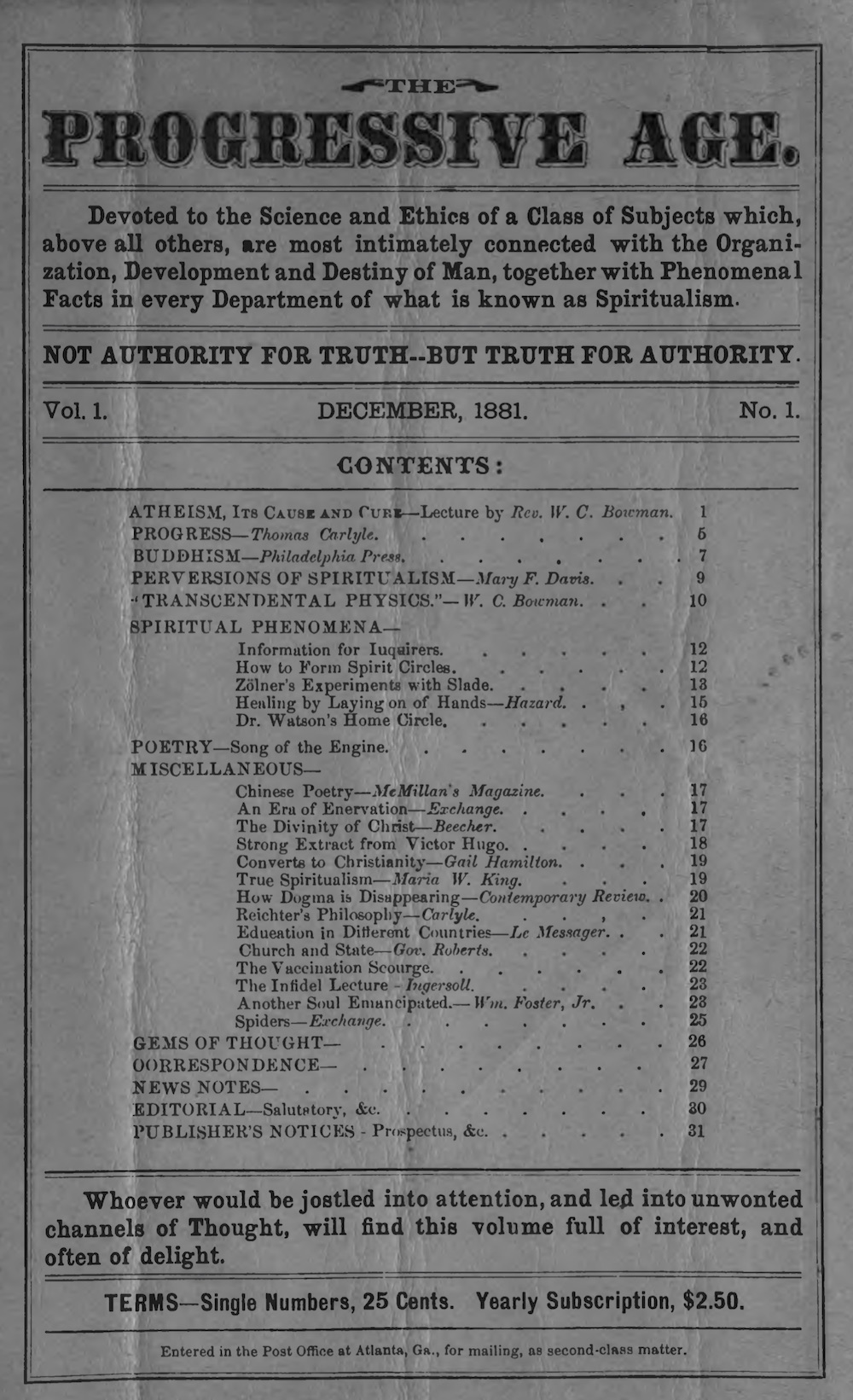
Progressive Age, The. This was started specifically to address what was perceived as a dearth of spiritualist journals in the south. In his introduction to the new journal, the editor says: "The first object in view is to keep fully ahead of the times and make The Progressive Age speak the best and brightest thoughts of the most advanced liberal thinkers, speakers and writers of the world, on all the great physical, social, moral and religious questions." As with many new journals, however, the initial issues suffered from a lack of original material and had recourse to reprinting excerpts, including, for example, Mary F. Davis’s Danger Signals (warning of the dangers of unconstrained pursuit of spiritual phenomena), the article from the Atlantic Magazine (September 1881) on Prof. Zöllner’s physics, and T.R. Hazard’s long letter on the healing wonders of Mrs. Fannie A. Dowd of Boston. J.M. Peebles, as noted in the Banner of Light for June 17, 1882,wrote a regular column for the journal. It was still running advertisements in November 1882 in the Banner of Light so it lasted at least until then, though it had come to proclaim itself as "Devoted to Liberal Thought and Spiritual Science" and addressed to "an able and careful presentation of argument and fact and purity and delicacy of expression." This was not enough. |
|
| Amherst College. | |
| Progressive Age V1 N1 Dec 1881 |
|
|