
| Periodical: | |
|
|
|
From Pat Deveney's database:
Hacker's Pleasure Boat. The journal continued the volume number of Pleasure Boat/
|
|
| Hamilton College; Rutgers University; American Antiquarian Society. | |
| The Pleasure Boat V1 N1 April 1 1845 | |
| Hacker's Pleasure Boat V17 N2 Aug 1867 | |
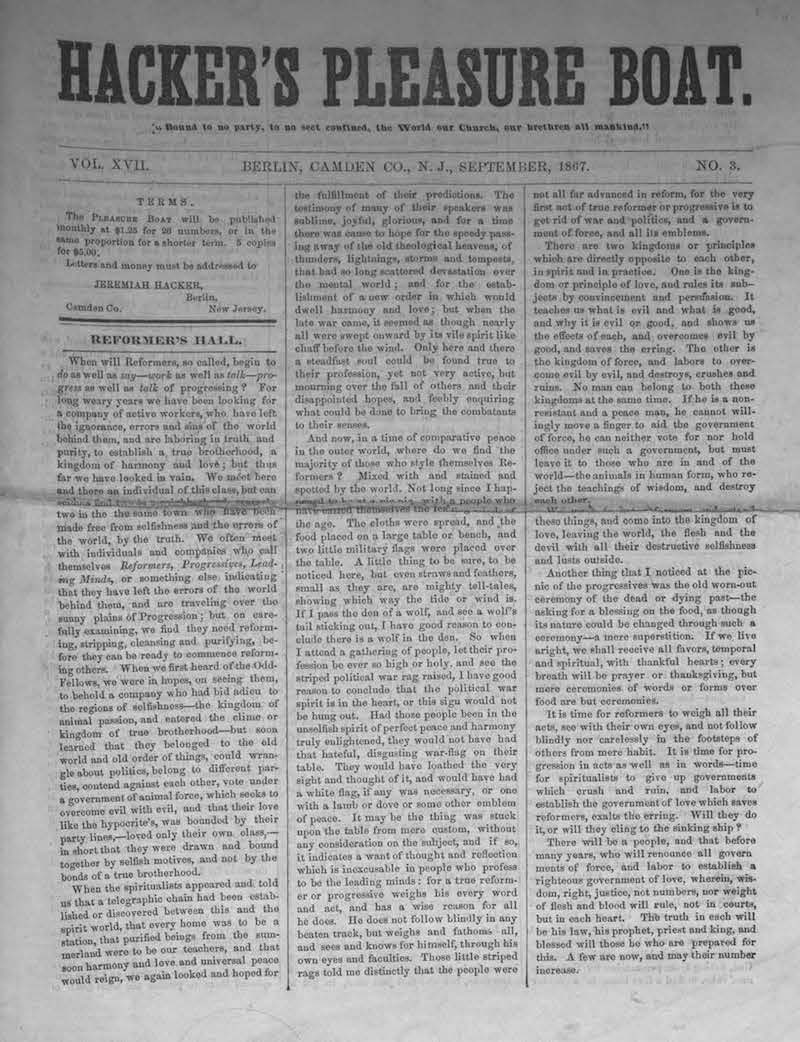
| Hacker's Pleasure Boat V17 N3 Sep 1867 | |
| Hacker's Pleasure Boat V17 N7 Mar 1868 | |
|
The Pleasure Boat was an antebellum American reform miscellany — a small, opinionated sheet mixing peace, government reform, moral exhortation and Bunyanesque allegory with reader testimonials for 'the Boat.' It is not an occult journal, but like much of the era's reform press it carried the two fashionable reform 'sciences' at their margins: a modest spiritualist thread of mediums, rappings and communications from the dead, and a phrenology of faculties and cranial 'organs' in the Gall tradition. Its 'brotherhood' language is fraternal-reform rhetoric, not Theosophy, which postdates it. In the corpus it registers as a reform paper with incidental spiritualist and phrenological content rather than a dedicated esoteric periodical. Generated by Claude from the periodical's digitized text; a thematic reading, not a bibliographic description. |
|
| Anarchism and Radical Individualism | Spiritualism |
|
|