
International Association for the Preservation of Spiritualist and Occult Periodicals


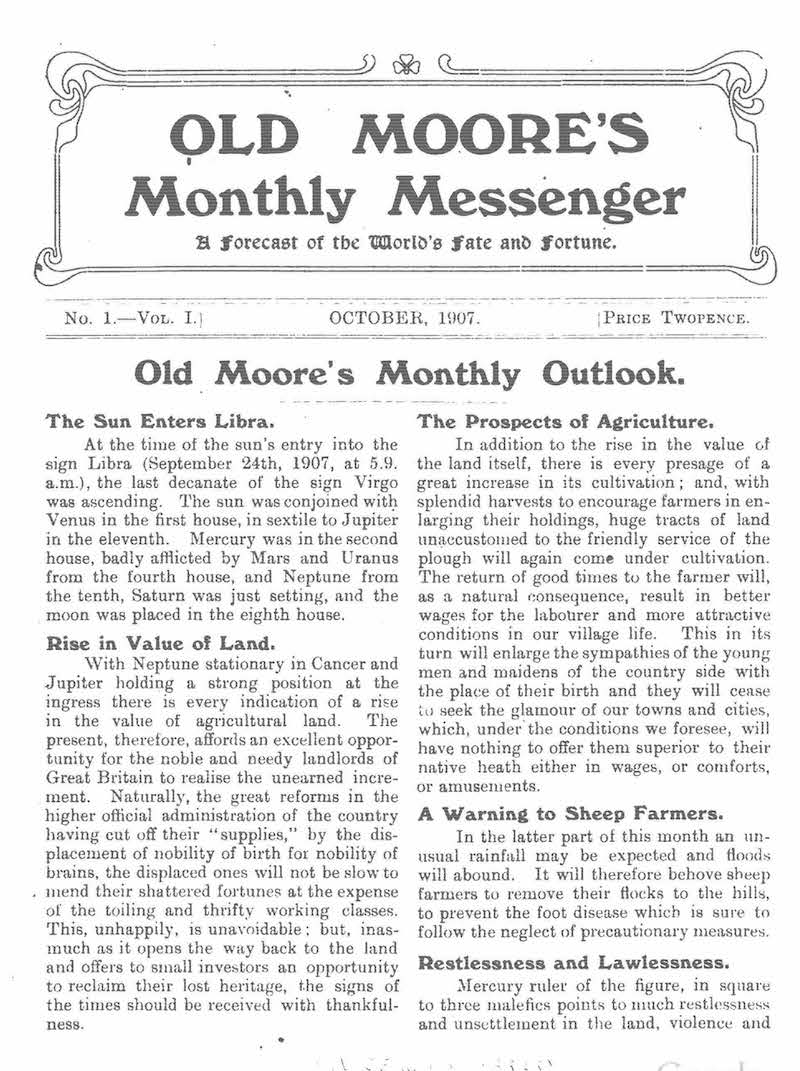
Periodical: Old Moore's Monthly Messenger

Summary:  From Pat Deveney's database:

Old Moore's Monthly Messenger.
A Forecast of the World’s Fate and Fortune.
Other titles: Old Moore’s Monthly Outlook and Forecast
1907-1914 Monthly
London, England. Language: English.
Publisher: W. Foulsham & Co.. Succeeded by: British Journal of Astrology (1914-1939)
1/1, October 1907-191. 40pp., twopence and issue.

The title changed to Old Moore's Monthly Outlook and Forecast in January 1908, then back to its original, and with January 1914 to the British Journal of Astrology, with which is Incorporated Old Moore's Monthly Messenger. Astrological journal with a rather unusual amount of material on spiritualism, talismans, hypnotism, New Thought, Rosicrucians, crystal gazing, phrenology, palmistry, and the occult generally. In 1908 the journal had the effrontery to print the horoscope of Annie Besant ("refined, kind, sociable and humanitarian, with plenty of balance and internal harmony"). Contributions by A.J. McIvor-Tyndall. Advertised in The Adept, April 1909.

Other Sources:NYPL.
Issues:Old Moore's Monthly Messenger V1 1907
Old Moore's Monthly Outlook and Forecast
Old Moore's Monthly Messenger V3 1909
Old Moore's Monthly Messenger V4-5 1910-11
Old Moore's Monthly Messenger V6-73 1912-23
British Journal of Astrology V8-9 1914-16
Claude-Generated Themes:   Old Moore's Monthly Messenger was a British popular-astrology monthly in the lineage of the Old Moore almanacs, and it belongs to the commercial fortune-telling trade rather than to the esoteric revival. Its staple is prediction sold by the calendar: day-by-day forecasts advising readers which days are fortunate for asking favours, seeking work or travelling and which are evil and best spent signing nothing, together with character sketches of the children born on each date, natal delineations, and transits of the slower planets read over public events. Around the astrology sits the rest of the almanac's stock — talismans and luck, a divining tablet worked by pinpricks with separate answers for good and bad fortune, weather prediction from the shapes of clouds, and the folklore of the fortune-telling trade. Its constant talk of success is astrological prognostication rather than self-culture. It is a valuable record of what popular astrology actually sold to ordinary British readers in the first decades of the twentieth century.

Generated by Claude from the periodical's digitized text; a thematic reading, not a bibliographic description.
Topics:Astrology | Hypnotism and Suggestion | New Thought | Palmistry and Chiromancy | Phrenology and Physiognomy | Rosicrucianism | Spiritualism | Theosophy