
| Periodical: | |
|
|
|
From Pat Deveney's database:
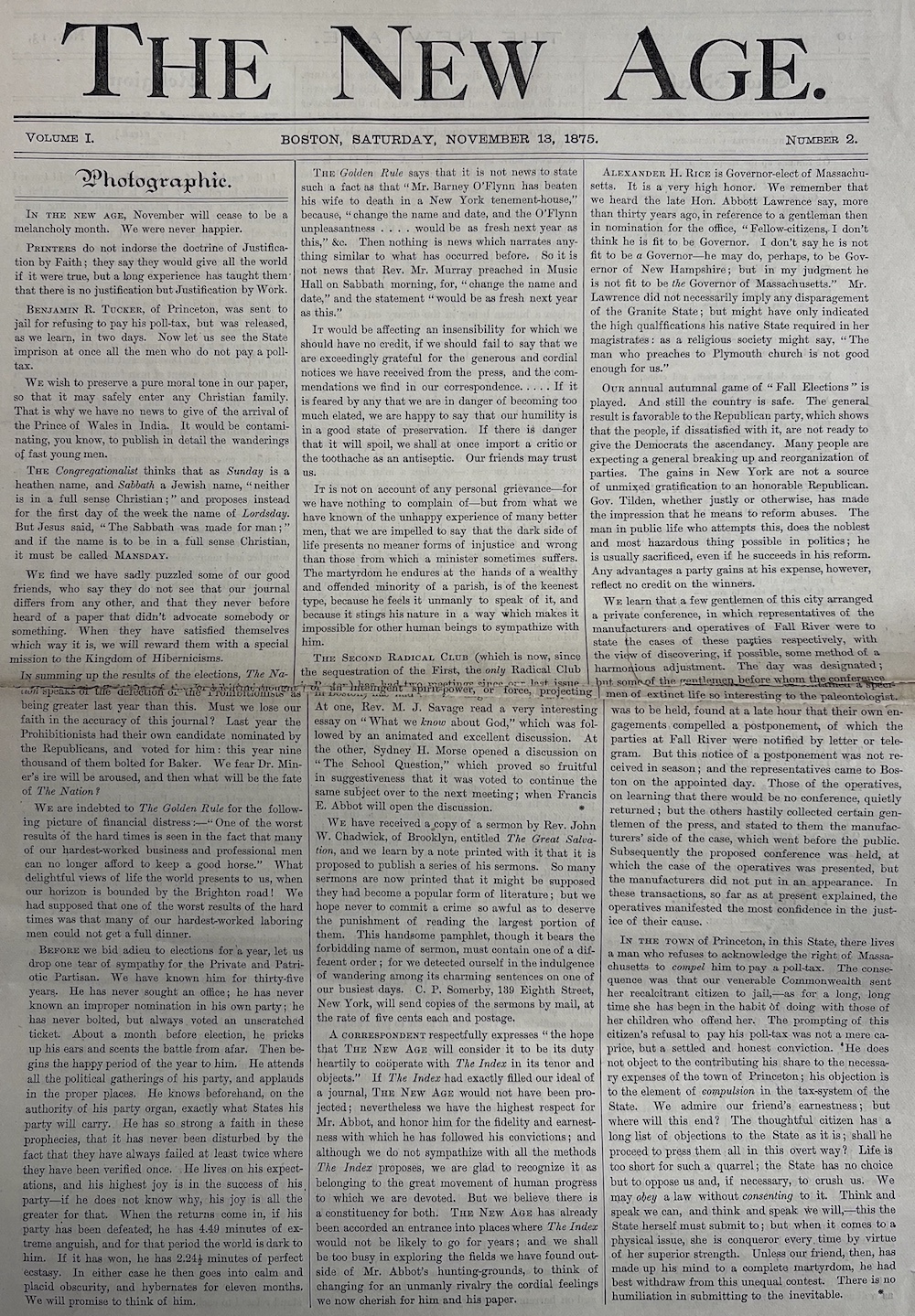
New Age, The. The first issue was said to have appeared in Maryland. This was yet another of the universal reform/free religion journals published at the end of the halcyon period around and just after the American Civil War when spiritualists walked hand in hand with the ranks of reform and shared a surprisingly large overlap in membership. While not every reformer was a spiritualist, every spiritualist was a reformer and believed implicitly in the perfectibility of human nature (through proper leadership and guidance) and in the necessity of practical reform here and now to create the inevitable new era that was inherent in the idea of progress shared by both movements until they went different ways over faith, free love and the consequences of abolition. The journal was intended to be the "organ of no party or sect, but ably represents progressive ideas and stands for reform of antiquated abuses wherever found." It was not a spiritualist journal but included spiritualism among the questions it sought to address: "Free Religion, Labor Reform, Emancipation of Woman, Spiritualism, Materialism, and Temperance, besides all the theories of Political Economy and Government, embraced in current political discussion. In addition to these, the Relation between Church and State, the complete Secularization of our Common School System." The journal carried contributions by Prof. William Denton (on "The Spiritualistic Philosophy of Life"), John Wetherbee ("The New Proof in Spiritualism"), Elizabeth Denton ("The New Proof of Spiritualism Examined"), and Caroline Dall (1822-1912), who is notable because of her correspondence with George H. Felt of Theosophy fame and for being a primary financial sponsor of Emma Hardinge's Home for Outcast Women and a co-editor (with the help of A.E. Newton and S.C. Hewitt) with Paulina Wright Davis of the Una . John Martin Luther Babcock (1822-1894) was a "gentleman of advanced ideas, able and independent" who had progressed from the printer's shop to the pulpit (Free Will Baptist and then Unitarian, which he seems to have lost because of his liberal ideas) and back to publishing. He had earlier published The People's Advocate. State Historical Society of Wisconsin; American Antiquarian Society.
|
|
| New Age V1 N1 Nov 6 1875 | |
| New Age V1 N2 Nov 13 1875 | |
| New Age V1 N3 Nov 20 1875 | |
| New Age V1 N4 Nov 27 1875 | |
| New Age V1 N5 Dec 4 1875 |
|
|