
International Association for the Preservation of Spiritualist and Occult Periodicals


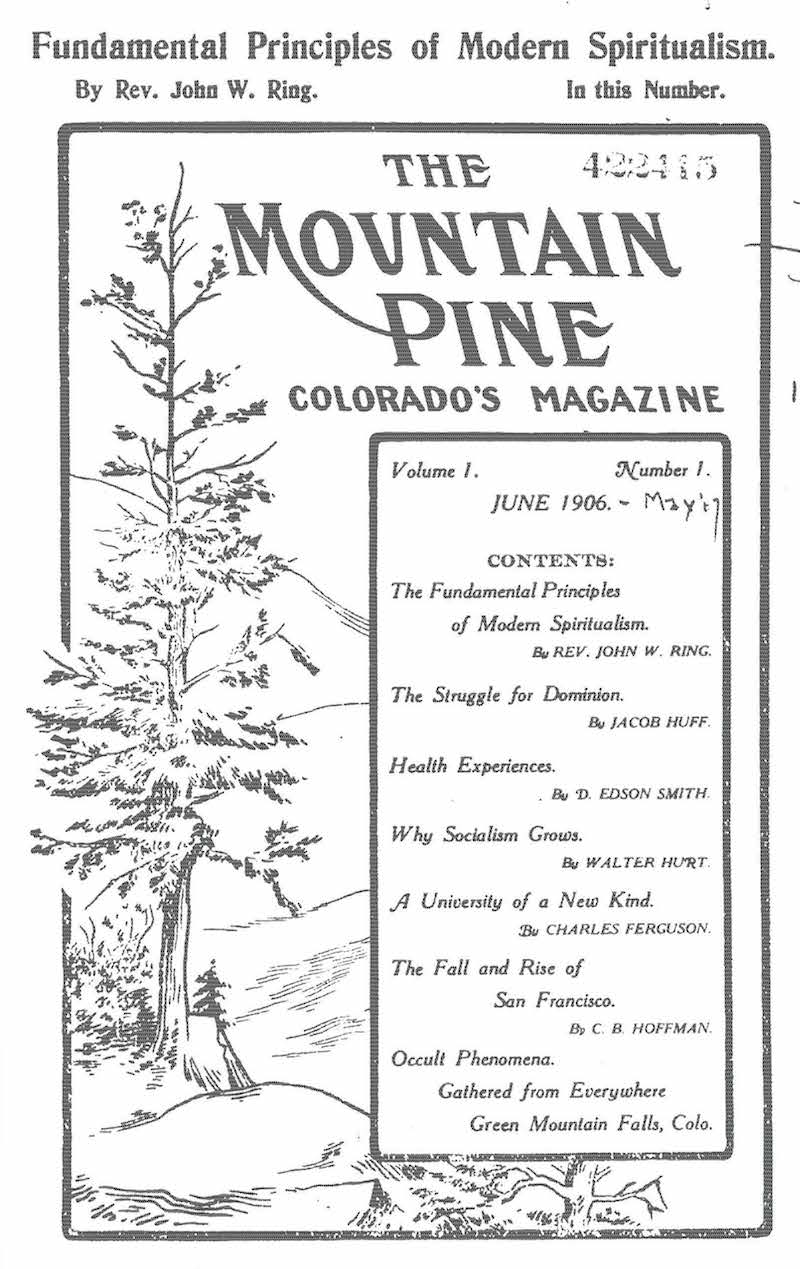
Periodical: The Mountain Pine

Summary:  From Pat Deveney's database:

Mountain Pine, The.
Successor to the Philosophical Journal.
Other titles: The Mountain Pine. Colorado's Magazine (with 2/10, February 1908)
1906-1908 Monthly
Crystola, CA, and from February 1908 in Langdon, CO. Language: English.
Publisher: Crystola Publishing Co.. Editor: George B. Lang.
Succeeds: Religio-Philosophical Journal -> Philosophical Journal
1/1 June 1906-2/12 May 1908. $1.00/year. Illustrated with photographs of J.M. Peebles, Henry Wagner, et al. 6 x 10, c. 36 pp.

This is the last gasp of the once-mighty Religio-Philosophical Journal, reduced in its old age to New Thought, fringe health advice, the "higher socialism" and long disquisitions throughout 1907-1908 by Dr. Henry Wagner of the H.B. of L. It functioned as a vehicle for the Crystola Camp and land-development in Green Mountain Falls, Colorado (near Pikes Peak and Ute Pass). In its last months devoted almost exclusively (except for Wagner's continuing series on "The Religion of Nature" and "The New Man") to cowboy stories and to tales of adventure and exploration in Africa.

Other Sources:NYPL.
Issues:Mountain Pine V1 1906
Mountain Pine V2 1907
Claude-Generated Themes:   The Mountain Pine was a San Francisco monthly of 1906 and 1907, published in the immediate aftermath of the earthquake and fire that destroyed much of the city and which it chronicled. Its first number opened with the Reverend John W. Ring on the fundamental principles of Modern Spiritualism, and mediumship remains its centre: seances and spirit controls, materialisation, and the fraud controversies that Spiritualists of the period argued out among themselves. Around that core the magazine gathered the reform enthusiasms of the Progressive-era West Coast — an essay on why socialism comes, health and physical-culture features, a proposal for a university of a new kind — together with an unusually substantial layer of occult and esoteric study, including hermetic material, karma and the vocabulary of initiation. The result is a hybrid characteristic of its time and place: Spiritualist at heart, but reaching into occult philosophy, mental self-culture and social politics as parts of a single reforming outlook.

Generated by Claude from the periodical's digitized text; a thematic reading, not a bibliographic description.
Topics:New Thought | Socialism and Labor Reform | Spiritualism