
| Periodical: | |
|
|
|
From Pat Deveney's database:
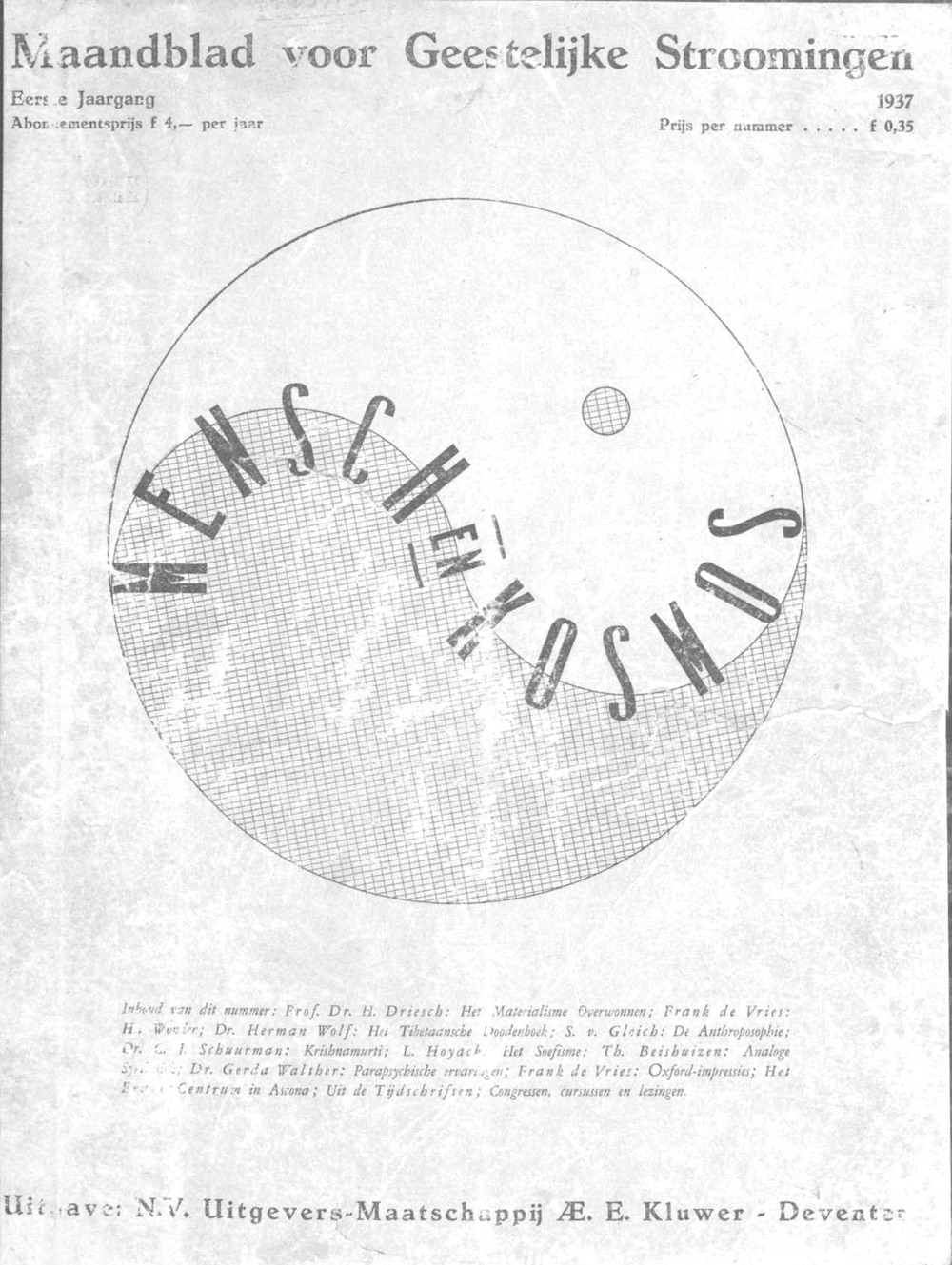
Mensch en Kosmos / Mens en Kosmos. Not published 1941-1947. After the War the journal changed its name from Man and the Kosmos to Mind and the Kosmos. This journal and its contemporaries like the Eranos Jahrbücher and the Modern Mystic (q.v.) were an outgrowth of the optimistic, rationalizing belief between the Wars that it was possible to synthesize the core truths of all religions and occult movements as a philosophy of life, and embrace them free of all "superstitions." It did not adopt any position or movement but rather thought to stand above all, without partisanship or favor, to synthesize their truths. Its articles were about occultism and the like rather than being occult. The movement attracted the sort of "long haired men and short haired women," highly educated, comfortable financially and international in their interests, who earlier had flocked around Swami Vivekananda, especially fashionable women of a certain age and financial standing of a vague Theosophical bent and a certain reverence for the more handsome and well-turned-out oriental holy men. In its long life, the journal featured articles by recognized scholars on Rainer Marie Rilke, parapsychology in Greece, personal survival after death, "Eternal Return in Nietzsche and Ouspensky," "Spinosa and Krishnamurti," "The Age of Aquarius," the "Oxford Group," "The Tibetan Book of the Dead," Anthropology, Sufism, Meher Baba, far-eastern art, mandalas, Boro-Boedoer, A.K. Coomaraswamy, René Guénon, New Thought, Anthroposophy and Rudolf Steiner, "Spiritisme-Spiritualisme," world idealism, "Reflections on the symbolism of the Edda," Eileen Garrett, Martin Buber and C.G. Jung, Inayat Khan, etc., etc. Rising costs forced the journal to be incorporated into Amersfoortse Stemmen in January 1970.
|
|
| Bibliotheek Universiteit van Amsterdam; Delft University of Technology; Erasmus University, Rotterdam; delpher.nl/nl, etc. | |
| Mensch En Kosmos V1 N1 Jun 1937 | |
| Mensch En Kosmos V1 N4 Sep 1937 | |
| Mensch En Kosmos V1 N5 Oct 1937 | |
| Mensch En Kosmos V1 N6 Nov 1937 | |
| Mensch En Kosmos V2 N12 May 1938 | |
| Mensch En Kosmos V3 1939 | |
| Mensch En Kosmos V5 N3 Aug 1938 | |
| Mens En Kosmos V4 N1 Jan 1948 | |
| Mens En Kosmos V5 N1 Jan 1949 | |
| Mens En Kosmos V8 1952 | |
| Mens En Kosmos V25 N5 Oct 1969 | |
| Mens En Kosmos V25 N6 Dec 1969 |
|
|