
| Periodical: | |
|
|
|
From Pat Deveney's database:
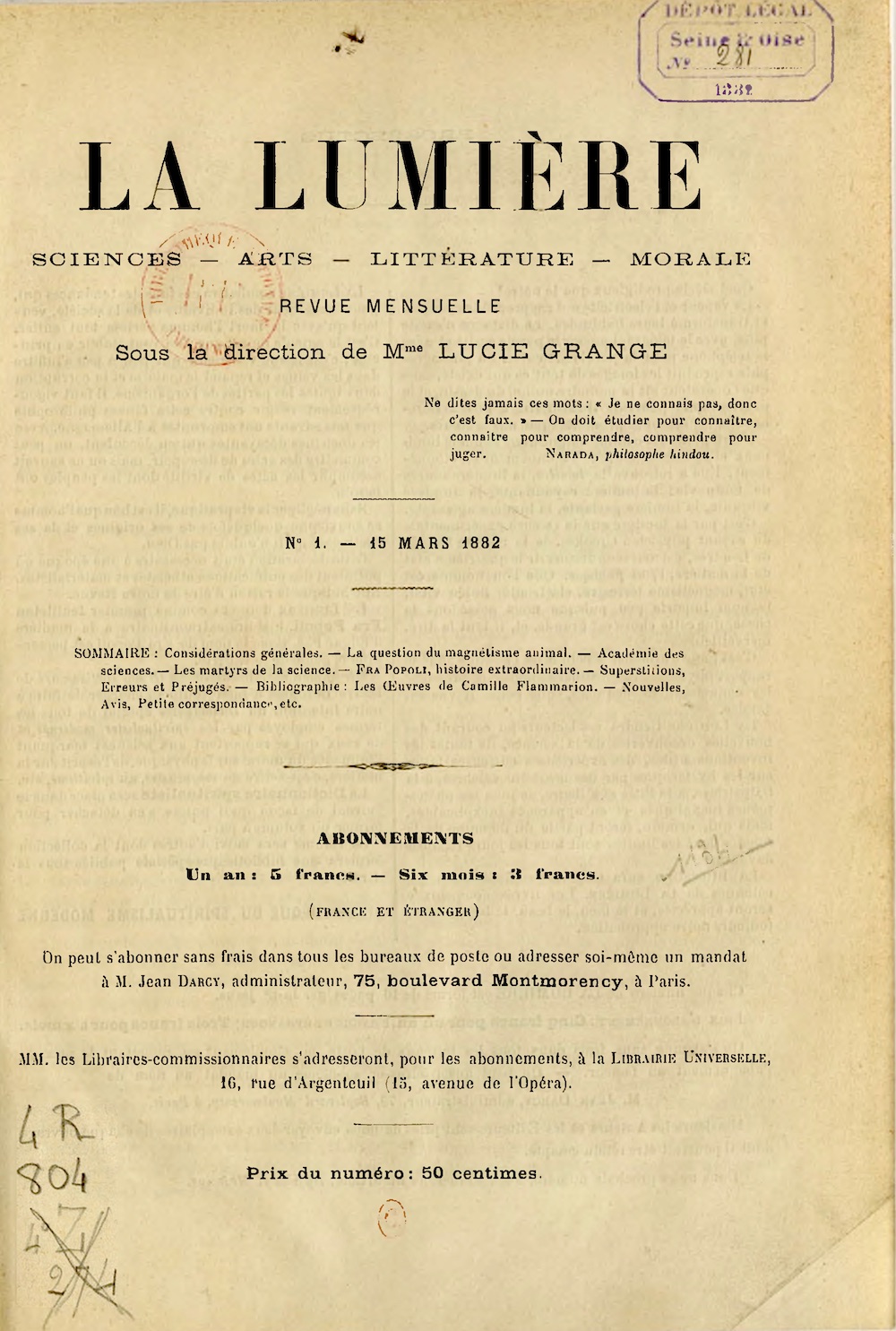
Lumiere, La. Lucie Grange (born Lucie-Ann Poujoulas, 1838-1909) was a universal reformer, visionary, spiritualist medium, psychic, prophet, poet, scryer, and a disciple of the strange prophet Pierre-Michel-Elie Vintras (1807-1875), about whom she wrote Le Prophete de Tilly (1897) under the pseudonym "Hab" which graced the cover of the journal. Grange had strong millennarian elements and claimed that she had been initiated and designated "The Light" or "Hab" / Habimelah" by her spirit guide Salem-Hermes to announce the coming of the androgynous New Eve who would return mankind to its primordial state. The goal was the "true soul-religion: It is the fusion of the hearts of humanity into the heart of God by Universal Spiritual Unity. From one end of the world to the other, across immeasurable space, in the bosom of prolific nature, souls, bathed in the Divine Magnetism, will vibrate with other souls, so all will be strengthened and made happy. . . . Hail! all hail! to the Empire of the Invisible, whose reign has now begun!" The journal rested on the proposition of the "Universal Communion of Souls in Divine Love" (illustrated by the symbol on the cover of a burning heart surmounted by the sun). It proposed "to attain the elevated spiritual goal of the Communion of souls in divine love to reach the harmony of hearts, convinced that the destinies of humanity were not limited to the material world." Grange's enthusiastic beliefs led to strong views about her and the journal: "On the subject of Mme Lucie Grange opinions are very divided among occultists. Many regarded her as hallucinating while others affirmed that she was really obtaining visible results and that she was not crazy." Papus, in his "Presses neo-spiritualistes," 1896, rather sharply said that "extravagance would perhaps be banished from the spiritualist milieu if La Lumiere did not exist. But it does." The vagaries he described were the journal's claim to be edited by Melchissedec, Joan of Arc and "Salem-Hermes," Lucie's guides. Grange stood apart in the morass of French spiritism in the last quarter of the nineteenth century and the journal is a breath of fresh air in the morass of orthodox spiritist productions. From her youth, Grange had been a visionary, conversing while awake or in trance, with "Salem" (later Hermes) and Jeanne d'Arc, and in 1875 had become convinced of the wonders of spiritualism. She had participated in the typical variety of literary, socialist and reform movements of the time, contributing under a numerous pseudonyms to a variety of minor literary, hygienic, musical and reform journals. Her husband, Adolphe (1833-April 1886) was an archeologist, antiquarian and former librarian in Dijon and then a printer, who was an ardent Freemason and socialist and who had been active in the army of the Commune. On her biography see her "Souvenirs et Impressions d'un Mediums" that ran in the journal 1883-1883; Mme Innes, "Lucie Grange," Banner of Light 98/21 (January 13, 1906): 5; and Nicole Edelman, "Lucie Grange: Prophete ou messie?" Hermetica, n. 20, 2006, 60-72. Grange expressed great respect for Allan Kardec and saw him as a prophet in the line of Moses and Jesus and firmly believed in reincarnation, but saw her journal as something new, a new step in the spiritualization of the world. Its scope was to be "from primordial occultism to Hermeticism, from Rose-Croix to the Kabbale, from alchemy to astrology. A unique doctrine has been transmitted, that of invisible intelligences acting variously on man and all created things. The doctrine of spiritualism, as you shall see, is certainly nothing new." The journal labeled itself as expositor of a "Revelation du Nouveau Spiritualisme" or of "Spiritualisme Moderne" -- for which terms the orthodox Kardecists reproached her as a defector -- but Grange refused to place her journal within the confines of "spiritism." "While we are united in heart and mind with the disciples of Allan Kardec, we are nonetheless independent. We are subservient to no person; we are not slaves of any coterie; and we dedicate ourselves to strive to defy all prejudices and to consider all things as a whole, leaving aside petty peculiarities. Lumiere would be unworthy of its title if it were not above controversies and envy. The truth which we seek is in the light, and the light embrace everything and is one of the conditions for progress, which is not thwarted." Despite this avowed aversion to controversy and her all-embracing universalism, however, Grange was not slow to take up the cudgels to wage war when it suited her principles: Her guides Michel and Jeanne d'Arc viciously attacked the black magicians of France in the in the 1890s ("Guerre a la magie noire!" November 1892) and the year before the journal had derided Abbe Boullan (to whom, however, she gave space in the journal to respond). She scoffed at Papus's snide attacks on her sanity, attacked the healer Zouave Jacob, accused Abbe Roca and Marie Sinclair, Duchess of Pomar of appropriating her revelations in their journal L'Etoile, and excoriated the Belgian Theosophist and occultist Jean Delville of "plagiarism" when he had the effrontery in 1899 to call his new journal by the same name as hers. She and her husband, Adolphe (1833-1886), started the journal in 1882 with few illusions. They had been warned: "You are embracing poverty. You will have to work hard and be repaid with abuse. 'Go for the money first.'" They did not heed that advice: "La Lumiere is not a business or a speculation. It has been created by the spirits who have conferred its direction on a woman of good will. The legion of spirits which protects this publication pursue a philanthropic goal of establishing a New Revelation. A permanent subscription has been started to aid the propaganda of the journal . . . and with the aid of God a great Alliance for human happiness will be the result of the united efforts of all the allies of [the journal]." The journal was successful enough to survive until 1909 and to do away with a subscription price in 1889, depending instead on financial contributions. It was run on a shoestring, without the panoply of secretaries, editors and managers of most similar journals of the time, and its list of contributors was bulked out by pseudonyms: Lucie writing as "Hab" and "Victor Flamen" and Adolphe as "Jean Darcy," "Matharel," and others. The spirit of Adolphe continued to contribute to the journal after his death in 1886. Besides the revelations of Grange's guides, the journal published several novelettes and a play, articles on superstitions and the importance of experimental science in combating them, levitation, astrology, displacement of the axis mundi, "communications by astral force," the Reign of Women, "Zancig et la transmission de la Pensee," the Davenport Brothers, Jesse Shepard, catalepsy, Helene Smith's paintings, lengthy revelations from Hermes, as well as excellent review of books and articles from around the spiritualist world. It carried contributions by Rene Callie, who played a prominent role in the journal in its first years before going on to edit L'Anti-Materialiste and L'Etoile, August Vande Kerkhove (later known as "S.U. Zanne," 1838-1923), P. Christian (fils), Jules Bois, et al.
|
|
| BNF. | |
| Lumiere N1-14 Mar 1882-apr 1883 | |
| Lumiere N15-46 May 1883-aug 1884 | |
| Lumiere N47-54 Sep 1884-dec 1884 | |
| Lumiere N137 Mar 1892 | |
| Lumiere N138 Apr 1892 | |
| Lumiere N139 May 1892 | |
| Lumiere N140 Jun 1892 | |
| Lumiere N141 Jul 1892 | |
| Lumiere N142 Aug 1892 | |
| Lumiere N143 Sep 1892 | |
| Lumiere N144 Oct 1892 | |
| Lumiere N145 Nov 1892 | |
| Lumiere N146 Dec 1892 | |
| Lumiere N147 Jan 1893 | |
| Lumiere N148 Feb 1893 | |
| Lumiere N149 Mar 1893 | |
| Lumiere N150 Apr 1893 | |
| Lumiere N151 May 1893 | |
| Lumiere N152 Jun 1893 | |
| Lumiere N153 Jul 1893 | |
| Lumiere N154 Aug 1893 | |
| Lumiere N155 Sep 1893 | |
| Lumiere N156 Oct 1893 | |
| Lumiere N157 Nov 1893 | |
| Lumiere N158 Dec 1893 | |
| Lumiere N159 Jan 1894 | |
| Lumiere N160 Feb 1894 | |
| Lumiere N161 Mar 1894 | |
| Lumiere N162 Apr 1894 | |
| Lumiere N163 May 1894 | |
| Lumiere N164 Jun 1894 | |
| Lumiere N165 Jul 1894 | |
| Lumiere N166 Aug 1894 | |
| Lumiere N167 Sep 1894 | |
| Lumiere N168 Oct 1894 | |
| Lumiere N169 Nov 1894 | |
| Lumiere N170 Dec 1894 | |
| Lumiere N171 Jan 1895 | |
| Lumiere N172 Feb 1895 | |
| Lumiere N173 Mar 1895 | |
| Lumiere N174 Apr 1895 | |
| Lumiere N175 May 1895 | |
| Lumiere N176 Jun 1895 | |
| Lumiere N177 Jul 1895 | |
| Lumiere N180-181-215-216 Jan-Feb 1895-Dec 1898 | |
| Lumiere N217 Jan 1899 | |
| Lumiere N262-273 Jan-dec 1903 | |
| Lumiere N274-285 Jan-dec 1904 | |
| Lumiere N286-296-7 Jan-dec 1905 | |
| Lumiere N298-309 Jan-dec 1906 | |
| Lumiere N310-334 Jan 1907-Jan 1909 |
|
|