
| Periodical: | |
|
|
|
From Pat Deveney's database:
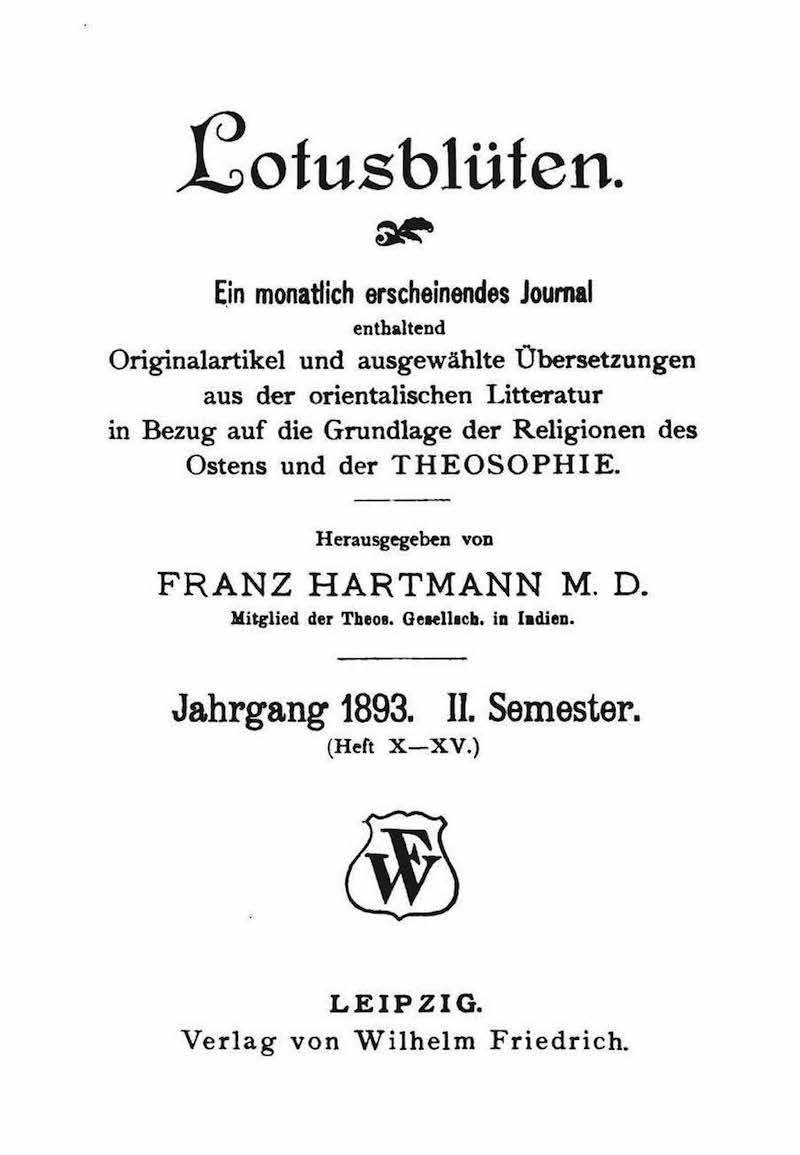
Lotusbluthen. The stated purpose of the journal was to reveal to a German audience the wonders of Eastern literature as the source of all true religion and mysticism. What would have been volume 1, nos. 1-3, was published separately in 1892 as Die Grundlage der indischen Mystik and contained Hartmann's German translation of H.P. Blavatsky's Voice of the Silence. The journal itself began with vol. 1, no. 1, in January 1893. It has selections from and contributions all of the leading Theosophists of the time: Blavatsky, Besant, Subba Row, and Hartmann himself, translations from the Sanskrit and Chinese, and German mystical classics such as those by Karl von Eckhartshausen (1752-1803) and Der cherubinische Wandersmann. The complete table of contents, compiled by Robert L. Hütwohl, is now online at http://www.austheos.org.au/indices/LOTBLGHU.HTM. Hartmann (1838-1912) was a Bavarian physician who spent almost 20 years in the United States. There he first encountered spiritualism and came to know of H.P. Blavatsky, whom he traveled to India in 1883 to meet. Both parties had their reservations (his expressed in his novella The Talking Image of Urur), and hers in her nickname for him: "dirty Franz"), but Hartmann continued to work for Theosophy (in the broader sense in which he interpreted it) for the rest of his life. This journal is one result. He was also involved in the confused beginnings of the O.T.O. (the Ordo Templi Orientis)--he, with Theodor Reuss and Heinrich Klein were the leaders of Reuss' Rite of Memphis and Misraim--and in Monte Verità and various other occult and Rosicrucian undertakings. Wilhelm Friedrich, the publisher of Lotusblüthen, also published the Bibliothek Esoterischer Schriften (12 volumes, 1898-1900). Hartmann revived the journal in 1907 under the modernized spelling Lotusblüten and it was continued after his death in 1912 by Dr. Paul Harald Gravell and then (1914) by Bertha Reich-Gutzeit. NYPL; Yale Universitiy; ATLA microfilm; Kongelige Bibliotek Dänemark; Osterreichischer Bibliothekenverbund; Sudwesdeutscher Bibliotheksverbund; ZDB: Tubingen UB; Freiburg UB; Freiburg Inst Grenzgeb Psychol; Munchen BSB; Erlangen-N UB; Augsburg SuStB; Berlin SBB Haus Unter d.Linden; Rostock UB; Wolfenbuttel HAugB; Bochum Ev.-Theol. Sem; Düsseldorf UuLB; Dresden SLUB, ZB. Robert Hutwohl's comprehensive index of articles is also available.
|
|
| LotusBluten V1 1893 | |
| LotusBluten V2 1893 | |
| LotusBluten V3 1894 | |
| LotusBluten V4 1894 | |
| LotusBluten V5 1895 | |
| LotusBluten V6 1895 | |
| LotusBluten V7 1896 | |
| LotusBluten V8 1896 | |
| LotusBluten V9 1897 | |
| LotusBluten V10 1897 | |
| LotusBluten V11 1898 | |
| LotusBluten V12 1898 | |
| LotusBluten V13 1899 | |
| LotusBluten V14 1899 | |
| LotusBluten V15 1899 | |
| LotusBluten V16 1900 |
|
|