
| Periodical: | |
|
|
|
From Pat Deveney's database:
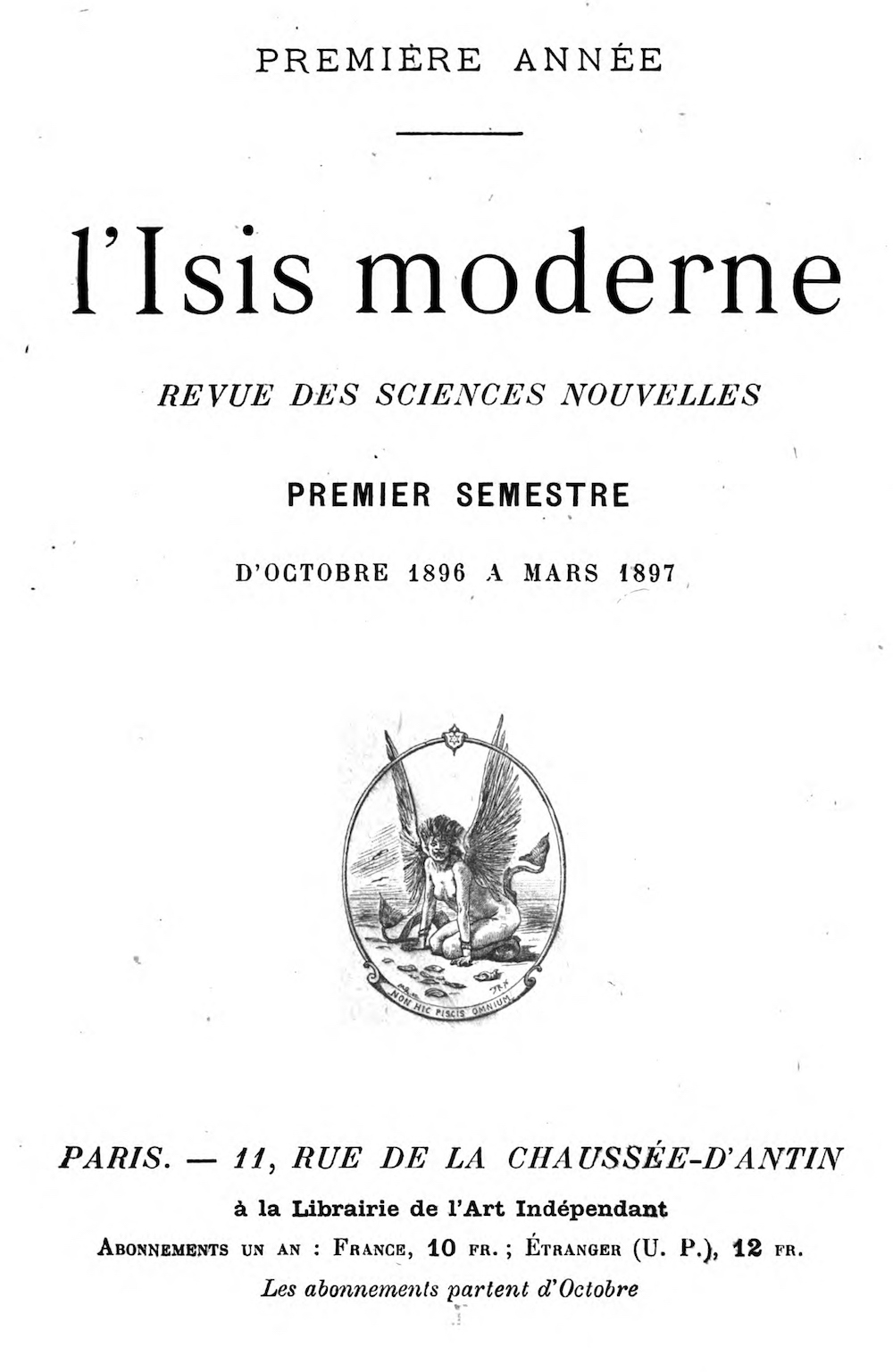
Isis Moderne, L'. Articles by Swami Vivekananda, "Jules Bois" (Henri Antoine Jules-Bois) (on Naundorff), S.L. MacGregor-Mathers (on the Kabbalah), Louis Menard (on oracles), V.E. Michelet ("Un drame d'Eliphas Levi"), Emile Bournouf, Edmond Bailly, and P. Braun (an adaptation of an article by him on the power of thought from Metaphysische Rundschau, "notre vaillant confrere allemand"), et al. The journal prided itself in its introductory "Aux Lecteurs" on the variety of its collaborators and presented a rather aristocratic face to the world, reflected in its motto: "Not everybody's cup of tea." Despite these pretensions, it soon took to padding its pages with the likes of a translation of Abraham H. Dailey's breathless Mollie Fancher: The Brooklyn Enigma. An Authentic Statement of Facts in the Life of Mary J. Fancher, the Psychological Marvel of the Nineteenth Century. Unimpeachable Testimony of Many Witnesses (Brooklyn, N.Y, 1894). Dailey, an ardent spiritualist and former judge, related everything knowable about Fancher , a young girl who became bedridden and blind at 17 years of age, spent nine years without (it was claimed) eating, all the while acting as the vehicle for various other personalities. Although she recovered physically, she remained subject to spirit possession. The journal was published by Edmond Bailly's Librairie de l'Art Independant which had earlier published the literary-occult Le Coeur and other occult and Theosophical journals and was widely influential in both the symbolist and occult worlds of France in the 1890s. |
|
| NYPL; Cornell University; Harvard University; Toronto Public Library; Amsterdamse Universiteitsbibliotheek. | |
| Isis Moderne V1 1896-1897 |
|
|