
International Association for the Preservation of Spiritualist and Occult Periodicals


Periodical: The Humanitarian

Summary:  From Pat Deveney's database:

Humanitarian, The.
A Monthly Magazine.
1892-1901 Monthly
New York, NY, then London, England. Language: English.
Publisher: Hutchinson & Co.. Editor: Victoria C. Woodhull (Mrs. John Biddulph Martin), Zula Maud Woodhull.

1/1, July 1892-1910. 16 pp., 50 cents/ 2s 6d a year. Though the journal was primarily devoted to eugenics and social issues, it was, as the Banner of Light, August 7, 1897, noted,"reformatory, progressive and devoted to psychic studies," with the last topic increasingly coming to light as the journal progressed. It was largely written by Woodhull but attracted contributions by Paul Tyner and other New Thought writers and published, notably, an article on the workings of the Golden Dawn Temple in Paris, complete with photographs. "Isis Worship in Paris. Conversations with the Hierophant Rameses and the High Priestess Anari," February 1900. Mrs. Martin is the re-fashioned Victoria Woodhull after her removal to England and marriage to the millionaire John Martin. On Woodhull, see the note under Woodhull & Claflin's Weekly. Zula Maud (1861- ) was Victoria's daughter, possibly by Canning Woodhull.

Other Sources:
Issues:Humanitarian V1 N1 Jun 1892
Humanitarian V1 N2 Aug 1892
Humanitarian V1 N3 Sep 1892
Humanitarian V1 N4 Oct 1892
Humanitarian V1 N5 Nov 1892
Humanitarian V1 N6 Dec 1892
Humanitarian V2 N1 Jan 1893
Humanitarian V2 N2 Feb 1893
Humanitarian V2 N3 Mar 1893
Humanitarian V2 N4 Apr 1893
Humanitarian V2 N5 May 1893
Humanitarian V2 N6 Jun 1893
Humanitarian V1-2 1892-3 Index
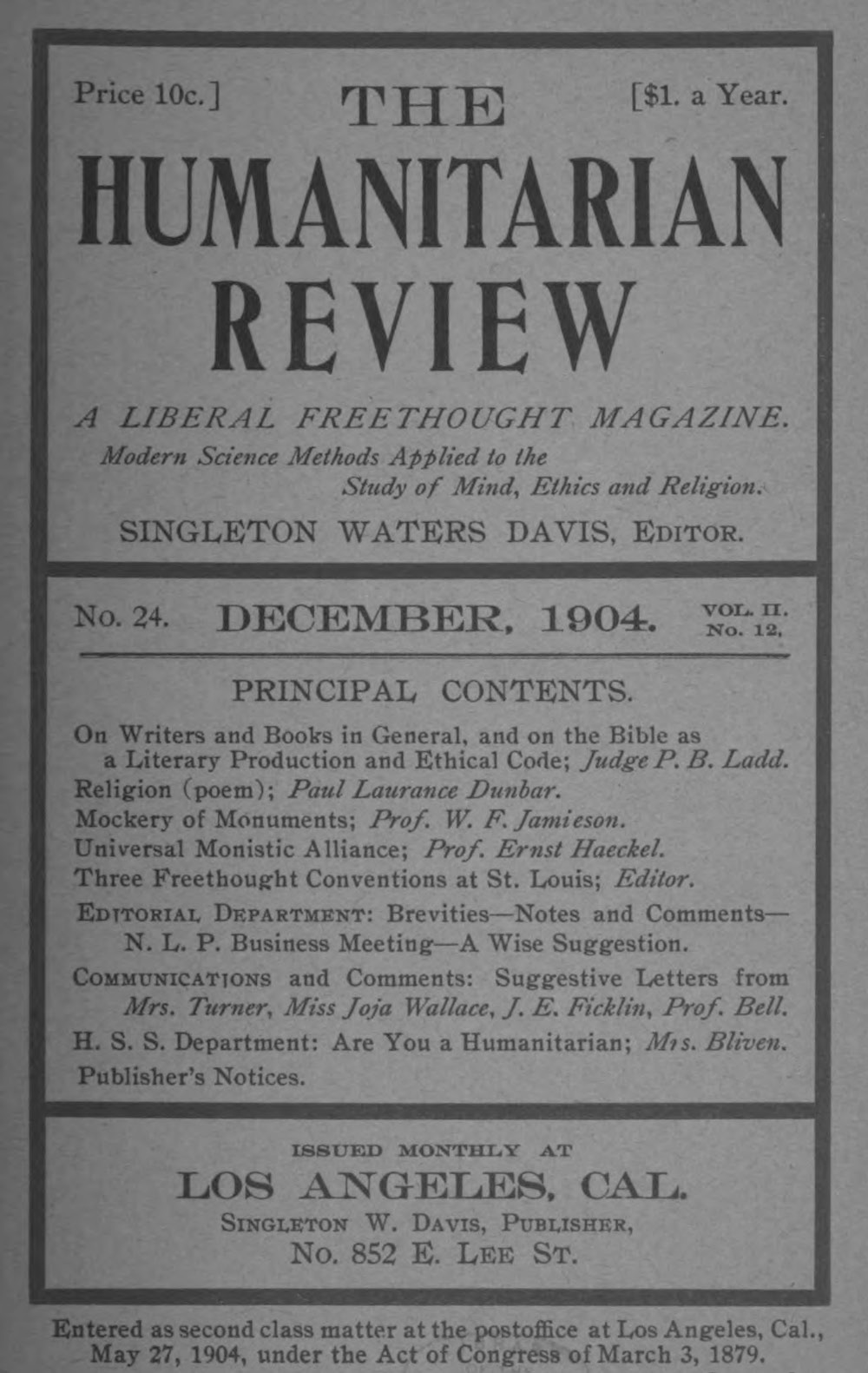
Claude-Generated Themes:   The Humanitarian Review was a Los Angeles monthly edited by Singleton W. Davis in the first decade of the twentieth century, billing itself as a study of mind, psychic phenomena, ethics and religion by the modern science. Its centre of gravity is American freethought in its rationalist and ethical mode: the criticism and natural history of religion, morality argued without dogma, the memory of Thomas Paine and the living example of Robert Ingersoll, and the practical politics of a minority seeking to lift the social ban its opponents placed on it. What distinguishes the Review from the ordinary secularist press is that it took psychical claims seriously enough to examine them. Mediumship, seances and the survival question appear throughout, handled as evidence to be weighed rather than doctrine to be held, alongside reports of the newer mental sciences and the drugless-living enthusiasms of Southern California. It is best read as a rationalist ethical journal with an investigator's curiosity about the phenomena its neighbours believed in.

Generated by Claude from the periodical's digitized text; a thematic reading, not a bibliographic description.
Topics:Ceremonial Magic and Thelema | Freethought and Secularism | New Thought | Women's Rights and Feminism