
| Periodical: | |
|
|
|
|
From Pat Deveney's database:
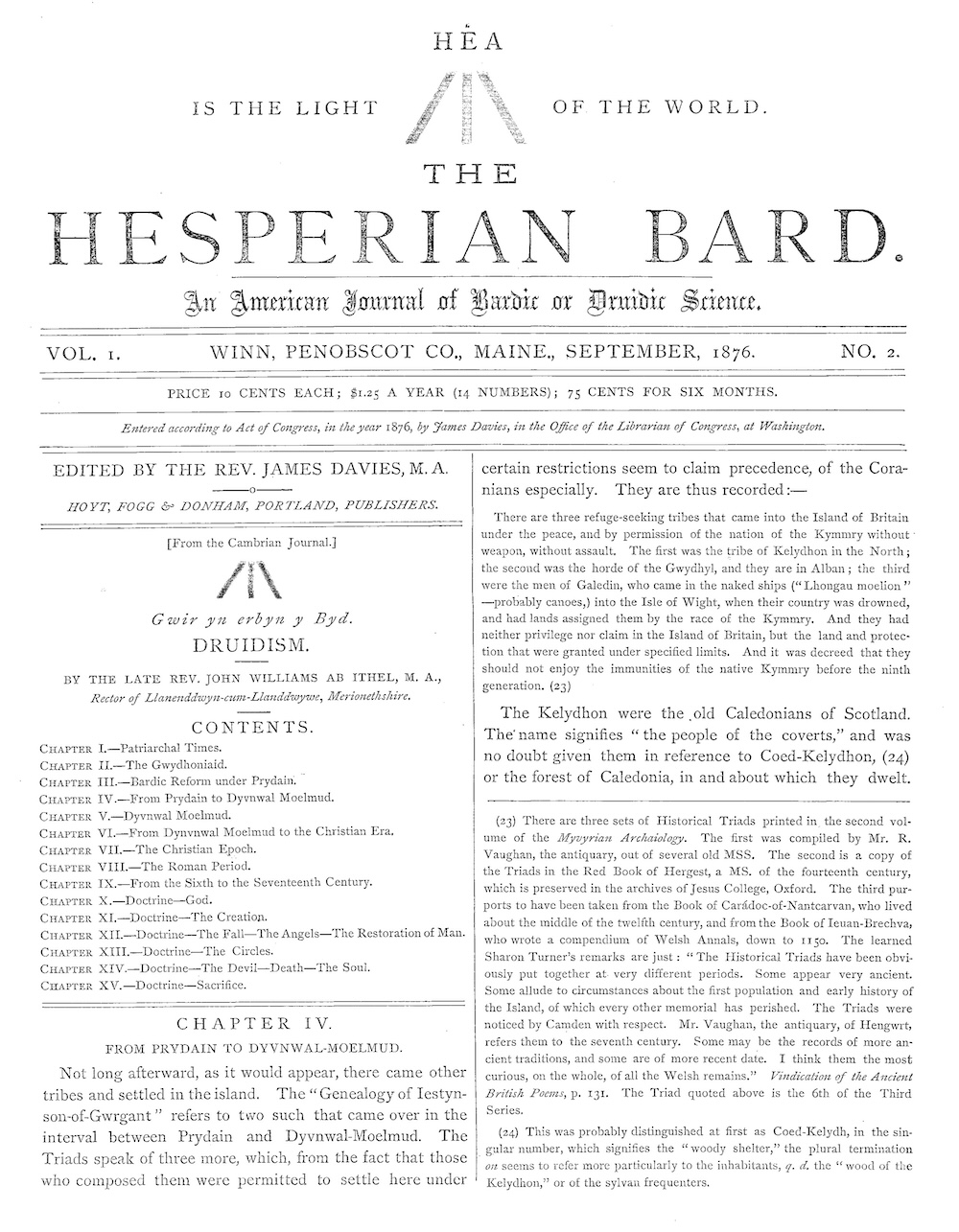
Hesperian Bard, The. At first glance this journal seems only a bit of the detritus of nineteenth century antiquarianism, an account of the manners and customs of the Welsh Druids produced by an obscure parson in backwoods Maine. It is more interesting than that, however, and represents the incursion of an imaginary mythology into the United States and its utilization for promoting dubious mail-order medical schools and universities – an enterprise that has a long subsequent history with Helmuth P. Holler, Garrett B. B. Larkeque and others. See the notes under The Official Theomonist Record, The Oriental University Bulletin, and The Oriental University Progressive Studies. Britain in the eighteenth and nineteenth centuries witnessed the creation of a reimagined version of its Celtic past in support of the reacquisition of a posited lost high wisdom and of a burgeoning national spirit in Scotland, Ireland and especially Wales, the intersection of an antiquarian pursuit through Classical and bardic remains coupled with an extreme Romanticism that peopled the windswept crags of pre-industrial Britain with Merlin-like sage bards and druid priests immersed in the wonders of nature, medicine and the stars. The surviving issue of the journal reprints without comment chapters from the long article on Druidism by the Rev. John Williams ("Ab Ithel," 1811-1862), taken from his Cambrian Journal. This in turn was a rephrasing of the pseudo-history of Wales and the Welsh Druids of Edward Williams ("Iolo Morganwg," 1747-1826), a poet and antiquary whose work was the kernel around which the sentiment of Welsh nationalism would arise. Despite the fact that he was later exposed as the fabricator of some of his ancient Welsh historical documentation and the imaginative creator of much of his supposed histories, the elaborate rituals and structures Iolo created for his Gorsedd/Gorsedh (throne) of the Bards of the Isle of Britain went on to form part of the Welsh Royal National Eisteddfod created by Williams in 1858 that still takes place today. The journal bears on its masthead the symbol of three descending lines (called the "Awen," which is said to be Welsh for "inspiration" or "flowing spirit") and the letters "HEA" which are said to stand for various triads (land, sea, sky; earth, sea, sky; mind body spirit, etc.), both of which symbols are creations of Iolo. As several eminent scholars have discovered, the editor of this journal, James Charles Davies (1838- ), was a Welsh-born Anglican minister who came to the United States in 1870 and settled in Maine, where he soon created a sensation by building a houseboat, loading his family on it, and leisurely floating around the coast of Maine collecting roots and herbs and peddling his cures. This wortcunning may have been an outgrowth of Davies' aspirations to Druidry: in 1874 he had been appointed "Regent" of the Druids in the United States, "with power to ordain ovates, bards, and druids," by Evan Davies ("Myfyr Morganwg," 1801-1888), the self-appointed "Arch-Druid" of Great Britain, who claimed to have inherited the dignity from Iolo Morganwg through Iolo's son Taliesin. He was an antiquary and watchmaker born in the Vale of Glamorgan and had had himself named Arch-Druid in 1852 and thereafter carried a "Druid's egg" (mentioned by Pliny) to indicate his status, although some thought it merely an ostrich egg. With his regency in hand, James Davies proceeded to organize the United Ancient Order of Druids, with himself as Arch Druid Vicarial of the Western Hemisphere and of the American or Western Hemisphere Gorsedd. He had by this point been graduated by the Eclectic Medical College of Maine and appended "A.M., M.D." to his name and titled himself "Druidic Physician and Surgeon." He also boasted that he had been appointed Emeritus Professor of Theory and Practice at Buchanan's Eclectic Medical School in Cincinnati, and it was a simple matter to start the Druidic University of America which proceeded to start medical diploma mills around the Northeast. The Maine branch of the university combined Bardic learning with an impressive list of required lectures on medical topics, practical laboratories, and the like. Graduation required a learned thesis and lengthy examination on all topics, as well as substantial fees ($75.00 a session for lectures, $10.00 for practical anatomy, etc.). In practice, the requirements were somewhat laxer. When the scam was exposed by the Boston Herald in 1887, a reporter who had gotten his M.D. degree after three hours of discussion with the school's dean laid out how he had "mastered the contents of a medical work containing 1000 pages in less than two hours" and "learned all about anatomy without ever looking into a medical work." Branch medical schools of the Druidic University were established in New Hampshire, Buffalo, New York, Vermont and other locations. This journal appears to have been Davies' attempt to make his Druidic revival in the United States known and it may have had some success: a journal named The Medical Druid was published by the Gorsedh of Pennsylvania in Detroit in 1885. His enterprise seems to have vanished with the exposure of the mail-order business in the late 1880s and early 1890s Davies' subsequent history is unknown and the last heard of him is the loss of his arm in 1893 in an accident on a trolley car while drunk. Myfyr Morganwg became a darling of American freethought because of his pamphlet "Ecce Diabolus; or, The Worship of Yahveh or Jehovah Shown to be the Worship of the Devil, with observations on the horrible and cruel ordinance of Devil Worship, to wit, Bloody Sacrifices and Burnt Offerings," by the Very Rev. Evan Davies (Myfyr Morganwg), D.D., LL.D., Arch-Druid of Great Britain, originally published in Welsh and then serially by D.M. Bennett in the Truthseeker and in 1882 as a pamphlet. Myfyr was also a signatory on a letter carried by Bennett on his round-the-world trip after he emerged from prison, addressed by the Gorsedh of New York to the Most August and Illustrious, the Prime Tutelary Officers of the Brahmanic System in Hindostan, and requesting cooperation in the extension of "knowledge, love, and truth." Druidism went on in the United States to a considerable success as a fraternal order, without reference to Davies, and worldwide it has been since the beginning of the nineteenth century a commonplace of the New Age and occult, especially in England and France.
|
| Hesperian Bard V1 N2 Sep 1876 |
|
|