
| Periodical: | |
|
|
|
From Pat Deveney's database:
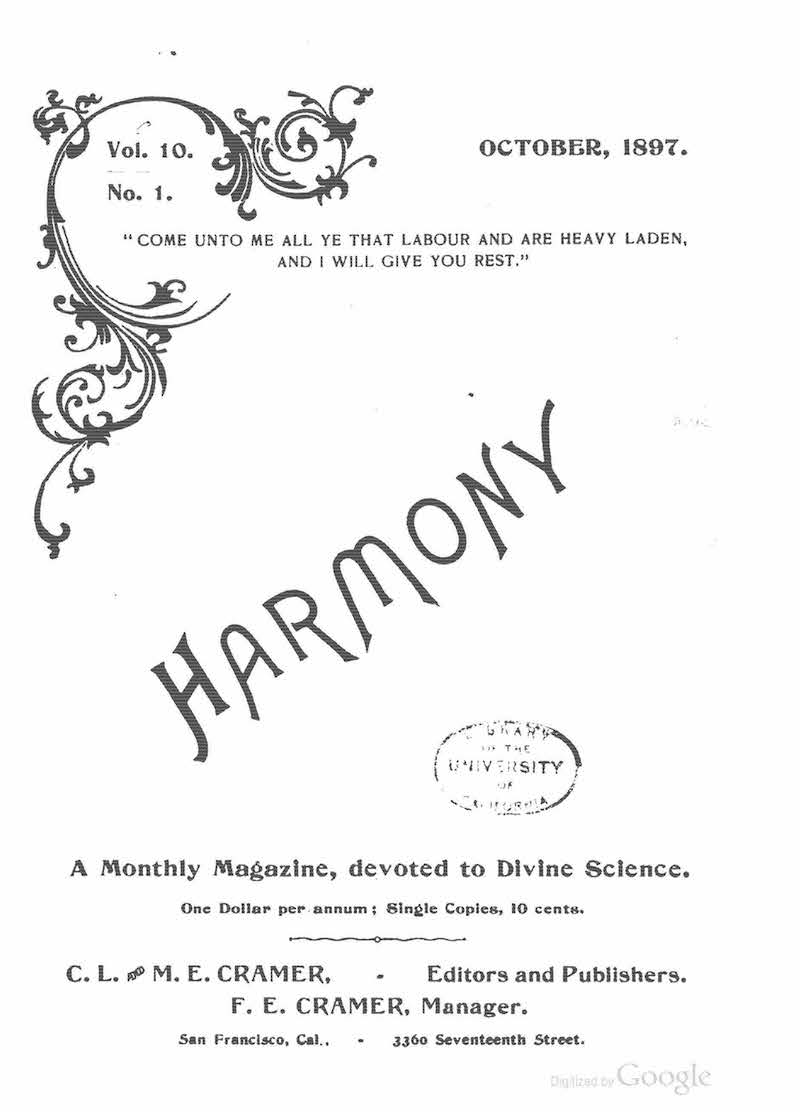
Harmony. This was started by Malinda Elliott Cramer ( 1844-1906), and was one of the most important New Thought/mental healing magazines. Cramer had earlier been involved with The Gnostic in San Francisco, and called her variety of New Thought "Divine Science." As early as 1890 she was offering a series of Lessons in the Science of Infinite Spirit, and the Christ Method of Healing. In 1888 she and her husband, Frank, began the Divine Science Home School, and in 1892 she organized the International Divine Science Association, a precursor to the International New Thought Alliance. She died as a consequence of injuries sustained in the San Francisco earthquake. The early issues of the journal are especially notable because they contain a long novelette by "Eulis" (F.B. Dowd) that illustrates the transition then taking place between the earlier magic of P.B. Randolph and the softer, more mystical approach of New Thought.
|
|
| LOC; NYPL microfilm; California State Library; Association of Research Libraries; University of Colorado, Boulder. | |
| Harmony V1 1888-1889 | |
| Harmony V2 1889-1890 | |
| Harmony V3 1890-1891 | |
| Harmony V4 1891-1892 | |
| Harmony V5 1892-1893 | |
| Harmony V6 1892-1894 | |
| Harmony V7 1894-1895 | |
| Harmony V8 1895-1896 | |
| Harmony V10 1897-1898 | |
| Harmony V12 1899-1900 | |
| Harmony V13 1900-1901 | |
| Harmony V14 1901-1902 | |
| Harmony V15 1902-1903 | |
| Harmony V16 1903-1904 | |
| Harmony V17 1903-1904 | |
| Harmony V18 1905-1906 |
|
|