
International Association for the Preservation of Spiritualist and Occult Periodicals


Periodical: The Gleaner

Summary:  From Pat Deveney's database:

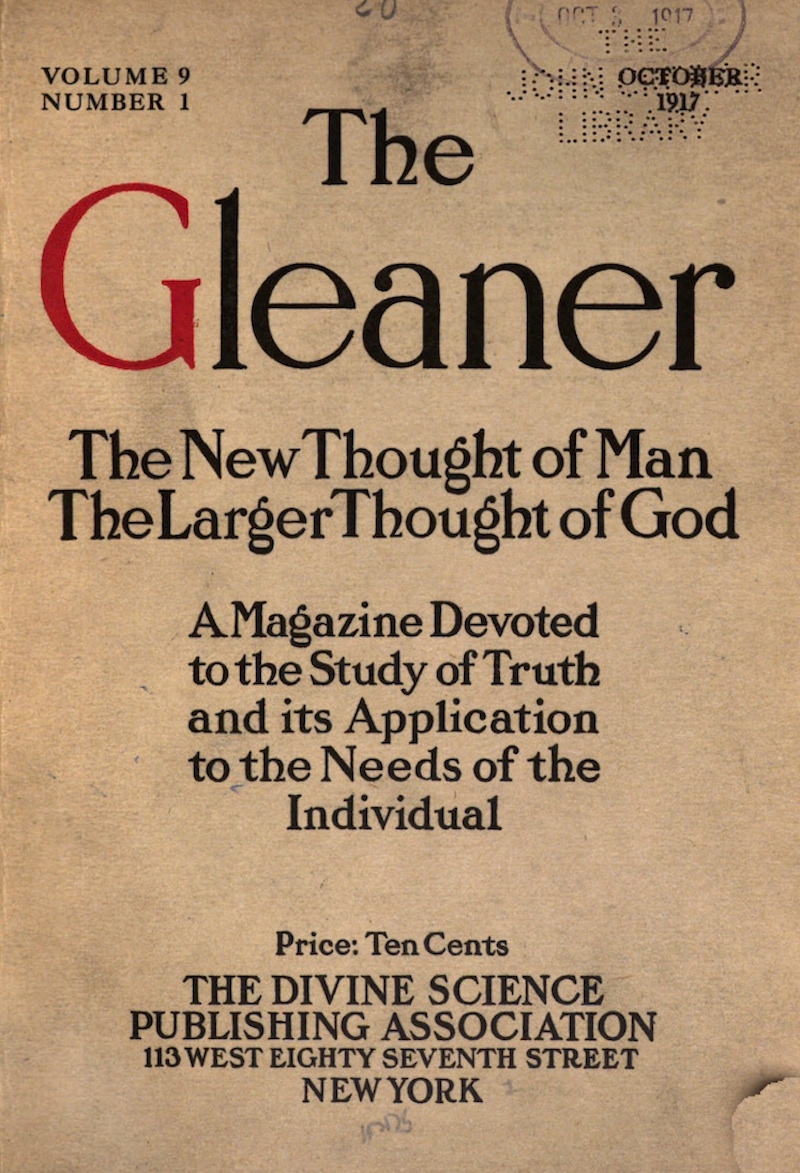
Gleaner, The
A Magazine Devoted to the Science of Practical Christianity / A Magazine Devoted to the Study of Truth and its Application to the Needs of the Individual.
The New Thought of Man. The Larger Thought of God
Other titles: W. John Murray's Magazine
1911-1927 Monthly
New York, NY. Language: English.
Publisher: The Church of the Healing Christ; Divine Science Publishing Company. Editor: Rev. W. John Murray, founder and editor.
1/1, 1911-1927. 32 pp., $1.50 a year.

Murray (1865-1925) was a disciple of Nona Brooks' Divine Science and the founder of the Church of the Healing Christ in New York (which held weekly services in the Waldorf-Astoria Hotel in Manhattan). He was succeeded in the pulpit by Harry Gaze and then Emmet Fox. Noted in The American Rosae Crucis, 1916, in the exchanges of The Master Mind, 1918, and in William C. Hartmann's Who's Who in Occult, Psychic and Spiritual Realms (1925).

Other Sources:NYPL; Wilmington University; University of Massachusetts, Amherst; McGill University; St. Andrews University.
Issues:Gleaner V4 1912-1913
Gleaner V5 1914-1914
Gleaner V6 1914-1915
Gleaner V9 1917-1918
Gleaner V10 1918-1919
Gleaner V11 1919-1920
Gleaner V12 1920-1921
Gleaner V13 1921-1922
Gleaner V15 1923-1924
Claude-Generated Themes:   The Gleaner was a New Thought monthly of the 1910s and early 1920s resting on the Divine Science teaching — the denomination founded at Denver by Nona Brooks and her sisters, one of the three churches that grew out of the American mental-healing movement alongside Unity and Religious Science. Its pages carry that movement's characteristic practice rather than its philosophy: lesson sheets pairing a scriptural passage with an affirmation to be held, instruction in entering the Silence, metaphysical readings of Genesis and the Gospels, and testimony to health and supply obtained by right thinking. A directory of practitioners with their office hours and telephone numbers runs through it, which is how these churches organised healing as a profession. The name Divine Science invites confusion with Mary Baker Eddy's Christian Science, and the two are cousins descended through Emma Curtis Hopkins, but the register here is New Thought throughout: affirmative, undogmatic, and without the ecclesiastical discipline that governed Eddy's church.

Generated by Claude from the periodical's digitized text; a thematic reading, not a bibliographic description.
Topics:New Thought