
| Periodical: | |
|
|
|
From Pat Deveney's database:
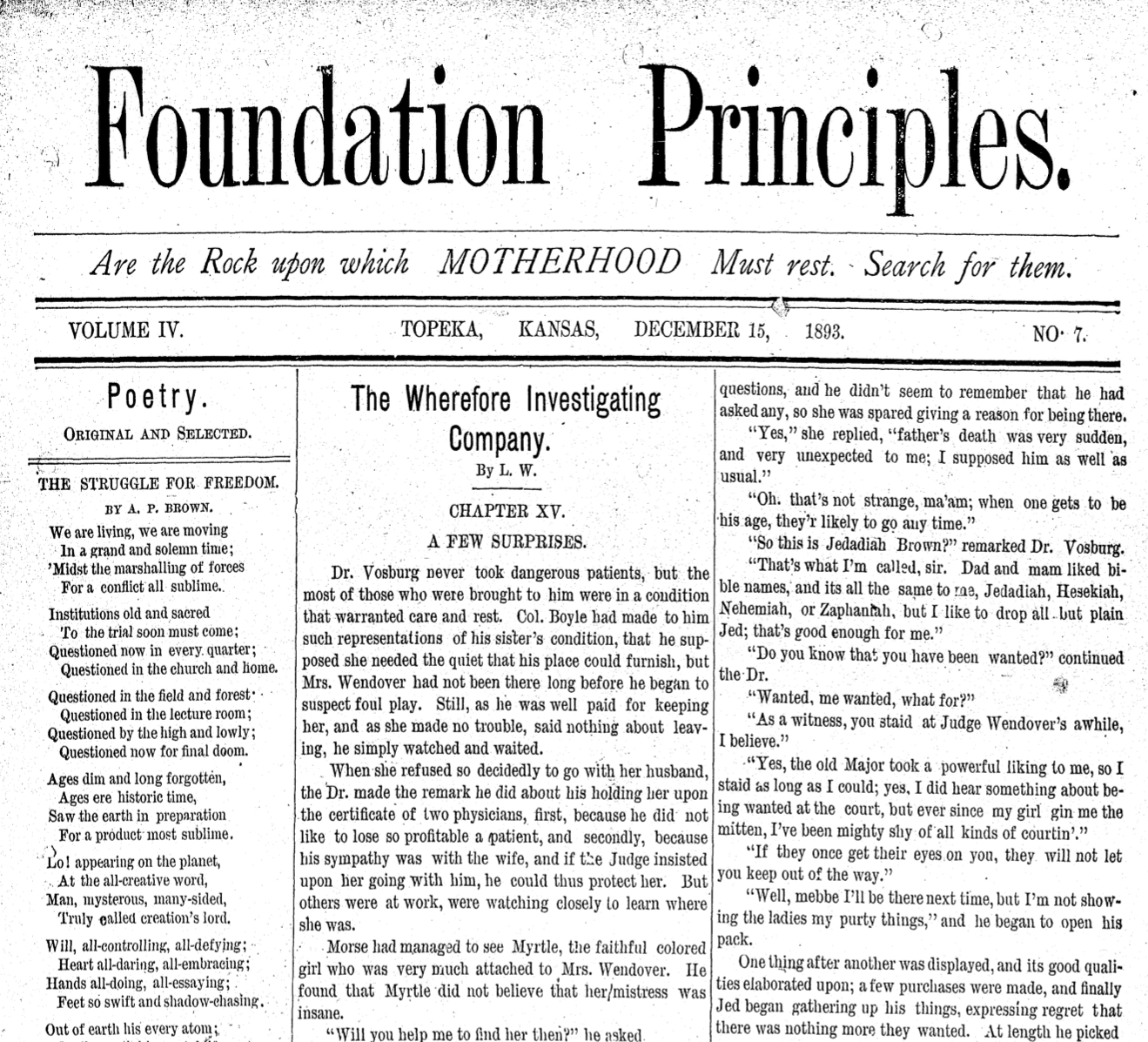
Foundation Principles. This was a radical spiritualist journal edited by the tireless Lois Waisbrooker, and published originally from Clinton, Iowa, the home of the Mount Pleasant Park spiritualist camp meeting. In its beginnings, as set out in its prospectus, it was primarily devoted to the then-current fringe economic "law of natural justice": "We hold it as a Foundation Principle that all gain coming from the use of natural wealth belongs to the party through whose labor it is secured and not from some other claimant--that no man or set of men has the moral right to hold land not in actual use from those who need it, and that rent taken from the use of such land is robbery, and illegal when measured by the law of natural justice." Over the life of the journal Waisbrooker continually struggled with the relationship between spiritualism and reform, emphasizing that her primary concern was not spirits in the summerland but the need for reform here and now. "My Spiritualist friends will be surprised, when I tell them that no time in my life have I given so little tho’t to the future life and to the friends over here [there: she corrected in 4/3] as during the last five years. Have you ceased to believe in another life? No. Have you ceased to love my friends? No; but I am here and now; what I have to do is here and if I would do it well it must have my entire attention." She was an early and devoted advocate of all reforms, including the "sexual revolution," which initially meant equality for women and frequently overlapped with what was called "free-love." This free-love variety of spiritualism embraced, along with Waisbrooker, W.F. Jamieson, Victoria C. Woodhull and her sister, Tennessee Claflin, Woodhull, Laura Cuppy Smith, Moses Hull, H.B. Storer, Warren Chase, Lyman C. Howe, J.H. Randall, J.H.W. Toohey, E.H. Heywood, Cephas B. Lynn, Benjamin Todd, Marion Todd, E.V. Wilson, Warren Chase, et al. But Waisbrooker also was an unheralded forerunner of the New Thought sexual synthesis built around the conviction that the sex aura lay at the root of magnetism, psychic powers and mediumship and could be harnessed by proper sexual intercourse and directed by thought to regeneration and from there to societal reform. Sex, as she came to understand it, was the "Fountain of Life": "[T]he natural meaning of regenerate is to generate anew, and how can this be done unless by a higher phase, a higher action of the generative forces?" "If the spiritual sex center renews the soul life, will not the same renewing power descend and permeating the physical generative sex center, so regenerate the body as to eventually redeem it from the power of death." She stood apart in her ideas from many contemporaries, like the "Alphaists" and proponents of "Dianism" in emphasizing "the natural use of the sex organs" rather than mere abstinence from or restriction of sex. Waisbrooker (1826-1909), who was born Adeline Eliza Nichols and added the names Fuller and Snell through marriage, assumed the name Lois Waisbrooker in the early 1860s, perhaps because of another, unknown marriage, when she was acting as a trance speaker, but more likely because of her long-lived "marriage" in the astral with a spirit ("I have a right to know about these things; I have a spirit husband who comes to me when I live right, obey the laws of life; otherwise he cannot"). Waisbrooker left for California in 1886, leaving the journal to the anarchist Jay Chaapell, but later resumed the editorship for a time from California. After the journal’s suspension, she revived it in July 1893 in Topeka, Kansas, as a sister-publication of Moses Harman’s Lucifer, the Light-Bearer, whose subscription list was used to restart the journal. Like Harmon, Waisbrooker was indicted for her publications. In 1894 she printed a letter from a dissatisfied husband with her reply which led to her arrest for obscenity. Though the journal ceased a few months later, the charges against Waisbrooker lingered until 1896 when she seems to have pleaded guilty and then decamped again for California. Waisbrooker also edited Our Age and Clothed with the Sun, and assisted Harmon in publishing Lucifer (when he was jailed for obscenity). Contributions to the journal by H.H. Brown, Susie T. Fuller, Lucinda B. Chandler, W.W. Judson, Mary E. Lease, Juliet Severance, et al. On her biography, see Joanne E. Passet, "Power through Print: Lois Waisbrooker and Grassroots Feminism," in James P. Danky and Wayne A. Wiegand, eds., Women in Print: Essays on the Print Culture of American Women from the Nineteenth and Twentieth Centuries (Madison: University of Wisconsin Press, 2006), 232-53. University of Kansas microfilm. |
|
| Foundation Principles V4 N1 Jul 1893 | |
| Foundation Principles V4 N2 Aug 1893 | |
| Foundation Principles V4 N3 Sep 1893 | |
| Foundation Principles V4 N4 Oct 1893 | |
| Foundation Principles V4 N5 Nov 1893 | |
| Foundation Principles V4 N6 Dec 1 1893 | |
| Foundation Principles V4 N7 Dec 15 1893 | |
| Foundation Principles V4 N8 Jan 1894 | |
| Foundation Principles V4 N9 Feb 1 1894 | |
| Foundation Principles V4 N10 Feb 21 1894 | |
| Foundation Principles V4 N11 Mar 1894 | |
| Foundation Principles V4 N12 Apr 1894 | |
| Foundation Principles V5 N1 Jun 5 1894 | |
| Foundation Principles V5 N2 Jun 20 1894 | |
| Foundation Principles V5 N3 Jul 1 1894 | |
| Foundation Principles V5 N4 Jul 15 1894 Partial | |
| Foundation Principles V5 N5 Aug 1 1894 | |
| Foundation Principles V5 N6 Aug 15 1894 | |
| Foundation Principles V5 N7 Sep 1 1894 | |
| Foundation Principles V5 N8 Sep 15 1894 | |
| Foundation Principles V5 N9 Oct 1 1894 | |
| Foundation Principles V5 N10 Oct 15 1894 | |
| Foundation Principles V5 N11 Nov 1 1894 | |
| Foundation Principles V5 N12 Nov 15 1894 |
|
|