
| Periodical: | |
|
|
|
From Pat Deveney's database:
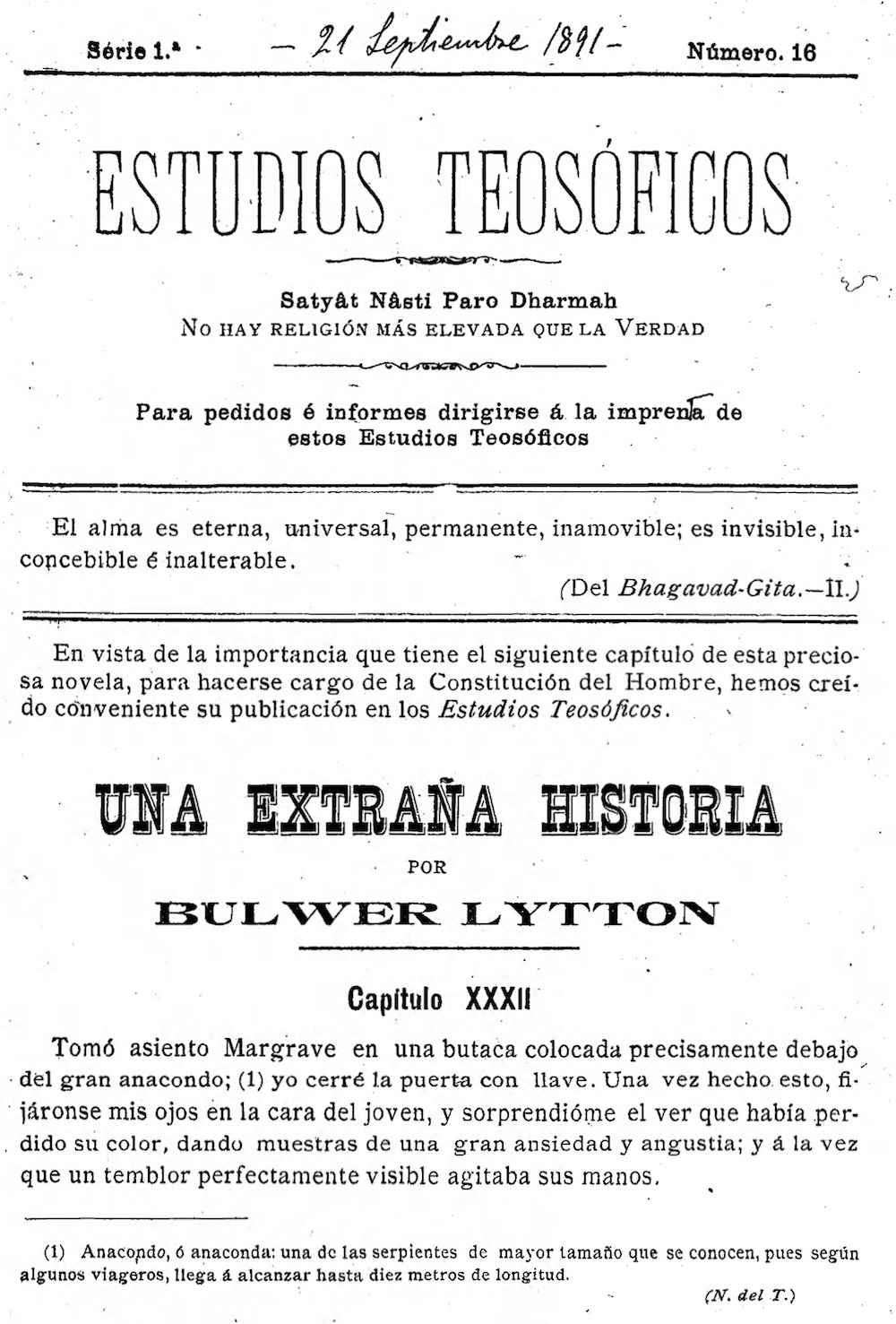
Estudios Teosoficos. This was the first Theosophical journal in Spain. It was started by Montoliu, an intense young man who first heard of Theosophy upon finding a copy of Revue Theosophique, wrote to H.P. Blavatsky in London, learned English in three months to allow him to read her works, and almost immediately translated Isis Unveiled into Spanish. He and Jose Xifre were the first to join, through the Hermes branch in Paris, and soon were gathering together small groups in Madrid to study Theosophy. Montoliu moved to Barcelona and started this journal in 1891, supplying a large part of the content by translations or articles under the name "Nemo," explaining the purposes and goals of the Theosophical Society. The journal also notably carried a chapter of Bulwer Lytton's "Una Extrana Historia," Bournouf's "El Buddhismo en Occidento," a series on Ocultismo Practico," and J. Campbell Ver Planck's "Catecismo Teosefico para Ninos," and reported on Theosophical events worldwide. It followed carefully the debate then taking place in the French occult journals and in Lucifer over the relative roles of Buddhism and Christianity in Theosophy. The journal had contributions by and excerpts from W.R. Old, Alexander Fullerton, Franz Hartmann, G.R.S. Mead, Florencio Pol, Rene Caillie, J. Roviralta Borrell, et al. The Theosophist in 1892 notes that the journal had a monthly circulation of 400, but its influence was far greater since the local branch printed up 3,700 copies of back issues to send to South America and the rest of Spain. Montoliu died on May 10, 1892, in the midst of the furor over the peculation, fraud, arrest, jailing, and expulsion of one of the Barcelona branch's members—the Count of Das—who came close to capsizing the society. He later traveled the world as Alberto de Sarak, Count of Das, starting Theosophical branches and occult societies and journals and leaving in his wake what has been knowledgeably described as hundreds of victims. The story appears in this journal in 1892. On Sarak, see the note under The Radiant Centre. The Theosophical cause in Spain was taken up the next year in Sophia, published in Madrid by Xifre, which claimed proudly that it had been founded by Montoliu. Vincente More has created a chronological list of many of the important Spanish Theosophical journals that will aid in studying Theosophy in Spain as a whole:
Estudios Theosoficos, Barcelona, 1891-1892 Vincente Penalva More, El Orientalismo en la Cultura Espanola en el Primer Tercio del s. XX: La Sociedad Teosofica Expanola(1888-1940), doctoral disseration, Universidad Autonoma de Barcelona, 2013. In addition, the following (q.v.) should be noted:
El Heraldo, 1885 (possibly Theosophical) Archivo General de la Guerra Civil Espanola. |
|
| Estudios Teosoficos V1 N1 Feb 7 1891 | |
| Estudios Teosoficos V1 N2 Feb 21 1891 | |
| Estudios Teosoficos V1 N3 Mar 7 1891 | |
| Estudios Teosoficos V1 N4 Mar 21 1891 | |
| Estudios Teosoficos V1 N5 Apr 7 1891 | |
| Estudios Teosoficos V1 N6 Apr 21 1891 | |
| Estudios Teosoficos V1 N7 May 7 1891 | |
| Estudios Teosoficos V1 N8 May 21 1891 | |
| Estudios Teosoficos V1 N9 Jun 7 1891 | |
| Estudios Teosoficos V1 N10 Jun 21 1891 | |
| Estudios Teosoficos V1 N11 Jul 7 1891 | |
| Estudios Teosoficos V1 N12 Jul 21 1891 | |
| Estudios Teosoficos V1 N13 Aug 7 1891 | |
| Estudios Teosoficos V1 N14 Aug 21 1891 | |
| Estudios Teosoficos V1 N15 Sep 7 1891 | |
| Estudios Teosoficos V1 N16 Sep 21 1891 | |
| Estudios Teosoficos V2 N1 Oct 21 1891 | |
| Estudios Teosoficos V2 N2 Nov 7 1891 | |
| Estudios Teosoficos V2 N3 Nov 21 1891 | |
| Estudios Teosoficos V2 N4 Dec 7 1891 | |
| Estudios Teosoficos V2 N5 Dec 21 1891 | |
| Estudios Teosoficos V2 N6 Jan 1892 | |
| Estudios Teosoficos V2 N7 Feb 1892 | |
| Estudios Teosoficos V2 N8 Mar 1892 | |
| Estudios Teosoficos V2 N9 Apr 1892 | |
| Estudios Teosoficos V2 N10 May 1892 | |
| Estudios Teosoficos V2 N11 Jun 1892 | |
| Estudios Teosoficos V2 N12 Jul 1892 | |
| Estudios Teosoficos V2 N13 Aug 1892 | |
| Estudios Teosoficos V2 N14 Sep 1892 | |
| Estudios Teosoficos V3 N1 Oct 1892 | |
| Estudios Teosoficos V3 N2 Nov 1892 | |
| Estudios Teosoficos V3 N3 Dec 1892 |
|
|