
| Periodical: | |
|
|
|
|
From Pat Deveney's database:
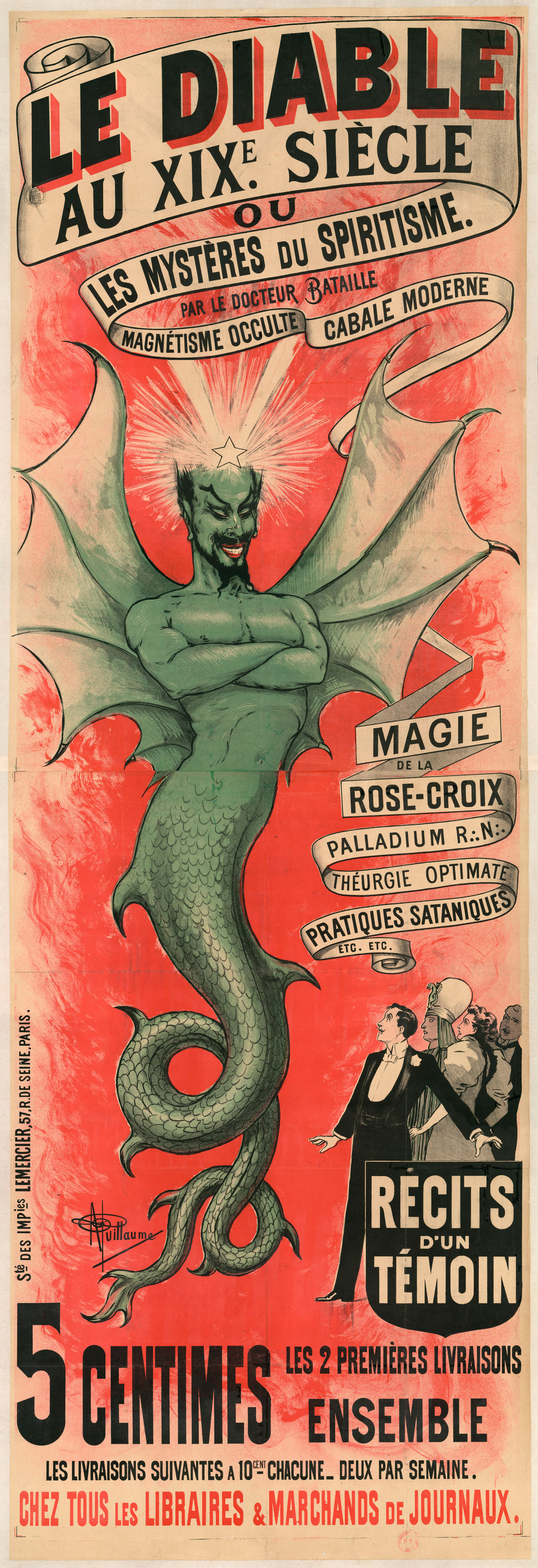
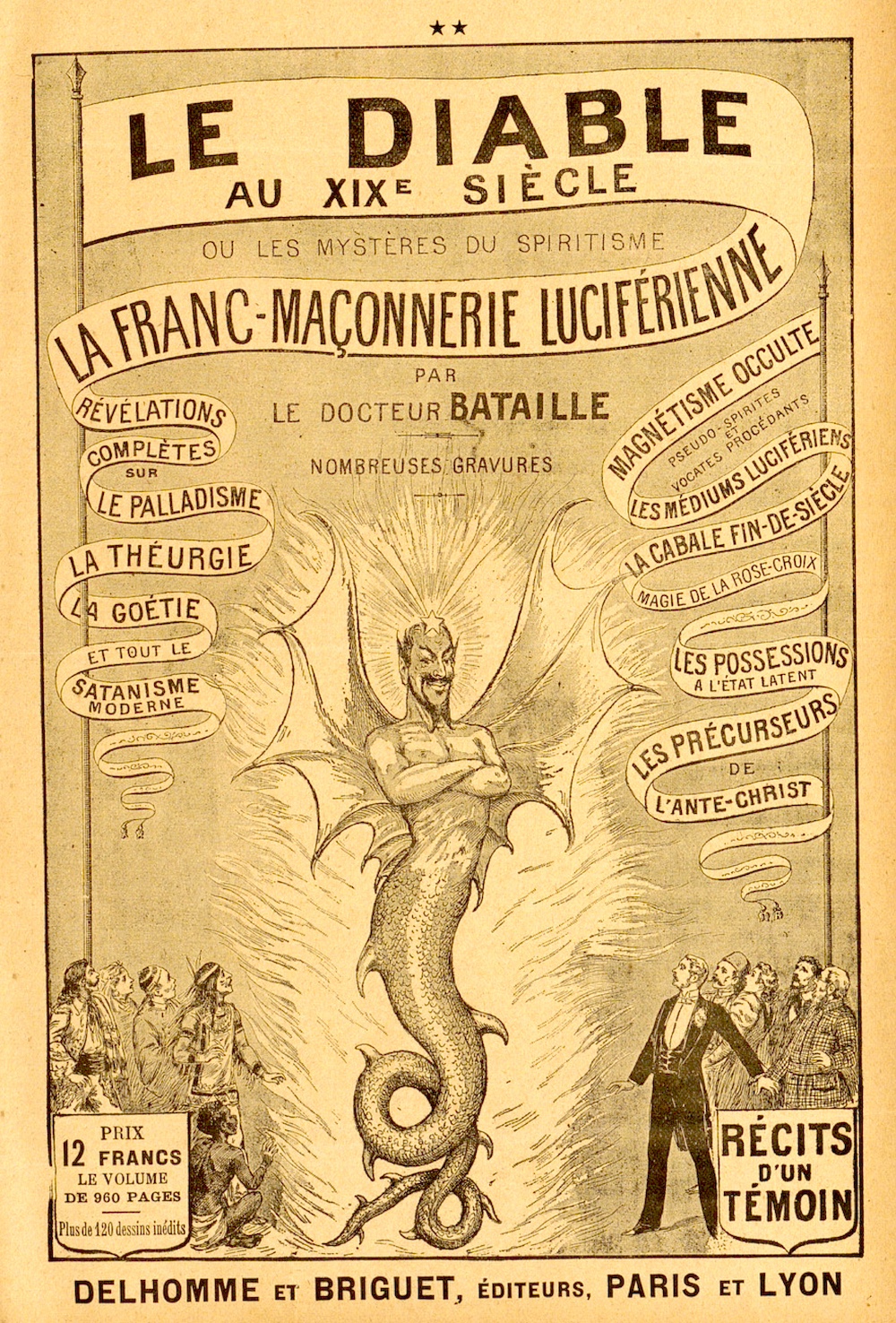
Diable au XIXe Siecle, Le. As an introductory offer, the first two were sold for 30 centimes, and thereafter the two weekly pamphlets sold for 50 centimes. Ten livraisons were then gathered into monthly dated and numbered fascicules and sold for 1 franc and then bound annually into a 960 page volume that sold for 12 francs. Twenty-four fascicules in all were published in 2 volumes, both heavily illustrated with plates of the marvels revealed and portraits of the principal perpetrators. The journal was wildly successful financially, and Taxil is said to have bought a castle from the proceeds. This was a combination of an occult travelogue and clickbait, luring the readers into the Russian-doll-like mysteries within ever more secret mysteries, to unveil, as the subtitle boasts, the mysteries of spiritism/spiritualism and Luciferian Freemasonry, all through the experiences of an eyewitness -- Dr. Bataille. Bataille, a fictive ship's physician, travels from India, to China, to Naples (where he bought High-Masonic degrees) and the United States. Everywhere, with his new Masonic diplomas, he is admitted into the lodges of the secret hierarchy of conspiracies that underlie spiritualism and ceremonial magic: the mysterious Livre Apadno, the Rosicrucians, androgyne lodges, the mysterious number 77, the future coming of the Antichrist on September 29, 1995, apparitions, the "Baptism of Serpents," creation of the homunculus, Black Masses, possession and "latent possession," the "principal demons," evocations, the Re-Theurgistes, mesmerism, "provoked hysteria" and somnambulism, Memphis and Misraim, Martinism, the occult in all its forms and Freemasonry, all being derived from and leading back up to the sexual mysteries of Luciferian and Satanic Palladism, and all under the control of the ex-general of Indian auxiliaries at the Battle of Elkhorn Tavern, Albert Pike and his "Vatican luciferien" in Charleston, South Carolina, and mysterious women like Sophie Walder, the daughter of a Satanic Mormon leader and great-grandmother to be of the Antichrist, and Diana Vaughan, a High Priestess of Palladism. While Dr. Bataille's name graces the covers of the journal, he actually had no role in its production. That honor fell to "Leo Taxil" ((Marie-Joseph Gabriel Antoine Jogand-Pages, 1847-1907), a French journalist, sometime anti-clericalist and anti-Mason, humorist and mild pornographer (who claimed that he had converted to Catholicism and wanted to expose the insidious conspiracy of the Luciferians), and Pierre Renaud Charles Hacks (1851-1935, a journalist and ship's physician for the Compagnie des Messageries Maritimes. Hacks, who later admitted that he wrote most of the first year of the journal, was the model for Dr. Bataille; Taxil collaborated in the first volume and wrote the second volume and the other journals (Revue Mensuelle Religieuse, Politique, Scientifique; Memoires d'une Ex-Palladiste; Palladium Regenere et Libre) in future years that together constitute the estimated 10,000 pages of the Affaire Taxil. The same year he began this journal he took over La France Chretienne (1892-1897), an anti-Masonic effort without the extravagances of this journal. Both Taxil and Hacks seem to have been pranksters, constantly trying to push the envelope of credulity by combining a massive amount of data mined from the entire occult literature of the eighteenth and nineteenth centuries with ever more unbelievable tales: fakirs rising through the air, magnetic chains of alternating living and dead men, Albert Pike's demon, men whose heads were turned backwards on their bodies, secret tunnels and laboratories under Gibralter, perpetual magic lamps, walking on water, corpses rising from the grave to feast at a banquet, divination by human sacrifice, desecration of consecrated hosts and black masses, communications evoked from the skeleton of Allan Kardec, washing of hands in molten lead, spirit voyage on the back of a white eagle from the Garden of Eden to the planet Oolis, etc. Most memorable was the eyewitness account (embellished with a plate of the scene) of a spiritualist seance in London in which a winged "hideous" crocodile went to the piano and played a melody "with the strangest notes." Throughout, the journal had a sinister, lurid air, with sexual overtones (like the Rite of Pastos, also shown in a plate, where the young daughters of Palladists mated with demons in the Nuptorium), and a heavy emphasis on the antisemitism of the time. The journal wove a who's who of occult and Masonic personages into the overarching theme of interlocking conspiracies: the Fox Sisters, Allan Kardec, spirit photographs, Buguet, Eusapia Palladino, various charlatans, Papus, Martinez Pasqualis, Saint-Martin, Abbe Roca, Sar Peladan, Charles Fauvety, Lucie Grange, Villiers de l'Isle-Adam, Proudhon, Karl Marx, Mme. Blavatsky, Jules Bois, Cagliostro, Abbe Boullan, Arthur Arnould, Eliphas Levi, J.-K. Huysmans, Stanislas de Guaita, P.-G. Leymarie, Albert de Rochas, and practically every other mage, Freemason and notable spiritualist of the period. Both Taxil and Hacks later said the journal and its successors were a hoax, but in the furor that followed publication a very surprisingly large audience rejected their confessions. The truth or falsity of the Taxil Affair became an occult milestone in its own right. For years the reader's position on the books became the touchstone for believers and the shibboleth to distinguish friend from foe. In a few cases, aspiring conspirators created their own Palladist rites and lodges, though they seem never to have evoked the piano-playing crocodile. Some even argued that the journal's outrageously miraculous and unbelievable elements were really a spoof within a spoof, designed to conceal the awful reality of the Luciferian world conspiracy behind ridiculous details that would lead unwary doubters to dismiss it lightly. After more than a century of diatribe and research many fundamental questions about the journal still remain unsolved. For thoughtful and careful reviews of the state of the questions, see the articles of J.-P. Laurent and Massimo Introvigne in Politica Hermetica and Introvigne's Satanism: A Social History (2016).
|
| Diable Au Xixe Siecle V1 1892-1893 | |
| Diable Au Xixe Siecle V2 1893-1894 |
|
|