
| Periodical: | |
|
|
|
From Pat Deveney's database:
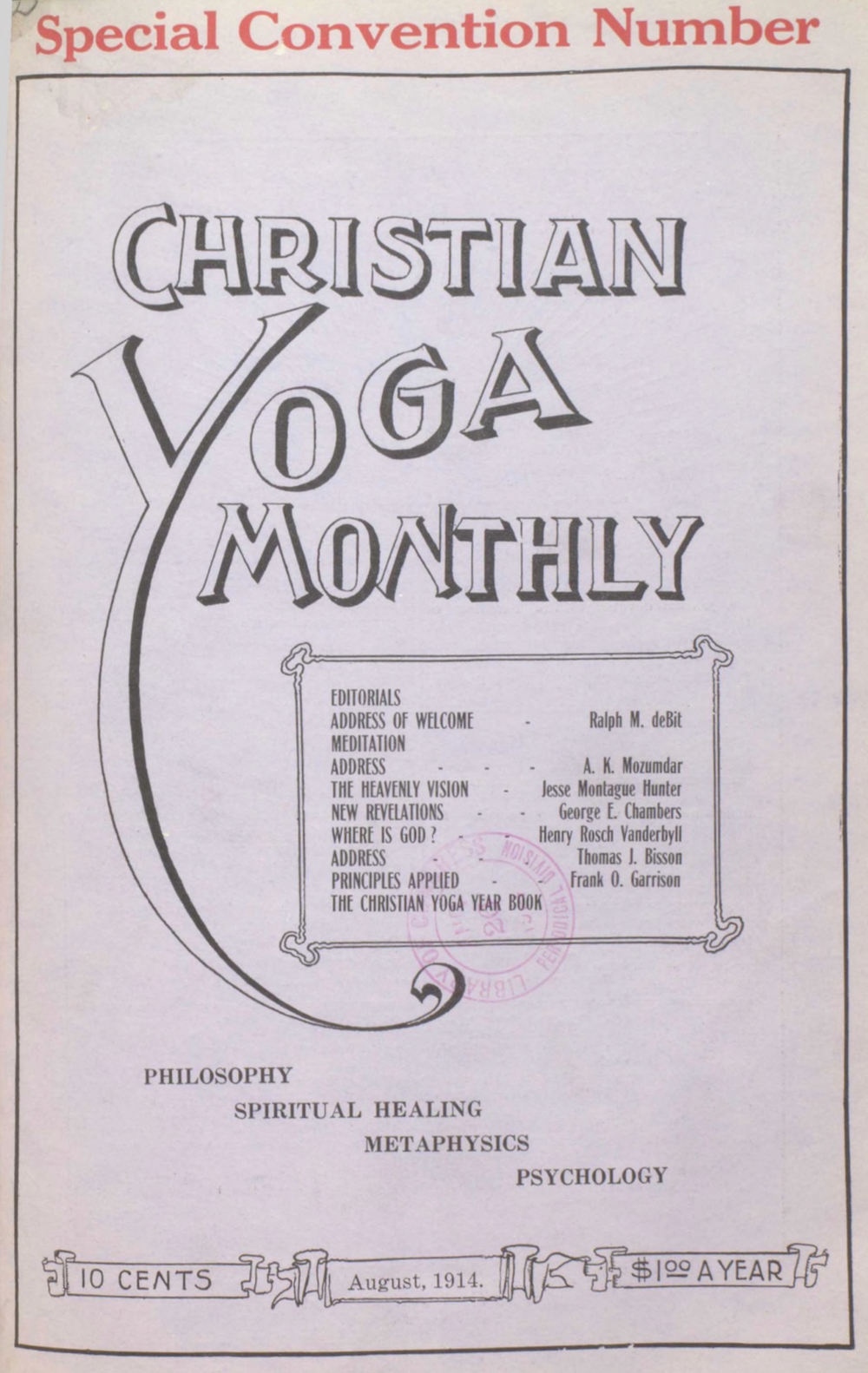
Christian Yoga Monthly. This was begun to make known the teachings of the Christianized Hindu A.K. Mozumdar and his Christian Yoga Society / Universal Messianic Church. Akhay Kumar Mozumdar (1881-1953, although like other such he asserted he had been born earlier, in 1864, in order to buttress his claim to have discovered the Fountain of Youth) was born near Calcutta, the son of a lawyer. After the mandatory years of study under his guru, he is said to have traveled in China and Japan and Palestine, and then arrived in the Northwest about 1904 and took up lecturing to Theosophical and New Thought audiences. In 1910, he first met Ralph Moriarity de Bit (or deBit or Debitt), whom he named "Vitvan," December 25, 1883-June 29, 1964), on whom see the note under Sacred Science Magazine, who taught him the business side of New Thought, and Mozumdar's message settled down to "Christian Yoga." This was a New Thought conglomeration of yoga, the teachings of the Bhagavad Gita, and Christianity, and centered around the ideas that: "Nothing exists but Consciousness. In the degree you become conscious of your own consciousness as God's, you reach and manifest God Consciousness. Your own thought reflects back on you, and makes you what you are by its quality. All manifestation is by reflection." "If man thinks and acts, is not the thinker. . . and actor. . . God? . . . If God is All-Life. . . then all lives are God." Despite these assertions, Mozundar rejected doctrinal statements ("No affirmations or denials in the form of fixed statements. . . . Reach the goal of freedom by the path of freedom"), an attitude that, along with his swirling robes, allowed him to fit in perfectly when he moved to Southern California, where he became a favorite of the Hollywood set -- he bought a house in Hollywood and wrote and produced "Beyond the Veil/Prince of India," a (now lost but) well-received movie. Mozumdar has a notable place in the history of immigration law in the United States because in 1913 he convinced a federal judge that, as a "high-caste Brahman," he was a "free white person" within the meaning of the naturalization laws. A decade later, however, the Supreme Court ruled that no person of East Indian origin could become a citizen and Mozumdar was retroactively deprived of his citizenship. (He reapplied under a new law in 1950 and again became a citizen.) In the 1930s he was involved in a famous court case when the children of a rich widow sued claiming that she was a puppet "in the hands of artful and deceiving persons." A guardian was appointed. The journal was mostly written by Mozundar and his disciples. It advertised the services of the healers Mozumdar had trained, and published regular affirmations for each month: "The Father which is my own Real Being is: ‘The Lord is my shepherd I shall not want.' Any one needing prosperity, we ask to just hold this thought with us for one month, and watch results." His American Council Christian Yoga offered monthly lessons (sent with envelopes to be kept "in convenient place for reception of offerings ‘as the Lord shall prosper me'"). One of the earliest photographs of Mozumdar (in well-tailored robes and with an impressive mustache) appeared in “a short-lived periodical," The Oriental Occult Series -- The Hindu Yoga Book of Occultism, which may have been an early effort of Mozumdar. No copy survives.
|
|
| LOC. | |
| Christian Yoga Monthly V3 N1 Jan 1914 | |
| Christian Yoga Monthly V3 N2 Feb 1914 | |
| Christian Yoga Monthly V3 N3 Mar 1914 | |
| Christian Yoga Monthly V3 N4 Apr 1914 | |
| Christian Yoga Monthly V3 N5 May 1914 | |
| Christian Yoga Monthly V3 N6 Jun 1914 | |
| Christian Yoga Monthly V3 N7 Jul 1914 | |
| Christian Yoga Monthly V3 N8 Aug 1914 | |
| Christian Yoga Monthly V3 N9 Sep 1914 | |
| Christian Yoga Monthly V3 N10 Oct 1914 | |
| Christian Yoga Monthly V3 N11 Nov 1914 | |
| Christian Yoga Monthly V3 N12 Dec 1914 |
|
|