
| Periodical: | |
|
|
|
From Pat Deveney's database:
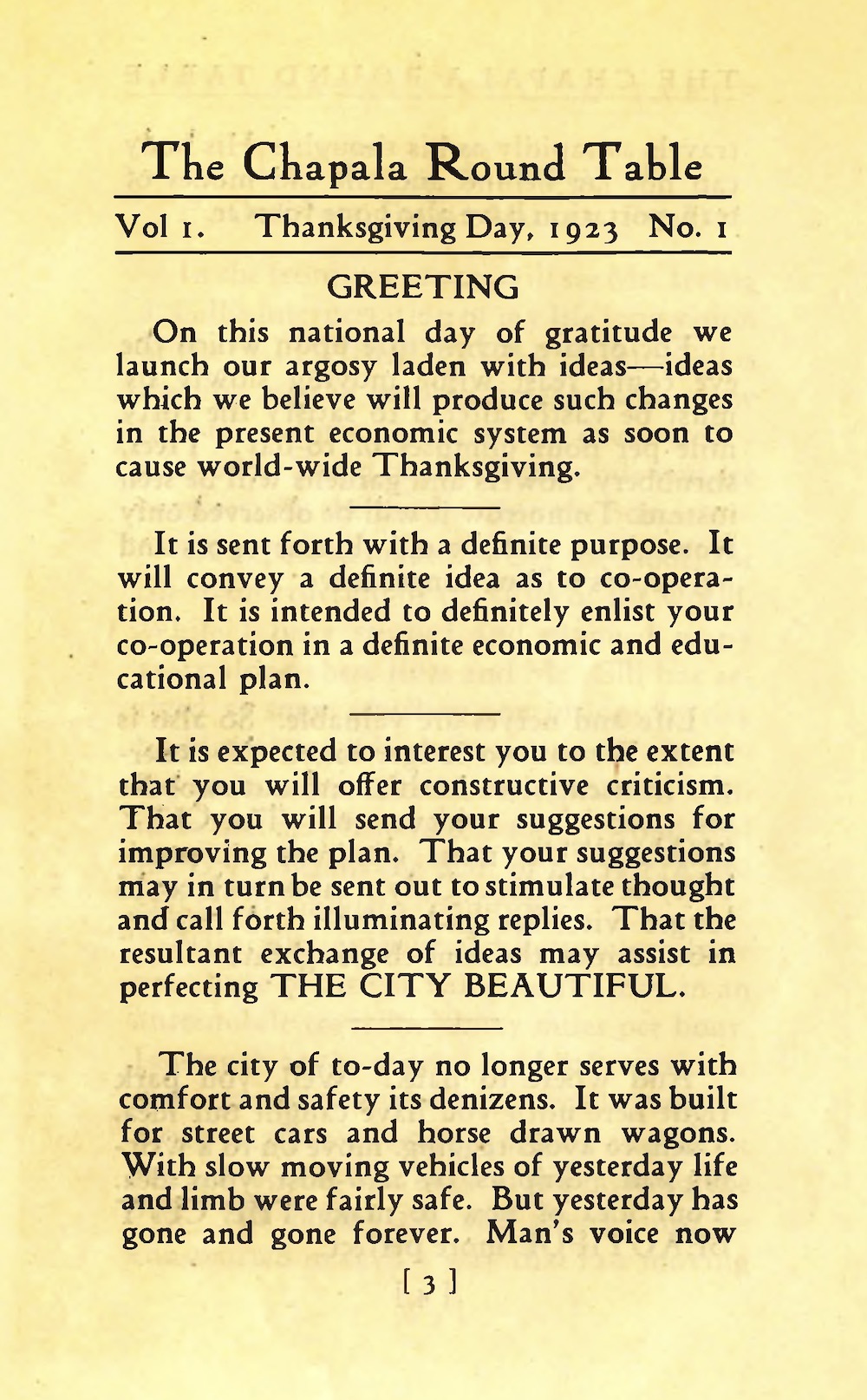
Chapala Round Table, The. The content of the journal was almost entirely copied from Miller's Psychological Review of Reviews. This was yet another production of Orlando Edgar Miller (1864-1947), one of the longest lived and most prolific of the New Thought confidence men. On Miller, see the notes under Mastery and Psychological Review of Reviews. In 1919, when he returned to the United States from eight years on the lam in Europe to avoid the consequences of earlier failed schemes, Miller brought with him what he said was his lifelong vision of a cooperative university and "City Beautiful." He tried Florida first as the location for the altruistic venture but rejected it because "the law-making machinery of the state seemed to be controlled by one of the magnates of 'Big Business.'" He then turned to Mexico, lured by its new (1917) "cooperative" constitution. According to the dubious letter later published by him in this journal, the new president of Mexico, the spiritualist Alvaro Obregon, welcomed him and promised his support, recommending Lake Chapala near Guadalajara for the University. As his ideas developed and were promoted to raise funding, the Chapala Co-operative University became the nucleus for a Temple of Psychology colony on Lake Chapala. The colony's members, under the guidance of Miller, were supposed to inculcate in themselves the principles of his applied psychology and become in the process potentially immortal supermen and superwomen, all the while supporting themselves in cooperative fashion in working the colony's land and luxuriating in the colony's environs. "The executive offices of the Eight Great Departments of the work will be housed in veritable temples. There will be a temple of Education, a temple of Art, a temple of Music, a temple of Commerce, a temple of Finance, etc., and these will be of such architectural design as to awaken the admiration of the people in the community; they will be built around the Great Civic Center, but the chief exterior thing of note about the homes will be the wonderful gardens, shady trees, palms and flowering shrubs. Each home will contain nearly an acre of ground and will afford a wonderful opportunity for beautiful gardens. While the houses will be constructed so as to afford shelter from sun, wind and rain, they will really permit one to live in the open. The windows of the various rooms will constitute the frames for beautiful land and seascapes. The heat, light and power within the community will be generated by water so that there will be no dust, smoke or dirt of any kind. The homes will be connected with lecture rooms, classrooms and places of amusement by automatic telephone and radiophone. Every home will contain a music room where at all hours of the day or night, the most beautiful music can be listened to by merely pushing a button." Etc. All of this was apparently intended develop along the lines of John Ruskin's paternalistic economic ideas,. The economic basis of the cooperative venture was worked out in enormous detail (complete with spreadsheets) by Miller in the Chapala Round Table (1923) and the Psychological Review of Reviews (1923). Miller claimed that he had been pursuing his vision with his own money for years but had determined that this approach was not "co-operative" and that the realization of the goal should depend on the contributions of others! "This is a clarion call for you to acid test your own sincerity and make your dreams come true. If you count yourself my friend, now is the time for a clean-cut demonstration. This work must go forward to completion NOW. I NEED MY FRIENDS NOW. May I have the happiness of hearing from you at your earliest convenience." Miller's ideas were a sort of contributory communism, funded with contributions of $1,000 from each member of the colony and allocated by the benevolent leader to land, machinery, housing, etc., all of which were to be owned and worked in common. Every member, including children, was required (or perhaps willingly agreed) to work a certain number of hours a day and in return was allotted a "units" to be credited at the university's bank. While Miller's ultimate goal was perhaps these contributions of the members, his immediate goal was the Founders' League of the Chapala Co-operative University that he created in San Francisco to raise a fund "for the completion of the preliminary work" necessary to create the colony. The League's goal was $1 million. "Those who contribute ten dollars or more toward further preliminary work will become Life Members and will be entitled to participate in the Chapala Round Table. Their names will be engraved in bronze and placed in the Memorial Hall in the Temple of Administration, upon completion. Each member will receive a beautiful engraved certificate, suitable for framing." Miller had an elaborate headquarters for the Founders' League on Geary Street in San Francisco, and when the pickings grew slim he turned to the East Coast with the same proposition but the attempt there was brought up short when a Boston grand jury began investigating one of the inducements offered to prospective members -- a special hammock which would "lengthen the bones of the spine [à la Albert Abrams' Concussor and C.S. Clark's Cartilage Company] and make certain [a] longer and happier life." President Obregon of Mexico, whose name and authority Miller had been using freely to convince potential donors of his bona fides and readiness to aid the colony, was apparently not amused when Miller's ideas came to his attention, and the Mexican government quashed the scheme, apparently convinced it was a "love cult."
|
|
| Hamilton College. | |
| The Chapala Round Table V1 N1 Nov 1923 |
|
|