| Summary:
|
From Pat Deveney's database:
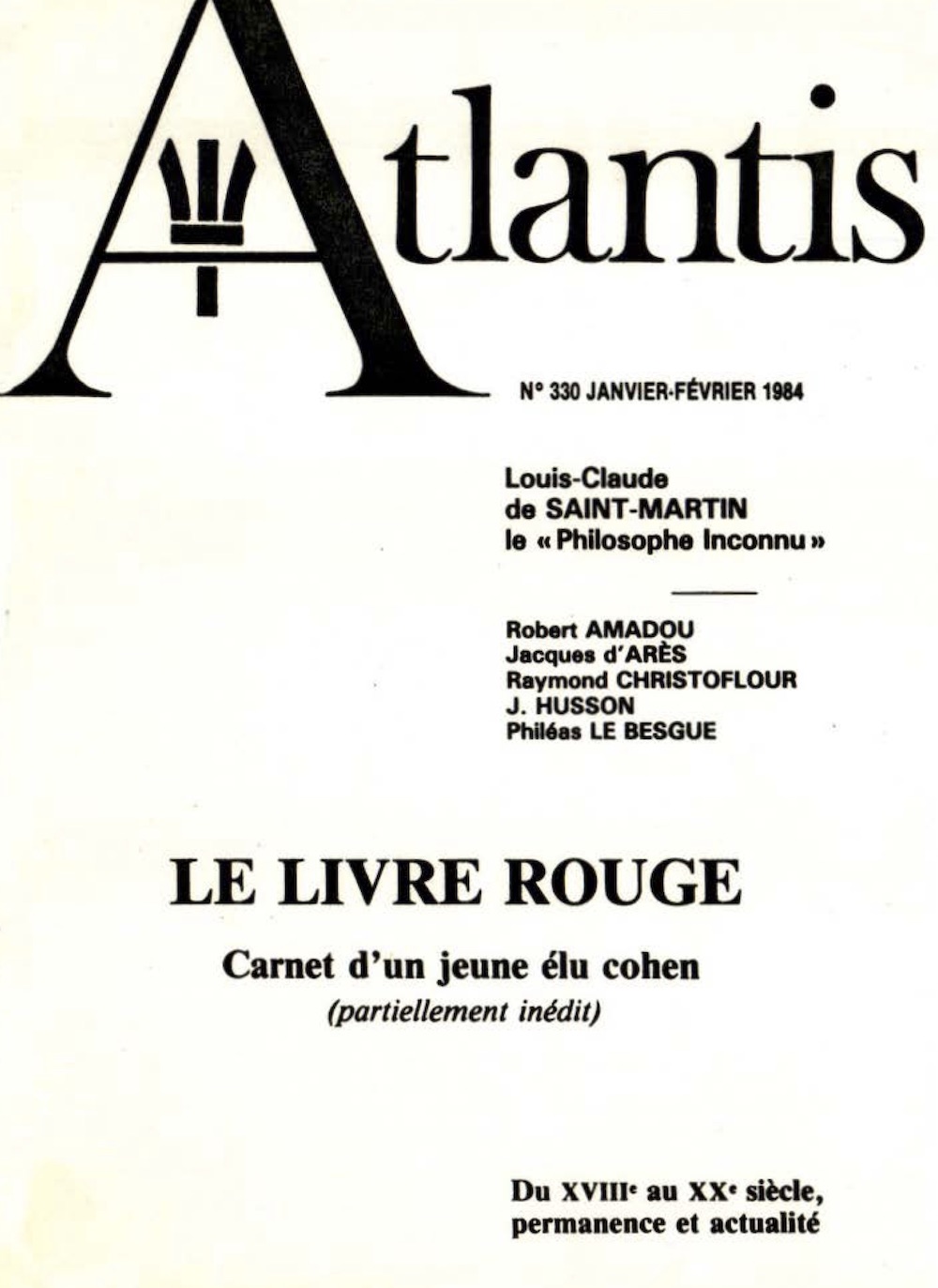
Atlantis.
Revue illustree d'archeologie scientifique et traditionnelle / Etudes Occidentales / Bulletin des Amis d'Atlantis.
1927 Monthly, bimonthly, quarterly (irregular)
Paris, France. Language: French. Publisher: Organe de la Societe d'Etudes Atlanteennes. Editor: Paul Le Cour, Gaston Luce, Phileas Le Besgue, P. Basiaux-Defrance, Jacques d'Arès. Corporate author: Organe de la Societe d'Etudes Atlanteennes
1/1, October 1927-1940; no. 133, January 1948-current.
Le Cour (1871-1954), was born Lecour but always published as "Le Cour," usually in the form "paul le cour," for effect. He was a French bureaucrat and Christian occultist whose writings were very important in the formation of French occultists who came of age decades around World War II, just as he himself was the product of the trends and internecine debates that roiled the French occultism of the first quarter of the twentieth century. From the Hieron du Val d'Or at Paray-le-Monial, a monastery and study group founded in 1873 by the Jesuit Victor Drevon and the Basque baron de Baron de Sarachaga, Le Cour took the idea of western civilization (and Christianity) as the descendent of Atlantis, the source of the universal sacred tradition, which survived in the West among the Celts, the Egyptians, and the Hebrews; the coming of the astrologically predicted new age of the coming reign of Christ (to happen in 2000); and the "word of power," Aor-Agni (fire-light). The exploration of the survival of the Atlantean tradition was pursued by what Le Cour called "traditional archaeology"—and Rene Guenon called "linguistic fantasy"—interpreting records, legends and monuments by imagination rather than evidence. Exploration of the sacred past and its precarious preservation in the modern world inevitably placed Le Cour in opposition, not only to eastern versions of occultism, like Buddhist Theosophy, but in opposition to the modern in general. True occultism was, he reiterated, the "fleau du monde." His background and researches inevitably led Le Cour to that form of French anti-semitism that equated Jews and modernity, and saw modern Freemasonry as a traditional remnant corrupted by Judaism.
In 1926, Le Cour, with Roger Devigne, helped start the "Association ‘Atlantis'" to explore his themes and others, like Martinism, and then, when Devigne was revealed as not sufficiently theoretical and esoteric in his researches, Le Cour resigned and the next year founded the "Societe d'Etudes Atlanteens" and this journal to publish, in monograph form, the society's conferences. Over the years, the journal published on the Western tradition; the Teutonic Knights; the Knights Templar; Tunisia and Atlantis; Atlantis and the Cro-Magnons; the Cathars; Saint-Martin (by Robert Amadou); the Graal; Poseidon and Chivalry; the Neo-Templars; Paray-Le-Monial;Montsalvage and the Troubadours; Magic Squares and Mandalas; Architectural Symbolism and Pythagorianism; the Sacred Tree; Symbolism and Atlantis; Sacred Geography; the Dauphin and the Trident; the Cycles of Tradition; the French Revolution and Tradition; The Rose Cross; Templars and Arabs; Black Virgins; the Drama of Europe; Agartha; etc., etc. The journal attracted to its pages most notably Robert Amadou and Eugène Eugene Canseliet (the disciple of the alchemist Fulcanelli—or perhaps Fulcanelli himself). Guenon regularly reviewed the journal in Voile d'Isis/Etudes Traditionnelles, usually critically. B.M. Lyon.
|